

In an earlier post on what an AI-augmented consultant actually does, I wrote that on the Seychelles fishing-net work, “the European scan could have been days rather than weeks.” It was a guess. This post tests it on a real piece of recycling market research.
The scan in question is the European study I did for Bureo, a fishing-net recycler that wanted to bring its operations to Europe. Bureo first approached us in 2022, and the study ran from July to October 2023. My timesheets show 96 hours on it, 32.5 of them desk research.
On 8 November 2026 I gave Claude Code the 2023 desk question, and a second question the 2023 study never asked. I timed every run and had every claim checked against primary sources.
The short answer is yes for the desk research, with checking. Here is what came out.
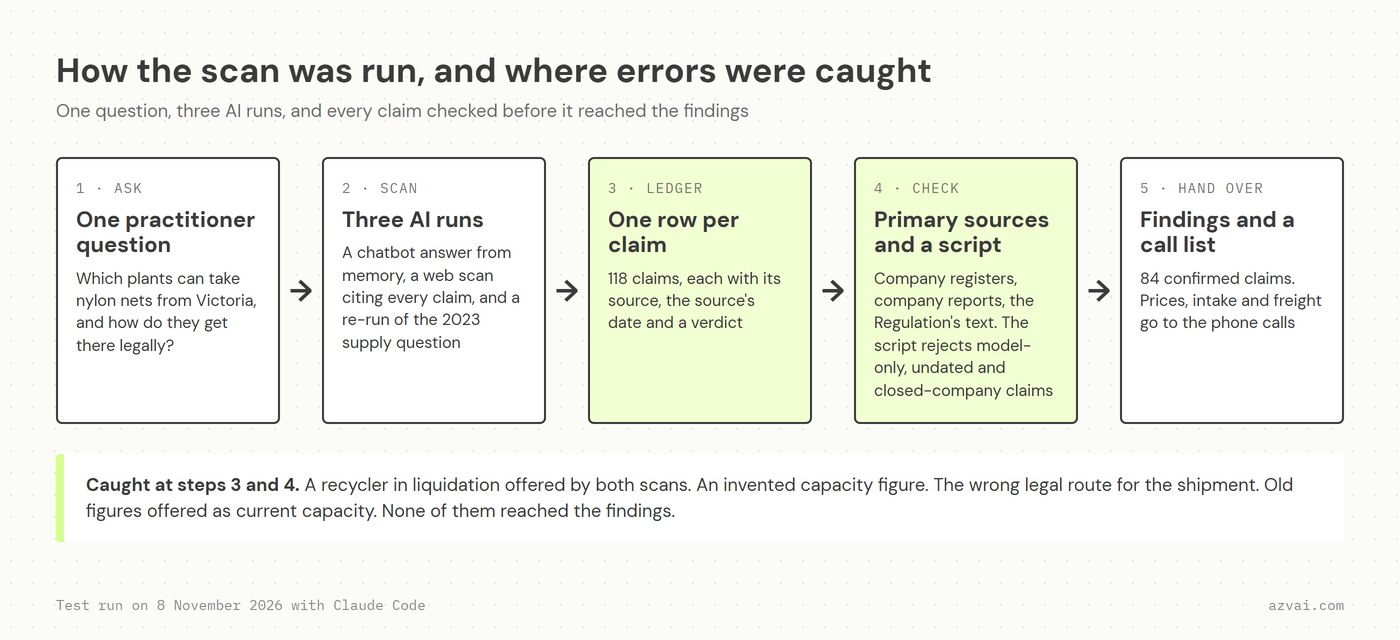
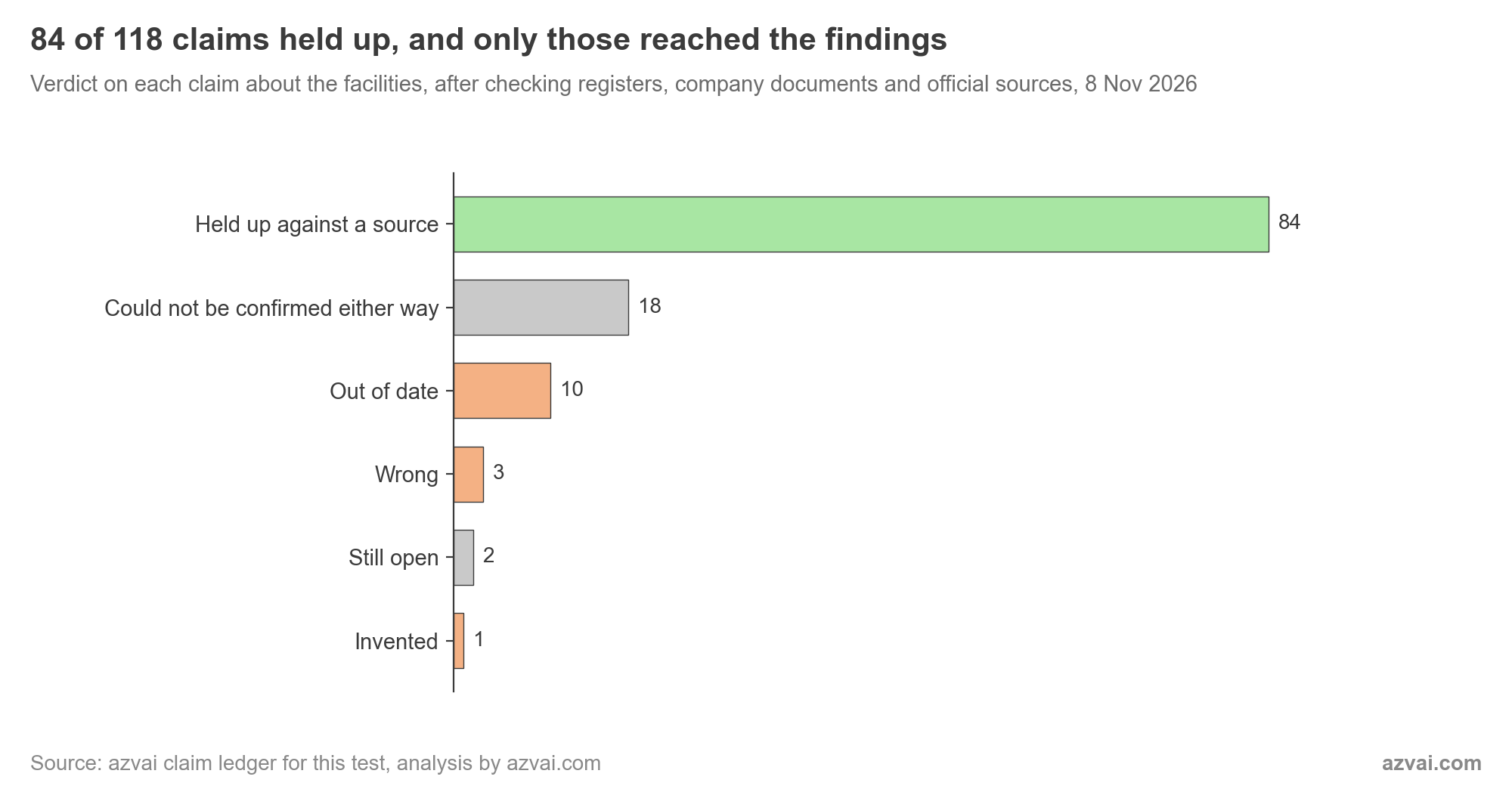
- 32.5 hours of desk research became about 15 minutes. The AI re-run of the 2023 question took 4.5 minutes, plus about 10 minutes of checks. The second scan, of which plants can take the nets and how to ship them legally, took 24 minutes to a list of 118 checked claims.
- The raw AI output had errors, and the checking caught them. Both scans offered a French recycler that had gone into liquidation in 2025, and the company-register check dropped it. The run without web access invented a capacity figure and described the wrong shipping route, and the claim-by-claim check flagged both. None of them reached the final list.
- Field knowledge still mattered. The supply re-run missed where Spanish and French tuna seiners leave their nets, a fact my 2023 study had from the quay in Victoria.
- The AI did more than research. In the same minutes it wrote the method, the country table and a short report with its limits stated, which in 2023 were part of my 32.5 hours.
- Europe has one confirmed industrial outlet for end-of-life nylon fishing nets. It is Aquafil’s ECONYL plant in Slovenia.
So the claim holds for the desk scan, and it undersold it. The bigger untested saving is in the outreach, which I come back to further down.
The 2023 question, and the half it skipped
In 2021 we found discarded purse-seine nets piling up on the quay in Victoria, the Seychelles’ main port. I worked on the Seychelles project at the consultancy Sinerxia, with the fishing industry and the Seychelles government. How we designed it is in my post on the field methodology behind it.

The project led to Brikole, a small company that collects and prepares those nets. It also put me in touch with Bureo, which recycles fishing nets in Chile.
Bureo’s desk question for Europe was where the nets are. Which countries and fleets throw away the most nylon net, and where should collection start?
I re-ran that question, and added the other half of the problem the Seychelles nets raise. Which European plants accept end-of-life nylon nets, in what condition, and how does the material get there legally? The 2023 desk research didn’t cover that second question, so it has no hand-made baseline here.
How I did it without AI in 2023
The supply question took most of the desk time. I exported Eurostat’s fleet data by gear type (fish_fleet_gp), treated surrounding nets and seines as the gear most likely to be nylon, and compared countries and regional blocks. Norway and Iceland have no gear split in that table, so I filled the gap with assumptions.
The conclusion was that Norway could be the largest single source. But Southern Europe, where Bureo already had partners, could hold more than half the market, with Spain the strongest country in it.
One part of that work came from the field. The large Spanish and French tuna seiners fish far from home, so many of their nets end their life in foreign ports. I knew that because I had seen them in Victoria.
The desk research was 32.5 hours between 26 July and 19 August 2023. It wasn’t all searching, since it also covered the spreadsheet work and writing the short report Bureo received, charts included. The rest of the 96 hours went on people and money.
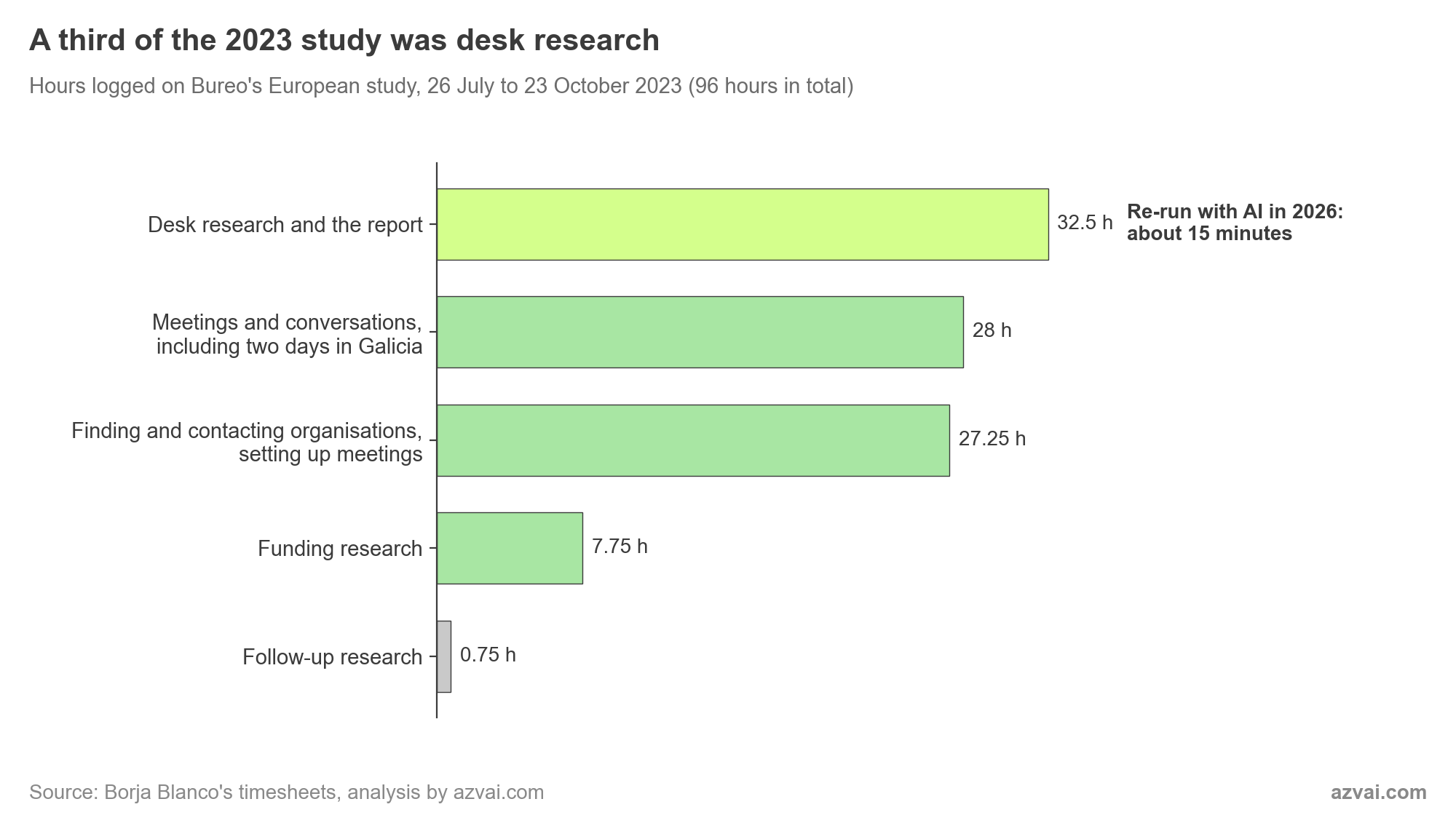
None of the earlier groundwork, the Seychelles project and a funding proposal I prepared at Sinerxia around 2021, is in those hours, so they are a floor.
Four AI runs, timed
I’ve written before about using Claude Code for circular-economy research. This time I logged the clock for each job. A tool call is one web search, page fetch or script run.
| Job | What it did | Time | Tool calls |
|---|---|---|---|
| Supply re-run | The 2023 question, with web search and the Eurostat download, blocked from my files and this site | 4.5 min | 32 |
| Chatbot answer | “Who can take the nets”, answered from memory with no tools, the way a chat assistant answers | 3 min | none |
| Web scan | The same question, with web search and an instruction to cite a source for every facility, capacity and price | 9 min | 76 |
| Checking | Two agents in parallel, checking every named organisation against company registers, company reports and official documents, one row per claim | 8 and 10 min | 82 and 90 |
While the agents ran, my main Claude session checked the shipping law against the Regulation’s text and re-opened the key sources the checkers relied on. The outlet scan took 24 minutes of wall-clock time from question to a clean list, because the jobs ran side by side. The five agent runs used about 770,000 tokens, not counting my main session.
What the supply re-run produced
The supply re-run worked from the 2025 data and made choices I didn’t make in 2023. It counted gill nets as nylon, backed by a Spanish study of fishing gear thrown away in ports (Basurko and colleagues, 2023).
It ranked countries by the number of vessels using that gear, which put Greece first with about a fifth of them. It left Norway and Iceland out of the ranking and said plainly that it had no source for their gear split. Its recommendation was to start in Spain and make Greece the second site.
It also built a volume estimate, and that is where it slipped. It took the Spanish study’s split, where purse seines are 0.2% of the gear thrown away in Spanish ports, and applied it per vessel to all of Europe. The result was about 266 tonnes of nylon net a year across every EU and UK port.
Brikole collected about 500 tonnes in Victoria alone in its first two years, roughly the same tonnage a year from one island port. A method built on Spanish port data can’t see nets that Spanish and French seiners leave abroad. The model flagged its figure as “very likely understated” and kept it in its conclusions anyway.
What the outlet scan found
After checking, the answer to “who can take nylon nets from Victoria” was shorter than either scan suggested.
| Organisation | What it is | Status on 8 November 2026, from public records |
|---|---|---|
| Aquafil, ECONYL (Ljubljana, Slovenia) | Chemical recycling of nylon 6 back to its raw material | The only confirmed industrial outlet. Publishes no plant capacity. Its 2025 report gives 15,961 tonnes of post-consumer waste collected, all kinds, and puts its 35,000-tonne collection target on hold |
| Nofir (Norway, dismantling in Lithuania) | Collector and dismantler that supplies recyclers | Collected 10,298 tonnes of gear in 2025, 8,042 tonnes of it sent to material recycling |
| Filets Recyclage (France) | Collector and sorter | Active, and publishes its intake rules: water and salt 7% at most, other organic matter 2% at most, no metal |
| Fil&Fab (Brittany, France) | Small mechanical recycler of nylon nets | Liquidation opened on 2 September 2025, struck off in October 2026 |
| Fishy Filaments, now 0rCA (Cornwall, UK) | Very small mechanical recycler | Trading. Its website shows 6,102 kilos of nets recovered |
| Plastix (Denmark) | Mechanical recycler of fishing gear | Current products are polypropylene and polyethylene only, so it isn’t an outlet for nylon |
| Brikole (Victoria, Seychelles) | The local collector | In June 2025 it stripped nets to Bureo’s specification and sold them to Bureo in Chile, after about 500 tonnes collected in its first two years. 2026 status not confirmed |
Shipping is where the rules are strictest. The Seychelles isn’t in the OECD, the group of mostly richer countries whose waste moves under lighter rules, but it is a party to the Basel Convention on waste shipments.
Under the EU’s Waste Shipment Regulation (EU) 2024/1157, which applies from 21 May 2026, Article 54 puts imports for recycling from such a country under the full procedure of Article 51. That holds even for clean, stripped nets.
- Prior written notification, and written consent from the authorities of dispatch, destination and any transit country
- A contract with the recycler
- A financial guarantee or equivalent insurance
- A decision within 30 days of a complete notification (Article 9)
What broke, and what caught it
The raw answers are where the errors were. Every claim then went into a list with its source, the source’s date and a verdict, and that is where they were caught. Only the confirmed claims went into the findings above.
| Error in the raw output | Which run | What caught it |
|---|---|---|
| Fil&Fab, a company in liquidation, listed as a working recycler | Both scans | The French company register and its official gazette |
| Fil&Fab at “a few hundred tonnes a year”, a figure with no source. It had recycled about 20 tonnes by April 2022 | Chatbot answer | No source found, graded invented. The checking script won’t accept a model’s answer as evidence |
| Aquafil at “35,000 to 40,000 tonnes a year of input” | Chatbot answer | Aquafil’s own 2025 report, where the nearest number is a collection target, now on hold |
| An “ECONYL Net Collection” programme | Chatbot answer | A search of Aquafil’s own sites, which never mention it |
| Old or planned figures offered as capacity, such as Aquafil’s 2011 plant output | Web scan | The date check. The script flags sources older than two years and capacities that don’t say what they measure |
| Clean nets from the Seychelles described as a light “green list” shipment, the lighter regime for clean waste between richer countries | Chatbot answer | The Regulation’s own text, Articles 52, 54 and 51 |
| Gate prices, freight and landed cost, flagged as unsure and still put in a table | Chatbot answer | No facility publishes prices, so they moved to the call list |
| Brikole, the collector in the same port as the nets, missing | Chatbot answer | The web scan found it |
| A volume estimate blind to nets that tuna seiners leave abroad | Supply re-run | Comparison with my 2023 study and what I saw in Victoria |
Every company the scans named exists or existed. The errors sat in the numbers attached to them, and in one company that had gone into liquidation since the articles the models drew on were written.
Two scans, two checkers and a script that rejects weak evidence turned a fast, unreliable answer into a list I’d put my name to.
The checking layer needed fixing along the way too. A search tool’s summary got the date the Seychelles joined the Basel Convention wrong, and the UN depositary record corrected it. The first version of the checking script marked the liquidated company “verified”, because it read any confirmed status as good news. Both are fixed in the skill, and the script bug has a test.
What a scan can’t close
The scan ends with questions only a person can close.
- Whether Aquafil and Nofir take nets from outside Europe today, at what specification, and who pays the freight
- Whether Brikole still sells to Bureo, and which European plant bought its first shipment in 2022
- A real freight quote from Victoria, and which shipping lines accept waste bookings
- The destination authority’s view on classification, the guarantee and the fees
The supply re-run’s blind spot shows why. The method was tidy, and it still missed where Spanish and French seiners leave their nets. That correction came from the time I spent on the quay in Victoria.
The verdict on “days rather than weeks”
The claim was only ever about the scan, and for the scan it was too cautious. The like-for-like part, the supply question, went from 32.5 hours of work to about 15 minutes, and the AI version was better sourced.
Two caveats keep that honest. The 32.5 hours included Spain- and France-specific research that the re-run didn’t repeat in full, so the comparison flatters the AI a little. And my own review of the draft and the list isn’t counted in any of these times.
The research is also only one product of a desk phase. The re-run wrote its method, tables and a report in the same 4.5 minutes. This month Claude also rebuilt the charts and data tables of my post on where Europe’s nylon nets are from the 2025 fleet data, work I did by hand in 2023.
Where AI would have helped most: the other 63 hours
Most of the Bureo study wasn’t desk research. It was introducing Bureo to fishing organisations in Spain. I cold-emailed many of them, ran semi-structured interviews and conversations, and travelled to meetings in Galicia.
This test didn’t touch that work, so what follows is my judgement from having done it, not a measurement.
| 2023 work (hours logged) | What AI could take on | What stays with me | Likely help |
|---|---|---|---|
| Finding and contacting organisations, setting up meetings (about 27 h) | Building the list of fishing associations, producer organisations and net makers from public registers, with what each one handles. Drafting a tailored first email to each, in Spanish. Keeping track of who replied | Deciding who matters, sending, and every follow-up that depends on trust | High. Most of this was screen work |
| Interviews, conversations and meetings (28 h, including two days in Galicia) | A short brief on each organisation before the call. A semi-structured interview guide. Transcribing and summarising each conversation, then pulling common themes across all of them | The conversations, the travel and reading the room | Medium. The preparation and notes shrink, the meetings don’t |
| Funding research (about 8 h) | Scanning open calls, checking eligibility, drafting the first summary of each fund | Choosing which bids are worth the effort | High, with the same checking rules as the scan |
Part of the middle row already runs without me today. My recorded meetings are transcribed and summarised automatically on my own machine.
The interviews themselves are the field work, the part the original post said AI should give me more time for, “more hours in the port talking to fishing crews”.
Try the recycling-capacity scan skill
I turned the method into a Claude Code skill, recycling-capacity-scan, free in my public skills repository next to the other Claude skills for sustainability work. It runs the scan the way this test ended up running it.
- Leads first. Search in the destination countries’ languages, and ask who already handles the material at the origin.
- One row per claim. Every capacity, specification and price gets its own source, date and verdict.
- Checks in a fixed order. Company register, then process and polymer, then capacity with its basis and date, then intake rules, then terms.
- A checker that stops with an error when a claim is confirmed only by a model or a directory, a confirmed claim has no date, or a capacity doesn’t say what it measures. It drops companies whose register shows they have closed.
- A shipping reference for imports into the EU under Regulation (EU) 2024/1157, with the article numbers.
- A call list of questions for recyclers, collectors, forwarders and authorities.
I tested it cold on a second material, plastic pipe and rope from salmon farms in Shetland. A fresh agent on a smaller model ran it in 29 tool calls, finished with no checker errors, and found eight gaps in the instructions, which I fixed. The example list from this test ships with it, with personal details removed.
Where to go next
- Whether shipping to a buyer pays is a financial model. There is a worked example in how a Claude Code skill rebuilt the business case for a Seychelles net-recycling facility.
- Other AI deployments in reuse, repair and recycling are collected in the AI in the circular economy hub.
- Where Scotland’s circular-economy policy and funding sit, for practitioners there, is in the Scotland circular economy map.
How this test was run
Times are wall-clock, from the logs of each run, on 8 November 2026. Every agent was Claude Opus 5.5 except the skill’s cold test, which ran on Claude Sonnet 5.5.
Facility claims were graded against company registers (the French register and its official gazette, Companies House, the Norwegian register), company reports and official documents, and against dated news and trade press where nothing primary existed. The supply re-run’s Eurostat figures were checked against my own verified 2025 tables. The 2023 hours come from my timesheets. No facility was contacted for this post.
FAQ
Which European companies recycle nylon fishing nets?
On 8 November 2026 the only industrial plant I could confirm for end-of-life nylon fishing nets is Aquafil’s ECONYL plant in Ljubljana, Slovenia. Collectors such as Nofir and Filets Recyclage gather and sort nets for recyclers. A small French nylon-net recycler, Fil&Fab, went into liquidation in 2025. Check each company’s register status before you rely on any list, including this one.
Can ChatGPT or Claude do recycling market research reliably?
They find the right names quickly. In this test the companies were real, but the figures attached to them were often outdated, misread or invented, and both scans listed a company in liquidation. With web access, a rule to cite every claim and a check against company registers and the companies’ own documents, the final list held up. Treat the model’s first answer as a list of leads to check.
What paperwork do you need to ship fishing nets from outside the OECD to an EU recycler?
Under Regulation (EU) 2024/1157, nets for recycling coming from a country outside the OECD that is a party to the Basel Convention need prior written notification and consent from the authorities of dispatch, destination and any transit country. The notifier also needs a contract with the recycler and a financial guarantee or insurance. This applies even to clean, sorted nets. Confirm the procedure with the competent authority in the destination country.
I write more about using AI for desk research on field projects under AI for sustainability research.
