

The most distinctive thing about xAI’s environmental position is that you can read about it in a federal court filing.
In April 2026, the NAACP, the Southern Environmental Law Center, and Earthjustice filed suit in federal court over 27 unpermitted methane gas turbines powering the Colossus 2 data centre in Southaven, Mississippi. That facility powers Grok.
Three things make the timing matter:
- A separate community campaign in Memphis has been challenging the original Colossus 1 site since 2024.
- In February 2026, SpaceX absorbed xAI into its corporate structure.
- On 12 June 2026, SpaceX completed its IPO, placing xAI inside a publicly traded company with a readable S-1 on file.
Of the three frontier US AI labs filing S-1s in the past six weeks, xAI is the only one whose disclosure document is already public. It is also the one whose physical infrastructure is most legally contested.
This article reads the S-1 directly, walks through what’s at Colossus 1 and 2, and asks the same question I asked of Anthropic in Is Claude Sustainable?. The framework is the same. The answer is sharper.
- Aug 2026. The Southaven case: plaintiffs now count 33 unpermitted turbines at Colossus 2 (27 original plus 6 added after notice) and allege 2,508 tons of NOx a year; the preliminary injunction motion is pending. SpaceX’s revised S-1 names water scarcity as a business risk while still saying nothing on emissions. Earthjustice; Bloomberg.
Key Takeaways
- xAI has the thinnest standalone climate disclosure of any frontier AI lab. No sustainability report, no Scope 1/2/3 figures, no climate target, no CDP submission, no SBTi commitment. The SpaceX S-1 acknowledges “natural gas and gas turbine technology” qualitatively and stops there.
- The infrastructure is actively in litigation. Colossus 2 in Southaven faces a federal Clean Air Act case from the NAACP, SELC and Earthjustice. The plaintiffs’ May 2026 injunction filing puts it at 2,508 tons of nitrogen oxides per year from 33 unpermitted turbines (their earlier estimate was 1,700). The data centre sits half a mile from homes and one mile from an elementary school.
- Grok 4 training used roughly 310 GWh. That’s the carbon equivalent of around 154,000 tons of CO2 from the training run alone. There’s no public per-query figure from xAI, and no entry on the AI Energy Score leaderboard.
- Grok 4 Fast is the closest xAI has to a per-query efficiency story. The vendor claims a 40% reduction in thinking tokens and roughly 98% lower operating cost than the prior generation. Useful, real, and a small share of the actual environmental story.
- Water is the second front. The Memphis facility was meant to come paired with an $80 million wastewater recycling plant that would have cut aquifer strain by roughly 9%. That project was paused in April 2026 and remains unbuilt at the time of writing.
- The federal disclosure floor is genuinely thin. SpaceX’s S-1 satisfied SEC requirements with a single qualitative line. The 2024 federal climate rule was terminated in 2025, so quantified emissions reporting is not compelled at federal level for any of the three labs going public this year.
- California’s SB 253 is the operative floor. SpaceX clears the revenue threshold trivially. Mandatory Scope 1 and 2 reporting begins in 2026, Scope 3 in 2027. That, not the IPO, is what compels real numbers.
This piece is one of four. The synthesis, with a side-by-side comparison of Anthropic, OpenAI, xAI and Google, is Is Generative AI Sustainable?
Where xAI Sits on Disclosure
The cross-vendor comparison I use across this series is below. The matrix is updated as of June 2026, after the SpaceX S-1 became public.
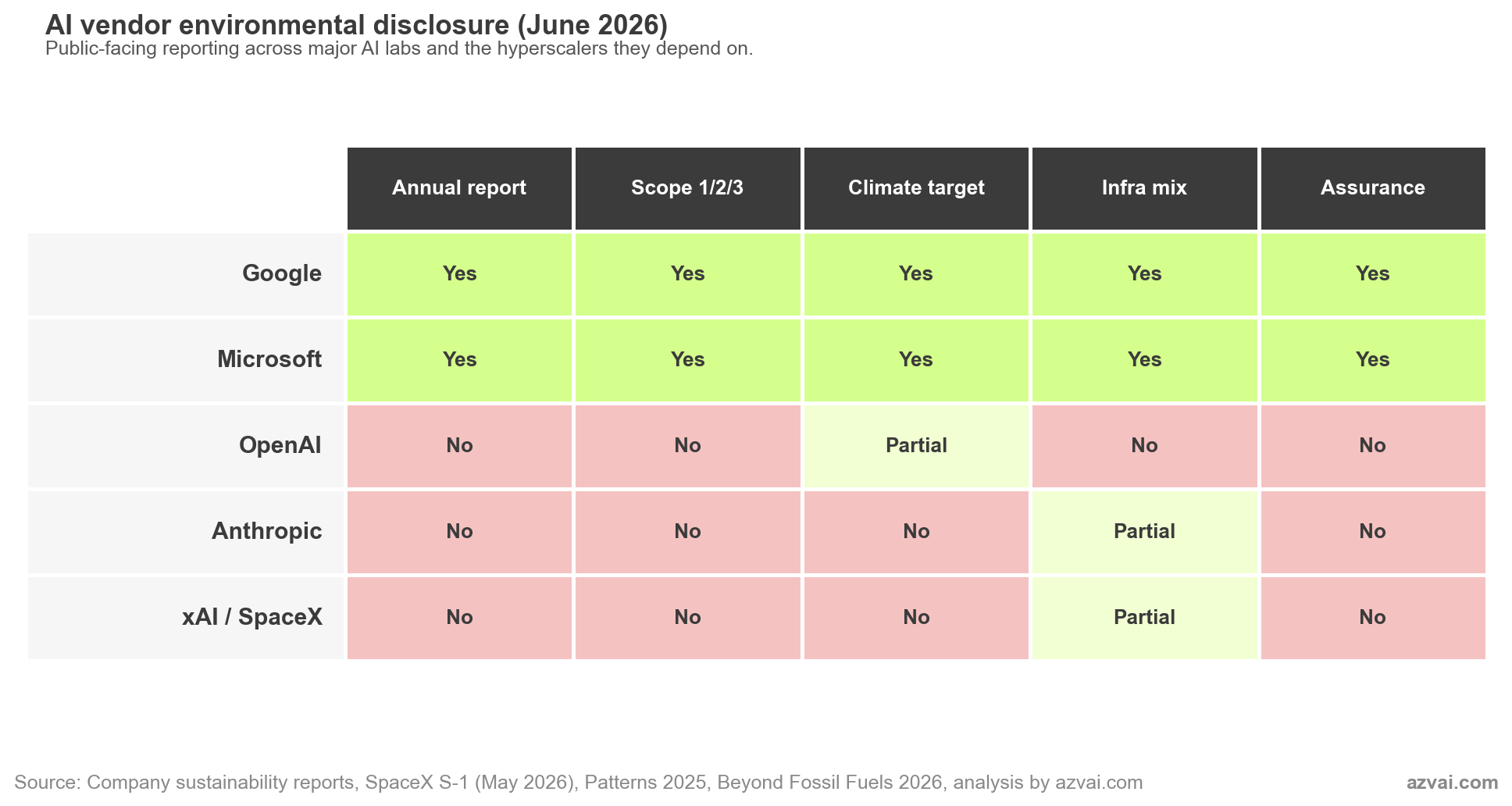
The xAI/SpaceX row earns a Partial on infrastructure mix for a single specific reason. The SpaceX S-1 filed on 20 May 2026 states, qualitatively, that the company’s data centres “currently run significantly on natural gas and gas turbine technology”.
That single line tells a reader more than any other disclosure xAI has ever produced. It is also the only quantitative-adjacent statement in the document. There is no Scope 1, 2 or 3 figure, no climate target, no third-party assurance, no breakdown of facility-level energy mix, no commitment to renewable PPAs.
By comparison, Anthropic sits at Partial on infrastructure mix through a different mechanism. Anthropic discloses nothing standalone, but inherits implied disclosure from its Google Cloud and Amazon Web Services hosting through hyperscaler reports.
The infrastructure-level reality, as I argued in the Anthropic article, is that Anthropic now also occupies all of Colossus 1, so part of its inferred footprint is now xAI infrastructure too. Google and Microsoft remain the only two labs in the matrix publishing detailed verified environmental reports with third-party assurance.
The Two Pictures, Applied to xAI
The two-pictures framing I introduced in the prior piece still applies. Per-query efficiency on one hand, infrastructure-level footprint on the other. xAI’s story on each is very different.
On the per-query side, xAI’s strongest data point is Grok 4 Fast. The vendor reports a 40% reduction in thinking tokens and roughly a 98% reduction in operating cost relative to the prior generation. The efficiency claim is plausible. It also matters less than the headline suggests, because Grok 4 Fast inference still runs on the same Colossus facilities as Grok 4. The model-level efficiency improves; the infrastructure-level footprint barely moves. There is no entry on the AI Energy Score leaderboard for any Grok model, which is the closest thing the field has to standardised per-query reporting. Without that, the procurement evidence reduces to vendor-supplied numbers.
On the infrastructure side, xAI is the only frontier AI lab with an active federal Clean Air Act case against one of its operating data centres. Per the Earthjustice case documents, the Colossus 2 facility runs 27 methane gas turbines plus 46 portable units, none with Clean Air Act permits, with a stated potential to emit more than 1,700 tons of nitrogen oxides per year. That would make it one of the largest single industrial sources of smog-forming pollution in Mississippi. The plaintiffs filed for emergency action in May 2026.
For a procurement team choosing between AI vendors on environmental grounds, the two pictures point in opposite directions. Grok 4 Fast is a reasonable inference-efficiency story. Colossus 2 is a reputational and legal-risk story sitting under it. The procurement question becomes which picture the buyer is accountable for.
Colossus 1, Memphis
Colossus 1 is the older of xAI’s two operating data centres. It came online in mid-2024 in Memphis, Tennessee. The facility powers Grok inference and was the training site for Grok 3 and earlier Grok 4 work. As of May 2026, the entire site is now under a multi-year compute lease to Anthropic, projected to generate $5 to $6 billion in annual revenue for SpaceX. xAI retains the physical and operational responsibility for the infrastructure.
The power mix is the first issue. The facility receives 150 megawatts from Memphis Light, Gas and Water (MLGW), with the remainder of its load met by on-site generation. According to the Southern Environmental Law Center, when Colossus 1 started in mid-2024 it ran on as many as 35 methane gas turbines classified as “temporary” installations under a permitting loophole.
After a notice of intent to sue from the NAACP and SELC, xAI removed all but 15 of those turbines and obtained Shelby County Health Department permits for the remainder. The MLGW grid supply, given Colossus 1’s proximity to the 1.1 GW Allen Combined Cycle Plant, is itself substantially natural-gas-derived.
In the words of the Southern Alliance for Clean Energy, the facility is “powered almost exclusively by combined cycle natural gas.”
The water position is the second. The Memphis aquifer is the city’s drinking-water source. xAI’s water draw was projected to increase significantly with Colossus 1’s growth. According to Memphis Flyer reporting, xAI purchased 25 million gallons of water from MLGW in its first year and projected increases as compute capacity expanded.
To offset that draw, xAI announced an $80 million wastewater recycling facility that would convert treated effluent from the Maxson Wastewater plant into 13 million gallons per day of reuse water for xAI, the TVA’s Allen plant, and Nucor Steel.
The project was designed to reduce strain on the Memphis aquifer by roughly 9%. xAI paused construction in April 2026. As of this article’s publication, the recycling facility remains unbuilt, and xAI’s water draw from the aquifer continues at the pre-project rate.
The community has not been quiet. The Protect Our Aquifer campaign, the NAACP, and the SELC have run a sustained pressure campaign on both the gas turbines and the water draw. The MLGW board has publicly raised concerns about utility load. The Memphis mayor publicly pushed xAI in May 2026 to complete the recycling facility. So far the project has not restarted.
Colossus 2, Southaven
Colossus 2 is the newer site, in Southaven, Mississippi, just across the state line from Memphis. The facility powers Grok inference and is the central target of the Earthjustice litigation. Two facts about the site are important to grasp before reading anything else.
- The turbine count. Per the Earthjustice complaint, Colossus 2 operates 27 methane gas turbines, with 46 portable units on site overall, generating up to 495 MW of power. None have Clean Air Act permits.
- The location. The data centre sits approximately half a mile from residential homes and one mile from an elementary school. South Memphis and northern Mississippi are predominantly Black neighbourhoods. The NAACP filed the suit explicitly framing it as an environmental-justice case.
The legal exposure is material. The Earthjustice case alleges that the unpermitted turbines have the potential to emit more than 1,700 tons of nitrogen oxides per year. NOx is the primary precursor to ground-level ozone and a known contributor to respiratory illness.
If the court accepts the plaintiffs’ figures, Colossus 2 would be one of the largest single industrial sources of smog-forming pollution in Mississippi. The case was filed in federal court on April 14, 2026. The plaintiffs subsequently filed an emergency motion to halt operations during the proceeding.
The case then escalated in June 2026. The US Department of Justice intervened on xAI’s behalf, moving to dismiss the suit and arguing that the turbines are a matter of national and energy security. The plaintiffs’ counsel called it remarkable for the federal government to step in on behalf of an alleged polluter. At the time of writing the court has not ruled, and the turbines keep running.
The corporate structure adds a wrinkle. The Earthjustice filing names xAI and its subsidiary “MZX Tech” as defendants. SpaceX, post-merger, is the ultimate parent of both. The S-1 filed in May 2026 contains the standard “legal proceedings” disclosure, but the document does not quantify the company’s exposure to Clean Air Act penalties or to potential injunctive relief that would shut down portions of the facility.
That non-quantification sits comfortably within current SEC materiality standards, which is part of why the federal disclosure floor is so thin.
If you are a procurement lead choosing between AI vendors with environmental criteria, the Colossus 2 case is the single most concrete piece of information you can take to your sustainability committee. It is sourced, documented, in court, and unambiguously attached to the product (Grok) you would otherwise be considering.
The SpaceX S-1 and the Regulatory Floor
The S-1 is worth reading in its own right. For the purposes of this article, three things matter.
First, what’s there. The S-1 discloses environmental risk in the standard risk-factors section. The relevant language addresses two main areas. Rocket-launch emissions and atmospheric byproducts, and the gas-turbine power infrastructure behind the AI data centres.
The “natural gas and gas turbine technology” line covering Colossus 1 and Colossus 2 is the closest the document comes to an infrastructure-mix disclosure. There are no Scope 1, 2, or 3 emissions figures. No climate target. No third-party assurance language. No commitment to renewable power purchase agreements. The 38 pages of risk factors include references to environmental enforcement risk as a category, but no quantification of pending exposure.
Second, what the federal floor permits. The 2024 SEC climate disclosure rule, which would have required US-listed companies to report quantified emissions consistently, was terminated by the SEC in 2025 when the agency stopped defending it in litigation. After the rule’s termination, S-1 disclosure of climate-related information is governed by general materiality. Companies must disclose material climate risks but are not compelled to quantify Scope 1, 2, or 3. SpaceX’s S-1 is squarely within that floor. So will Anthropic’s and OpenAI’s be when they become public.
Third, what the binding floor actually is. California’s SB 253 (the Climate Corporate Data Accountability Act) requires Scope 1 and 2 reporting in 2026 and Scope 3 in 2027 for any company with over $1 billion in annual revenue doing business in California. SpaceX clears that threshold trivially. The first SB 253 filings are due in mid-2026, which is approximately six to twelve weeks from the publication of this article. That filing will require numbers the S-1 was not required to provide.
The same filing obligation will apply to Anthropic and OpenAI, both California-headquartered with revenue well above the threshold. The European Union’s CSRD also applies to companies with significant EU operations and ratchets disclosure obligations further from 2026 onwards.
The mental model worth holding is that the IPO process makes each lab’s voluntary choice publicly visible. The state and EU laws make the floor mandatory. xAI/SpaceX has shown what the voluntary floor looks like when stretched to its minimum. The mandatory floor lands shortly after.
What Grok Users Should Know
If you use Grok directly through X or through xAI’s API for production inference, the procurement question changes slightly from the Anthropic equivalent. There are three things worth weighing.
Inference attribution. Grok inference runs primarily on Colossus 1 and Colossus 2. Both facilities are documented to run substantially on gas turbines, with Colossus 2 specifically in litigation over unpermitted operation. Per-token emissions attribution from xAI is not published. The lower bound is the Anthropic-Colossus shared infrastructure footprint from the Claude article; the upper bound is the litigation-quantified NOx and combustion-derived figures from the Earthjustice filing.
Brand and reputational risk. If your organisation has a sustainability committee, an ESG officer, or a procurement-disclosure obligation, the question of explaining a Grok choice in light of Colossus 2 is not theoretical. The Earthjustice case is a matter of public record. A Google search for “xAI environment” returns the litigation in the first results. For a buyer who plans to defend the choice in a sustainability review, the documentation requirements are higher than for an Anthropic, OpenAI, or Google equivalent.
Disclosure timeline. The first chance to evaluate xAI on quantified emissions data will arrive in mid-2026 when SpaceX files its first California SB 253 report. If your procurement timeline permits waiting until autumn 2026, the comparison evidence base will be materially better. If it doesn’t, the current floor is the S-1 plus the Earthjustice filings, and that is what’s available.
What Better Disclosure Would Look Like
The five-element bar I named in the Anthropic article applies here unchanged. xAI’s specific position against each is worth naming directly.
- Verified Scope 1, 2, and 3 emissions. Currently zero. The lower bound xAI could meet at minimal effort is a Scope 1 figure for the Colossus 1 and Colossus 2 facilities, which the company has direct meter access to via the gas-turbine fleet.
- Per-model energy and water reporting. Currently zero. xAI does not submit Grok to the AI Energy Score leaderboard. A Grok 4 Fast entry would be a useful starting point, given the efficiency claims the company makes for that model elsewhere.
- Infrastructure mix disclosure. Currently Partial through the S-1’s qualitative line. What’s missing is the percentage breakdown of gas, grid, and renewables at each facility, the proportion of grid load covered by direct PPAs versus unbundled RECs versus residual mix, and the timeline for any renewable build-out.
- A time-bound climate target. Currently zero. No net-zero commitment, no SBTi-validated target, no operational carbon goal at the company level.
- Material event disclosure. The Colossus 1 to Anthropic lease was disclosed publicly but without an environmental impact statement. The paused Memphis wastewater recycling project was disclosed via local press, not via xAI corporate communications. Both qualify as material events for a sustainability reader of the company.
None of these are technically difficult for a company at xAI’s scale. The infrastructure is there. The decision not to publish is strategic.
Five Questions to Ask xAI (or Any AI Lab)
The procurement question template I use across this series, adapted with xAI-specific lead-ins where helpful.
Most vendors won’t answer most of these in writing. That itself is the data point. For xAI specifically, the third and fourth questions are the most likely to receive a non-answer, and the fifth is the one that should appear in the procurement file regardless of the response.
The Position I’ve Landed On
If a client asked me today whether they should use Grok for an internal AI workflow on environmental grounds, this is the answer I’d give.
Default to no for sustainability-sensitive workloads. Not because Grok is uniquely incapable as a model, and not because Colossus’s gas turbines invalidate Grok’s per-query efficiency claims as such. The reason is that the documentation burden of defending the choice is materially higher than for an Anthropic or OpenAI equivalent.
The Earthjustice case sits in the procurement-due-diligence file by default. The paused water project sits next to it. The lack of any climate target or verified emissions removes the rebuttal that would otherwise be available.
Wait for the SB 253 filing if the timeline allows. California’s first SB 253 reports land in mid-2026. SpaceX-xAI will be filing within roughly six to twelve weeks of this article. That filing will provide the first quantified Scope 1 and 2 numbers from the company. If the procurement decision can wait until then, the comparison evidence improves substantially. If it can’t, the current floor is what’s available.
Watch the litigation trajectory. The Earthjustice case will move. The plaintiffs’ emergency motion may force operational changes at Colossus 2 before trial. Any of those outcomes would shift the procurement calculus.
Don’t overweight Grok 4 Fast’s per-query efficiency. The efficiency gain is real but it doesn’t change the infrastructure-level picture. Per-query efficiency is the easy part. The harder part is what powers the facility the inference runs on, and what the local community sees of that power.
Where This Is Heading
The series this article belongs to tracks each frontier AI lab against the same five disclosure criteria over time. Is Claude Sustainable? covered Anthropic. This article covers xAI. The next two pieces will arrive after the Anthropic and OpenAI S-1s clear SEC review later in 2026.
The procurement landscape is shifting on two parallel tracks. On one, the IPO wave makes voluntary disclosure choices visible in S-1s and subsequent 10-Ks. On the other, California’s SB 253 and the EU’s CSRD compel quantified reporting that the SEC currently does not. For a sustainability advisor, the practical implication is that the next twelve months will produce more comparable data on these companies than the previous five years combined.
For xAI specifically, the most useful single document to watch is the company’s first SB 253 filing in mid-2026. If the figures it contains differ materially from what the SpaceX S-1 implied, that delta will be informative on its own. If they don’t, the choice the company has made on environmental disclosure will be a matter of permanent public record. Either way, the next time I write about this lab, the evidence base will be quantitative rather than qualitative.
If you found this useful, the companion piece on the same series is the Anthropic deep-read (linked above). The OpenAI and ChatGPT audit is now published, applying the same methodology. The shared methodology is the same. The data improves with each filing.
Vetting AI vendors on environmental grounds? If you are weighing them and working out which picture your team would be accountable for, that is exactly the kind of call my consulting helps with.