

I use ChatGPT most days, alongside Claude and the other frontier tools, and I write about using these models for sustainability research. None of that answers the question a client, a peer, or a sustainability event keeps putting to me.
Is ChatGPT sustainable? Is OpenAI sustainable as a company? Can I credibly advise a client to build an AI workflow on a tool whose maker publishes no environmental report and rests its entire public case on a single number in a blog post?
The honest answer takes longer than a yes or a no. I use ChatGPT and OpenAI interchangeably through this piece, because the product and the company cannot be separated on this question. OpenAI’s public per-query figure is reassuring, and it is also unverified and easy to misread. At the same time OpenAI discloses less than the hyperscalers it runs on, and it is building the single largest AI infrastructure project in history. These things sit alongside each other. The work, for anyone advising clients on AI adoption, is to hold all of them in view.
This is the third in a series. The Anthropic and Claude audit and the xAI and Grok audit apply the same framework to the other two leading labs. The method is the same. The answer for OpenAI is its own shape.
- 12 Aug 2026. Bloomberg reports OpenAI has a sustainability steering committee, is hiring a head of ESG reporting, and is coordinating with data centre partners ahead of California SB253 (Scope 1 and 2 reporting from November 2026). Still no published emissions data. Source.
- Jun 2026. OpenAI confidentially filed its S-1 with the SEC on 8 June, targeting a listing later in 2026. Its environmental disclosure choices will become part of the permanent public record.
- Stargate. The buildout reached roughly 7 GW of planned capacity across the Abilene flagship and five new sites, over $400 billion committed. The Abilene campus trained GPT-5.5 and runs partly on on-site natural gas turbines.
- Jun 2025. Sam Altman’s “0.34 watt-hours per query” figure remains the only per-query number OpenAI has ever published, and it is a CEO blog post, not verified data.
Key Takeaways
- OpenAI discloses as little as Anthropic. No formal environmental report, no verified Scope 1, 2, or 3 emissions, no public climate target, no water disclosure. It supports sustainability reporting in principle in its policy filings, and publishes none of it. Google and Microsoft both publish detailed, third-party-assured reports.
- The famous number is a CEO blog statistic. Sam Altman’s “0.34 watt-hours and 0.000085 gallons of water per average query” is self-reported, carries no methodology, and describes an average query. The independent “How Hungry is AI?” study puts OpenAI’s o3 reasoning model among the hungriest measured, using more than double the energy of the most efficient competitor.
- Infrastructure is the real story. OpenAI runs on Microsoft Azure and is building Stargate, a $500 billion, roughly 7 GW project. The Abilene flagship uses on-site natural gas turbines for power, and OpenAI has published no carbon accounting for any of it.
- Per-query efficiency is necessary but not sufficient. When inference scales to gigawatts, the infrastructure mix and the growth rate dominate. Microsoft’s own report shows the pattern. Scope 1 and 2 emissions fell almost 30% since 2020 while total emissions still rose 23.4%, driven by data-centre Scope 3.
- No climate action on the record, though the reporting machinery is now being built. OpenAI has made no carbon-removal purchase, joined no buyers coalition, and named no renewable commitment publicly. Anthropic at least made a first gesture in June 2026. OpenAI’s ledger on this is still blank.
- The IPO makes the choice visible. OpenAI confidentially filed its S-1 on 8 June 2026. Federal SEC rules do not compel quantified emissions, but California’s SB 253 will require Scope 1 and 2 reporting from 2026, and OpenAI’s California headquarters and revenue put it well inside the threshold.
This piece is one of four. The synthesis, with a side-by-side comparison of Anthropic, OpenAI, xAI and Google, is Is Generative AI Sustainable?
Where OpenAI Actually Sits on Disclosure
The first thing a sustainability advisor does with a vendor question is compare disclosure. Not because disclosure equals performance, but because disclosure is the precondition for any honest assessment. A company that publishes verified Scope 1, 2, and 3 emissions, an infrastructure mix breakdown, and a third-party-assured transition plan is signing up for scrutiny. A company that publishes none of those is asking to be trusted.
OpenAI is in the second group. It has never published a formal environmental or sustainability report. There are no verified Scope 1, 2, or 3 emissions, no science-based or net-zero target through a recognised framework, no CDP submission, and no water-use disclosure. In its public policy agenda OpenAI says it supports sustainability reporting requirements and points to low-emission backup generators and low-water cooling, but supporting the idea of reporting is not the same as reporting. Stanford’s 2026 AI Index notes that OpenAI, along with Anthropic and Google’s AI divisions, has stopped disclosing even the training compute and energy details it once shared. On the public record, OpenAI sits roughly where Anthropic does, and behind the hyperscalers it depends on.
Here is how the five companies most relevant to AI workloads compare, based on what each has published as of mid-2026.
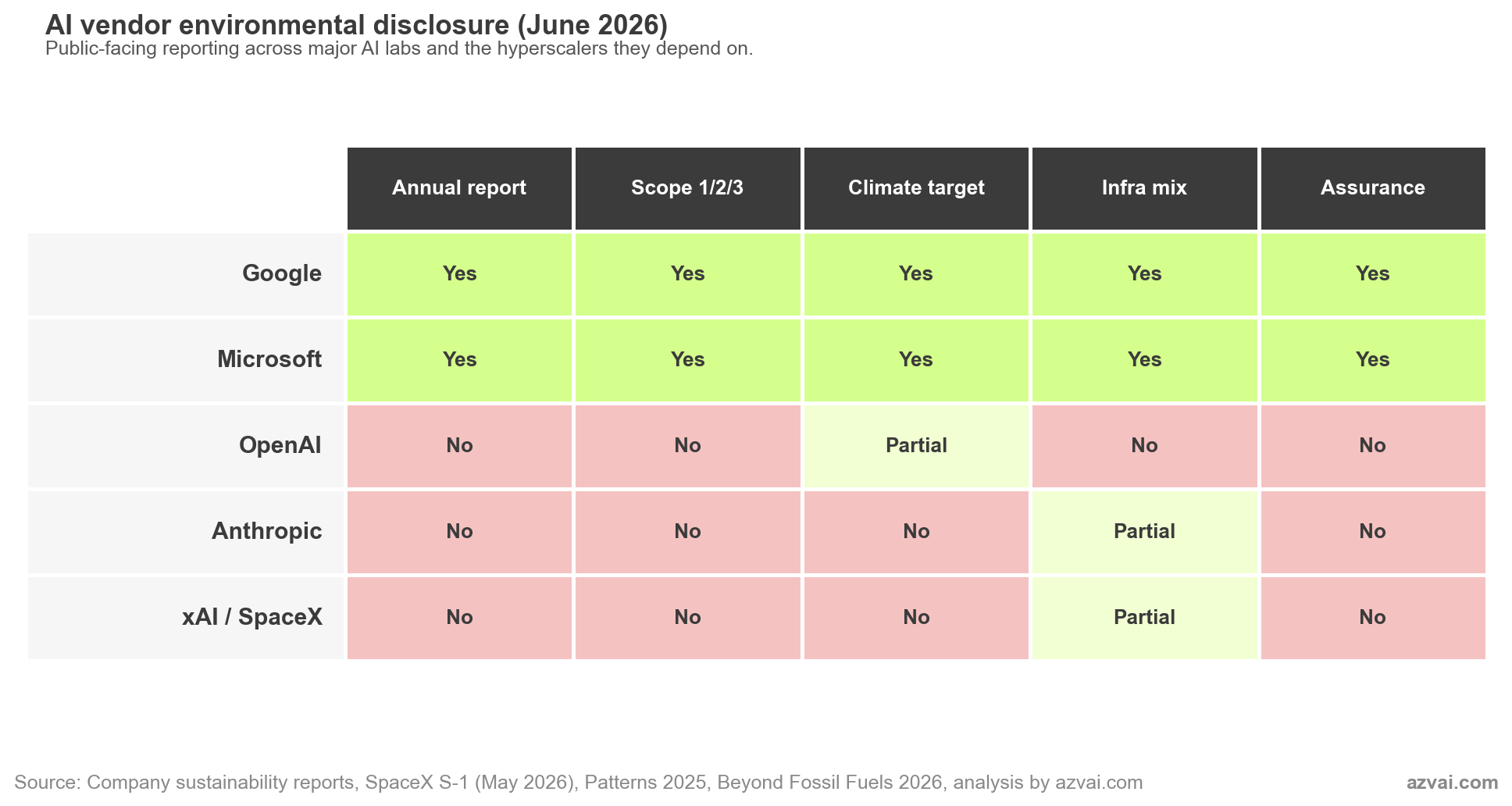
The pattern is the same one that shows up in the Claude and Grok audits. Google and Microsoft, the hyperscalers the AI labs run on, publish detailed environmental reports with verified emissions, named targets, and third-party assurance. The leading AI labs publish almost nothing on a standalone basis. They rely on their cloud partners’ disclosures to imply a footprint, and that implication is partial at best. OpenAI is the largest of them and discloses the least relative to its scale.
The gap is closing, but through regulation rather than choice. California’s SB 253 already applies to private companies. Any US company with over $1 billion in annual revenue doing business in California has to report Scope 1 and 2 emissions from 2026, with Scope 3 from 2027. OpenAI is headquartered in California and clears that revenue threshold many times over. The legal obligation is months away, not years, which means the current silence is a choice about timing, not a question of capacity. OpenAI could publish a verified report today and front-run the rule. It has not.
The Number Everyone Quotes
When someone defends ChatGPT’s footprint, they almost always reach for one figure. In his June 2025 essay The Gentle Singularity, Sam Altman wrote that “the average query uses about 0.34 watt-hours, about what an oven would use in a little over one second,” and “about 0.000085 gallons of water, roughly one fifteenth of a teaspoon.” It is a genuinely small number, and it has been quoted in board papers and procurement memos ever since.
Three things are worth saying about it before it goes into your own analysis. First, it is self-reported. It carries no methodology, no boundary definition, and no third-party verification. We do not know whether it counts training amortisation, cooling overhead, or the embodied carbon of the hardware, and we cannot check it. It is a CEO’s assertion, not a measurement.
Second, the word doing the work is “average.” Most queries to a chat assistant are short, and a short query on a small model is cheap. A long reasoning trace on a frontier model is a different order of magnitude. The independent “How Hungry is AI?” study, which measured energy, water, and carbon across thirty-plus models in May 2025, placed OpenAI’s o3 reasoning model among the most energy-intensive it tested, using more than double the energy of the most efficient competitor on long-form input. An average that blends millions of trivial lookups with a smaller number of heavy reasoning calls will always look reassuring, and it will always understate the calls a consultant actually makes.
Third, a per-query number, even a true one, is the small story. That is the point the rest of this article is about.
The Stargate Buildout
OpenAI’s inference runs mostly on Microsoft Azure, and it is building its own dedicated capacity at a scale nothing in the industry matches. In January 2025 OpenAI, SoftBank, Oracle, and MGX announced Stargate, a new company intending to invest $500 billion over four years in AI infrastructure for OpenAI in the United States, with $100 billion deploying immediately. By 2026 the project had grown to roughly 7 gigawatts of planned capacity across the Abilene, Texas flagship and five further sites, with over $400 billion committed over three years. For scale, 7 GW is comparable to the peak electricity demand of a mid-sized US state.
The Abilene campus is the one to look at, because it is operating and it trained GPT-5.5. It runs on Oracle Cloud Infrastructure with NVIDIA GB200 systems, across eight buildings on 1,100 acres. According to Oracle’s and OpenAI’s own descriptions of the site, power includes on-site GE Vernova natural gas turbines, fitted with selective catalytic reduction to cut nitrogen oxides. That last detail matters, and it is the honest contrast with xAI. OpenAI’s gas turbines are presented as permitted and emissions-controlled, not the unpermitted fleet that put xAI’s Colossus sites into federal litigation. The Abilene turbines are a cleaner version of the same underlying choice, which is to bridge a gigawatt-scale compute buildout with on-site fossil generation because the grid cannot supply it fast enough.
What OpenAI has not published is any carbon accounting for Stargate. No Scope 1 figure for the on-site turbines, no grid carbon intensity for the sites, no renewable power purchase agreements named against the load, no projected ratio of gross capacity growth to clean energy procurement. For the largest AI infrastructure programme ever announced, the environmental disclosure is a set of press releases about jobs and national competitiveness. The energy and the emissions are left to be inferred.
Why Per-Query Efficiency Is the Small Story
The total environmental footprint of an AI vendor is roughly the product of four things. Per-query energy. Volume of inference. Infrastructure mix, meaning grid carbon intensity, water source, and the power purchase agreements in place. And the growth rate of compute capacity. Improving one factor while another grows can leave total impact flat or rising. The hyperscalers are the clearest published example, and they are the infrastructure OpenAI sits on.
Microsoft’s 2025 Environmental Sustainability Report documents a 29.9% reduction in Scope 1 and Scope 2 emissions from a 2020 baseline, driven by 34 GW of contracted carbon-free electricity. Despite that, total emissions across Scope 1, 2, and 3 rose 23.4% over the same period, because the build-out of AI data centres added Scope 3 faster than operational improvements could offset. Google’s 2025 report shows the same shape. A 12% year-on-year fall in data-centre emissions despite a 27% rise in AI electricity use, and total company emissions still up 11% because Scope 3 grew 22%. The efficiency per unit of compute genuinely improved. The absolute footprint still went up.
OpenAI is the demand driving a large share of that growth, through its Azure consumption and now through Stargate. A model that is efficient per query, scaled into gigawatts of new capacity that partly runs on gas, produces more absolute emissions than a smaller workload on older, cleaner infrastructure. The 0.34 watt-hour figure does not bend that math, and neither would a figure half its size. The IEA projects that data-centre electricity demand will more than double by 2030, with almost half the net increase driven by AI accelerated servers. Per-query efficiency is the easy, measurable, optimisable part of AI sustainability. It is also where the smallest share of the total harm sits.
The IPO Wave Forces the Question
The disclosure question is shifting from voluntary to publicly visible. In June 2026 the three largest US AI labs all entered the IPO process. SpaceX, which absorbed xAI, listed on 12 June with a thin S-1 that acknowledged gas-and-turbine data centres in a single qualitative line and quantified nothing. Anthropic confidentially filed on 1 June. OpenAI confidentially filed on 8 June, targeting a listing later in the year.
Federal SEC rules do not compel quantified Scope 1, 2, or 3 figures, because the 2024 climate disclosure rule was terminated by the SEC in 2025. So what appears in any S-1 is the company’s own materiality call. What changes at IPO is that OpenAI’s choice about what to disclose becomes part of the permanent public record, in the S-1 first and in the annual filings that follow. The binding test is not the IPO but California’s SB 253, which requires Scope 1 and 2 reporting from 2026 and Scope 3 from 2027, and applies to OpenAI directly. A reader will soon be able to compare what OpenAI chose to volunteer against what the law eventually forces.
Five Questions to Ask Any AI Vendor
Most enterprise AI procurement processes still have no sustainability section. The categories of question are easy to write down and harder to find good answers to. Here is the short version I use, which any sustainability advisor or procurement lead can adapt.
Ask these of OpenAI today and the answers are mostly “no” or “a blog post.” That is a useful baseline. The point is not to reject the vendor on it. It is to make the gap legible to the client, document the trade-off, and put pressure on the vendor to close it over time.
The Position I Have Landed On
I keep using ChatGPT, alongside the other tools, where it is the best instrument for the task. The case for using AI well in sustainability work is stronger than the case for refusing it on environmental grounds, given the marginal energy cost relative to what most consultants substitute for it in practice. Using less, batching, caching, and choosing smaller models for routine work does more to cut the footprint of my own usage than switching vendor would.
And I think OpenAI’s environmental position is weak, weaker than its scale and its resources can excuse. It is the largest builder of new AI infrastructure in the world, it discloses less than the clouds it runs on, and it defends its footprint with a single unverified number. On the disclosure test that runs through this whole series, OpenAI and Anthropic sit together at the bottom of the labs that publish anything, with xAI just below. Anthropic has at least made a first gesture toward the climate ledger. OpenAI has not made even that.
For a client in a sustainability-adjacent sector, I would name the vendor disclosure gap explicitly in any AI procurement memo. Not because OpenAI is uniquely bad, but because the gap is real, and pretending otherwise sets up an awkward conversation when the question eventually arrives from procurement, sustainability, or a board sub-committee. The honest answer to “is ChatGPT sustainable?” is that it depends what you mean. Per average query, on the company’s own number, it is small. As a vendor, with no environmental report, a gigawatt-scale gas-bridged buildout, and a single blog statistic standing in for data, it is not something you can credibly certify. The work for those of us who use it is to hold both pictures at once, and to keep asking for the disclosure that would let us evaluate it properly.
If you found this useful, the companion audits cover the other two labs. The Anthropic and Claude report card works through the strongest per-query efficiency story and the Colossus infrastructure deal. The xAI and Grok report card reads the SpaceX S-1 and the Clean Air Act litigation over the Memphis data centres. Together they are the closest thing I have to an honest position on how to work with AI in sustainability consulting without pretending the trade-offs do not exist.
Using AI in sustainability work, without the greenwash. I run these vendor footprint audits with the same rigour I bring to a materials audit, and I use these tools every day in circular-economy consulting. If your team is working out where AI actually fits, and where it does not, that is the work I do. See how I work.