

I use Claude every day. Most of my consulting work runs through it, from sustainability research with Claude Code to the skills and caching patterns that cut its energy use. So when clients and peers ask me whether Claude is sustainable, and whether Anthropic publishes a sustainability report, I owe them a better answer than a shrug.
Anthropic does not publish a sustainability report. There is no emissions inventory, no climate target, and no figure for the energy or water its models use. The most detailed primary disclosure is the Form S-1 it filed with the US Securities and Exchange Commission on 26 October 2026, ahead of its stock market listing. I searched all of it, more than 400 pages, and it contains no emissions, energy or water figure of any kind.
What the filing does contain is the clearest description yet of the physical footprint behind Claude. Some of Anthropic’s planned data centres will run on their own gas-fired power plants. Their cooling depends on water in regions where it is scarce. Local opposition to data centres has become organised enough to appear in the risk factors, alongside moratoriums on new construction. So is Claude sustainable? On the evidence available today, nobody can show that it is, Anthropic included.
This article reads the S-1 for what it says and what it leaves out, sets it against the independent estimates of Claude’s footprint, and compares it with ChatGPT. It ends with the questions I now ask any AI vendor and how I use Claude myself.
Key Takeaways
- Anthropic publishes no sustainability report. No Scope 1, 2 or 3 emissions, no climate target, no energy or water data. Its first annual Public Benefit Report, released in October 2026, does not mention energy, emissions, water or climate.
- The S-1 is the closest primary disclosure, and it has no environmental numbers. The words “Scope 1”, “emissions”, “renewable” and “net zero” do not appear anywhere in it.
- Natural gas is part of the build-out. Certain planned data centres “rely on dedicated on-site natural gas-fired generation”, with fuel costs passed through to Anthropic without caps (S-1, p. 35).
- Water and heat are named risks. Cooling water is “in some regions” scarce, and higher temperatures are expected to raise both power and water use (pp. 35-36).
- The scale is very large. Named compute agreements add up to more than $600 billion, including up to $120.5 billion with SpaceXAI (formerly xAI) into 2029 and at least $110 billion with Amazon to 2036.
- California will eventually force emissions figures. SB 253 requires companies above $1 billion in revenue that do business in the state to report emissions, and Anthropic’s 2025 revenue was $4.6 billion. Its first cycle allows a statement of non-reporting, so the first mandatory figures may not arrive until 2027. The S-1 itself says California’s rules, the EU’s CSRD and CSDDD, and the UK’s SECR will require significant resources.
- Per query, there is no lasting winner. Independent estimates put the top Claude and GPT models close together, and the ranking changes with each model generation. Which model you use, and how, matters far more than which lab made it.
This piece is one of four. The synthesis, with a side-by-side comparison of Anthropic, OpenAI, xAI and Google, is Is Generative AI Sustainable?
Does Anthropic Publish a Sustainability Report?
No. Anthropic has never published a sustainability, ESG or climate report, and it has never published an emissions figure. That sets it apart from Google and Microsoft, the cloud providers it rents much of its compute from, which both publish detailed environmental reports with third-party assurance.
The gap stands out because Anthropic publishes so much else. It releases system cards for each model, its Responsible Scaling Policy, the Anthropic Economic Index with its underlying data, and regular risk reports. In October 2026 it added its first Public Benefit Report, a 20-page review of progress against the five pillars of its charter as a public benefit corporation. I read it looking for the environment. Energy, emissions, water and climate are not mentioned once.
The one public climate action on record is carbon removal. In June 2026 Anthropic joined the buyers in Frontier’s $915 million advance market commitment for permanent carbon removal. Its own share is undisclosed. Removal is a real and useful market, and it is meant to come last, after measuring and reducing emissions. Anthropic has done it first.
| Environmental disclosure | What Anthropic publishes (October 2026) |
|---|---|
| Sustainability or ESG report | None |
| Scope 1, 2 and 3 emissions | None. The S-1 contains no emissions figures |
| Climate or net-zero target | None |
| Energy use, per model or in total | None |
| Water use | None. Water scarcity is named as a business risk (S-1, p. 35) |
| Power sources for its data centres | Qualitative only. Some planned sites use on-site gas generation (S-1, p. 35) |
| Community and ratepayer commitments | Yes, described without figures (S-1, pp. 34 and 36) |
| Carbon removal | Frontier buyer since June 2026, amount undisclosed |
What Anthropic’s S-1 Says About Energy, Gas and Water
A prospectus has to tell investors what could go wrong, and that obligation produces more environmental detail than Anthropic has ever volunteered. The S-1 (accession 0001628280-26-067168) is a preliminary version, with share counts, the price range and several commitment totals still blank, so an amended S-1/A will follow. The passages below are unlikely to change much, because they describe risks Anthropic is already exposed to.
On-site natural gas, with the fuel bill passed through
The most specific sentence in the filing is on page 35. “Certain of our planned data center facilities rely on dedicated on-site natural gas-fired generation.” Under these arrangements Anthropic bears the fuel cost “on a pass-through basis without cost caps”, and it expects more competition for the same gas supply and pipeline capacity as other data centre operators turn to gas. Page 75 adds that Anthropic has entered into arrangements involving the “development, operation, or control of power stations”, which expose it to “environmental liabilities”. The business section (p. 205) describes this behind-the-meter power as supplying “electricity directly to the facility rather than through the broader electric grid”.
The filing does not say how many sites, how many megawatts, or what share of Claude’s compute this covers. It does say that solar, wind, batteries, nuclear and geothermal “may not be available in the quantities or on the timelines we require”. Read together, the message is that gas is filling the gap while cleaner supply catches up, and nobody outside the company can see how big that gap is.
Water for cooling, and a hotter climate
“Our facilities separately depend on access to reliable water for cooling, which in some regions is scarce, subject to use restrictions, or increasingly costly” (p. 35). On page 36 the filing goes further and treats climate change as an operating cost, because “higher average temperatures can increase the power consumption and water usage required to cool equipment”. There is no figure for how much water Anthropic’s facilities use, or where. The risk is acknowledged and the volume is not.
Local opposition and moratoriums
The S-1 names public controversy over “environmental impact, land and water use, and the allocation of limited power resources” in regions where Anthropic has contracted compute (p. 35). It notes that some US states and municipalities “are also considering or have approved moratoriums on new data center construction, citing public health, safety, and environmental concerns” (p. 36), and gives New York’s pause on state permitting for large new facilities as an example (p. 37). It also says opposition “has become more organized and coordinated across jurisdictions” and that Anthropic’s public profile may draw extra attention to its projects.
Promises to neighbours and ratepayers
Anthropic has “publicly committed to covering the cost of electricity price increases to consumers caused by our data centers” (p. 34). Page 36 lists voluntary commitments to local communities and electricity ratepayers, including paying for grid upgrades, procuring new generation to match its energy needs, investing in systems that cut demand at peak times, and addressing environmental impacts. These commitments “have increased” operating costs, and Anthropic expects such commitments to become “increasingly standard or required” across the industry.
I think this is the most constructive part of the filing. Protecting local bills and the grid is a genuine obligation, and few companies write it into a prospectus. The commitments are described without amounts, though, and none of them mentions emissions.
What the S-1 Leaves Out
The absences are as informative as the risk factors. I searched the full filing for the terms any environmental reader would look for. “Scope 1”, “Scope 2”, “Scope 3”, “greenhouse”, “emissions”, “PUE”, “renewable”, “net zero” and “carbon-free” return nothing. The word “carbon” appears once, inside the name of the UK’s Streamlined Energy and Carbon Reporting framework. There is no total for electricity consumed, no water volume, and no list of the facilities that run Claude.
Set that against the scale the filing does quantify. Compute and infrastructure cost Anthropic $7.3 billion in 2025 and $8.9 billion in the first half of 2026 alone (p. 22). The compute agreements described on pages 170 and 171 run to more than $600 billion, counting the “up to” amounts at their ceiling and before an expected $20 billion or more with AMD and further Google TPU capacity.
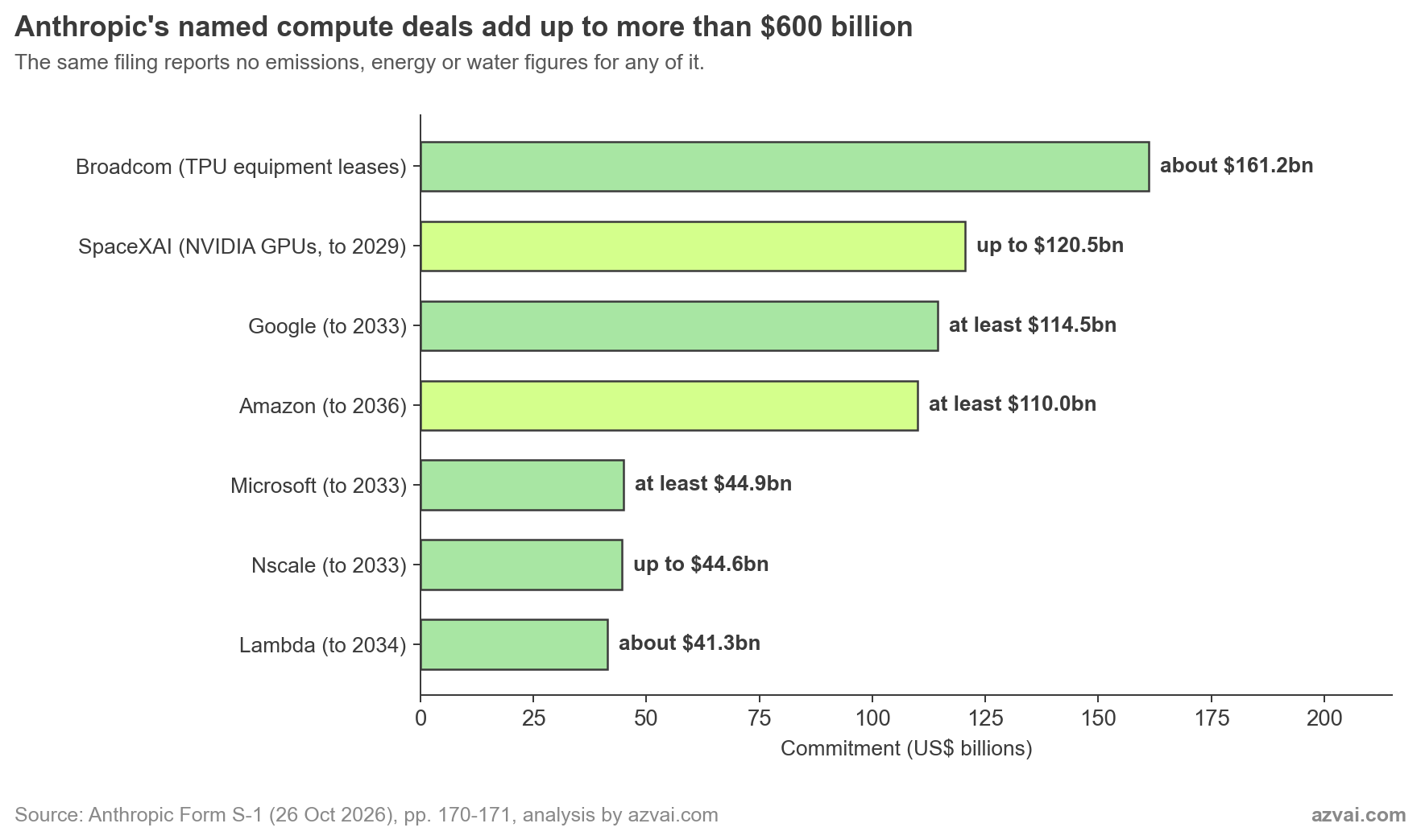
Two of those agreements matter most for the environmental picture. Anthropic has committed at least $110 billion to Amazon between May 2026 and April 2036. Between May and October 2026 it also signed agreements with SpaceXAI, the former xAI and now a SpaceX subsidiary, worth up to $120.5 billion over terms running into 2029, for compute on NVIDIA GPUs (p. 171). Anthropic’s filing does not say where the SpaceXAI capacity sits. SpaceX’s own prospectus does, in part. It says the May 2026 agreements give Anthropic compute “across COLOSSUS and COLOSSUS II”, about 325,000 NVIDIA GPUs, at data centres in Memphis and Southaven, Mississippi, that SpaceX says were brought online almost entirely through on-site power generation, mostly gas. I cover those sites, and the Clean Air Act case over the Southaven turbines, in the xAI audit. Which buildings run Claude, and on what share of gas, is not on the record.
Dollars cannot be turned into tonnes without knowing which grids and which power plants sit behind them. That is exactly the information the S-1 does not give, and it is why the filing tells you the footprint is large and growing without letting you measure it.
Claude’s Carbon Footprint and Water Use
At company level, Claude’s carbon footprint is unknown, because Anthropic has never published one. Is Anthropic carbon neutral? It does not claim to be, has no net-zero target, and buys carbon removal in an undisclosed amount. Any total you see quoted for Anthropic’s emissions is a third-party estimate.
Per query, independent researchers fill some of the gap. The CLEER dataset from Sustainable AI Group (released under CC BY-NC 4.0) estimates closed models by matching them to open models measured on known hardware. Its September 2026 release put a typical chat with Claude Opus 5 at about 1.6 Wh, and a typical agentic session, the kind a coding agent runs, at about 43 Wh. Claude Fable 5 had the highest estimate of the 51 models in that release, with the lowest confidence score. These are estimates of one generation of models, and the next release will change them.
Water is harder still. Anthropic publishes no water figures, so any number for the water a Claude prompt uses rests on assumptions about cooling systems and power plants that nobody outside the company can check. The S-1 confirms that water is a constraint and that heat will make it worse. It does not say how much.
Is Claude Better for the Environment Than ChatGPT?
There is no lasting answer at the level of the brand. Both labs release new models every few months, each model has its own energy profile, and the model that topped one independent study did not top the next. What holds from one release to the next is that the model you choose and how you use it matter far more than the lab that made it. As companies, neither Anthropic nor OpenAI publishes enough to call either one sustainable, and both are scaling onto data centres that run partly on natural gas.
Why the per-query ranking keeps changing
Neither lab publishes energy data per model, so every comparison is an independent estimate of one generation. In May 2025, the “How Hungry is AI?” study ranked Claude 3.7 Sonnet the most efficient major model and OpenAI’s o3 among the most energy-intensive. By September 2026, CLEER put the two labs’ top models close together, at about 1.6 Wh for a typical chat with Claude Opus 5 and 1.4 Wh with GPT-5.6 Sol, and about 43 Wh for a typical agentic session with either.
Three findings from CLEER are more durable than any ranking, because they describe how energy use works across models. The spread between models from the same lab is far wider than the gap between the labs, reaching more than 30 times for the same task. A typical agentic session uses about 27 times the energy of a typical chat with the same model. And newer models are not reliably more efficient than older ones.
What each company discloses
| Claude (Anthropic) | ChatGPT (OpenAI) | |
|---|---|---|
| Sustainability report and climate target | None | None |
| Energy per query, self-reported | None published | 0.34 Wh per average query (Sam Altman blog post, June 2025), no methodology |
| Water | No figures. Named as a business risk in the S-1 | 0.000085 gallons per average query, from the same blog post. No company water reporting |
| IPO filing | Public S-1 filed 26 October 2026, no environmental figures | Confidential S-1 announced June 2026. No public filing on EDGAR as of 27 October 2026 |
| Data centres | Google, Amazon, Microsoft, SpaceXAI and others. Some planned sites use on-site gas generation | Microsoft Azure plus Stargate. The Abilene flagship runs partly on on-site gas turbines |
| Climate action | Frontier carbon-removal buyer (June 2026), share undisclosed | None on the record |
The water question comes up often, and nobody can answer it with data. Anthropic publishes no water figures, and OpenAI’s only number is an unverified average from a blog post. Any claim that Claude uses more or less water than ChatGPT is an estimate.
For your own footprint, the choices that matter are within your control and hold whichever lab you use. Send quick questions to a small model, keep the large models for work that needs them, and treat long agentic sessions as the expensive option they are, since a single one can cost hundreds of times more than a quick question. The full audit of OpenAI, including the Stargate numbers, is in Is ChatGPT Sustainable?
Why Per-Query Efficiency Is the Smaller Story
When a procurement lead asks whether Claude is sustainable, the per-query figure is usually what they are shown. It is the easiest number to produce and the least informative about total impact. A vendor’s footprint is roughly the product of four things, which are energy per query, the volume of queries, the power mix behind the data centres, and how fast compute capacity is growing. Improving the first while the other three grow can leave total emissions flat or rising.
The two companies that do publish show the pattern. Microsoft’s 2025 report recorded a 29.9% fall in Scope 1 and 2 emissions from its 2020 baseline, while total emissions rose 23.4% because building AI data centres added Scope 3 emissions faster than operations improved. Google’s 2025 report showed data centre emissions down 12% in a year despite 27% more electricity use, while total emissions still rose 11%.
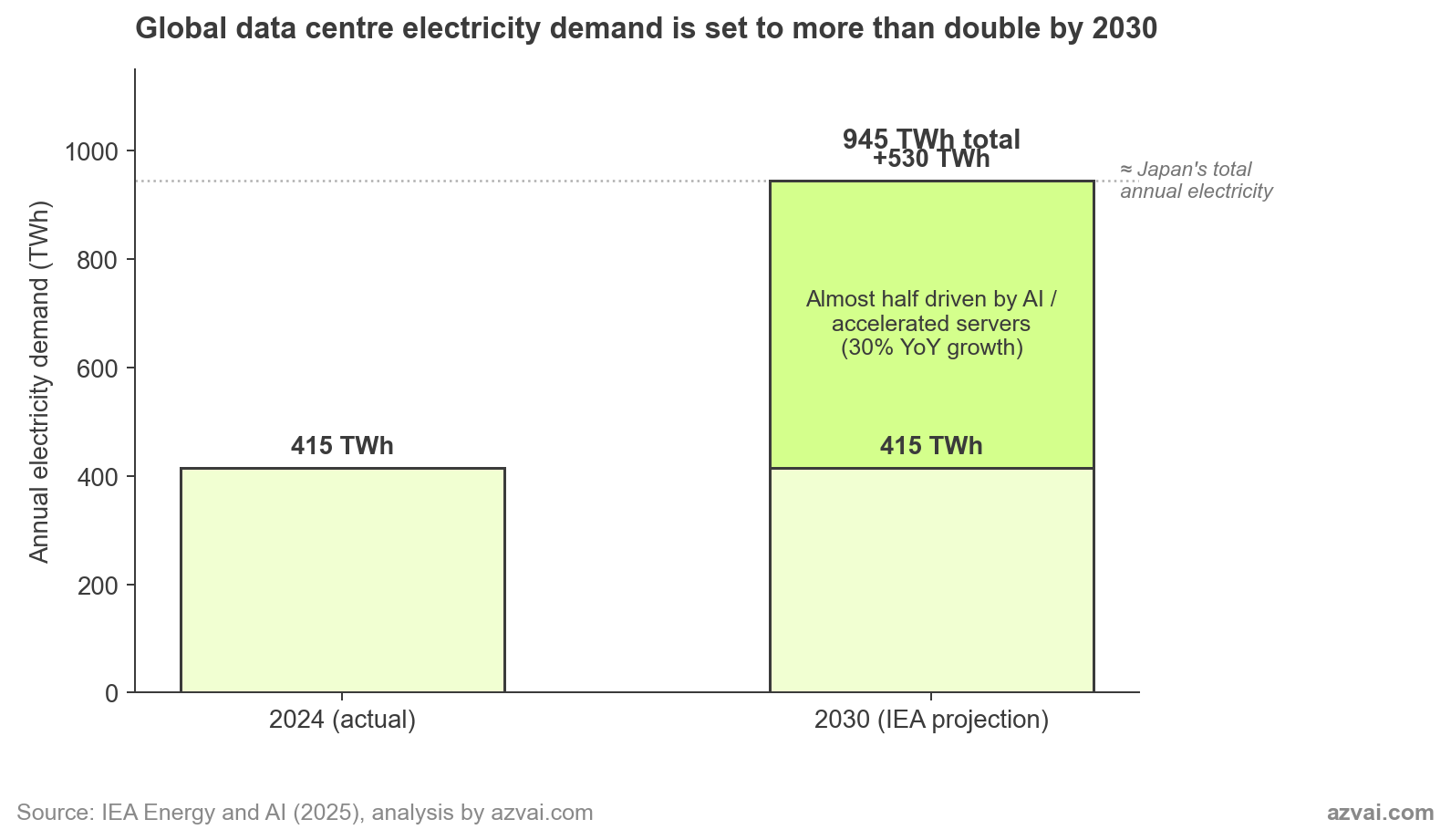
Anthropic’s S-1 describes the same dynamic from the inside. More than $600 billion of compute, some of it on new gas generation, will outweigh any plausible gain in efficiency per query. A model that uses 30% less energy per answer, running in a new gas-powered facility that did not exist before, adds emissions that the same workload on an existing wind-powered site would not.
Even the companies that publish leave gaps. A 2025 analysis in Patterns of thirteen AI developers found that ten disclosed none of the model-level environmental metrics a buyer would need. A February 2026 review by Beyond Fossil Fuels and Stand.earth found that 74% of Big Tech’s claims about AI’s climate benefits were unproven. Google and Microsoft set the bar for disclosure among the companies Anthropic depends on, and that bar still sits below what the field needs.
When Anthropic’s First Emissions Figures Are Likely to Appear
The IPO will not force Anthropic to publish emissions. The SEC voted in March 2025 to end its defence of the federal climate disclosure rules, so what goes into an S-1 on climate is the company’s own judgement of what is material. The pressure comes from state and foreign law, and the S-1 says so.
Its ESG risk factor (p. 103) states that compliance with “California legislation that requires various climate-related disclosures”, the EU’s Corporate Sustainability Reporting Directive and Corporate Sustainability Due Diligence Directive, and the UK’s Streamlined Energy and Carbon Reporting framework “will require the dedication of significant time and resources”. The same page names public concern about “the power-intensive nature of the industry” and “high consumption of water” as reasons some investors may stay away.
California’s SB 253 is the nearest trigger. According to the California Air Resources Board, it requires US companies with more than $1 billion in annual revenue that do business in California to report Scope 1 and 2 emissions from 2026 and Scope 3 from 2027. The first reports are due by 10 November 2026. CARB’s September 2026 guidance for that first cycle, though, says companies that were not collecting emissions data when it issued its enforcement notice in December 2024 are not expected to report this year, and can file a statement of non-reporting instead. Anthropic reported $4.6 billion in revenue for 2025 (S-1, p. 22) and is headquartered in San Francisco, well above the threshold. Whether it was measuring its emissions in December 2024 is not public, so its first figures may only come in the 2027 cycle, when Scope 3 reporting also begins.
Three documents are worth watching over the next year. The amended S-1/A, which will fill in the blanks and may sharpen the risk language. Anthropic’s first SB 253 submission, which will show whether it reports figures this year or files a statement of non-reporting. And its first annual report as a listed company, where any sustainability goals it sets become claims it can be held to.
Five Questions to Ask Any AI Vendor
Most enterprise AI procurement still has no sustainability section. These are the questions I add, and they work for Anthropic, OpenAI, Google or anyone else.
- Do you publish Scope 1, 2 and 3 emissions with third-party assurance? For Anthropic today the answer is no, and California’s law will eventually require at least Scope 1 and 2.
- Where will my workload run, and what powers those facilities? Ask specifically about on-site gas generation. Anthropic’s S-1 confirms some planned sites use it and names none.
- How much water do those facilities use, and in which river basins? A risk factor is not a volume.
- Do you publish energy per model, or per thousand tokens? Without it, choosing the smaller model is the only lever you can be sure of.
- What climate target do you hold, and how does your compute growth fit inside it? Carbon removal purchases belong in the answer only after reductions.
Asked of the major AI labs today, most of these get “no” or “not yet”. That is still a useful result. It makes the gap visible in the procurement file, documents the trade-off the client is accepting, and tells the vendor which questions will keep coming back.
What Good Disclosure Would Look Like
Criticising a gap is easy, so here is the bar I would hold any AI lab to. None of it is technically difficult, and Google and Microsoft already publish most of it.
- Annual Scope 1, 2 and 3 emissions, assured by a third party and reported under the GHG Protocol.
- Energy, water and carbon per model, for training and for inference, updated when models change.
- The power mix by facility, separating on-site gas, grid supply, direct renewable contracts and certificates.
- A time-bound climate target that covers value-chain emissions and explains how growth in compute fits inside it.
- Environmental disclosure alongside major compute deals, so the footprint of a $100 billion agreement is not left for journalists and law centres to estimate.
The S-1 shows that Anthropic already tracks the inputs. A company that can describe its gas pass-through terms, its water risks and its commitments to ratepayers in a securities filing has the data to count its emissions. Publishing them is a choice, and California’s law will make part of that choice for it.
Where I’ve Landed
I keep using Claude. The reasoning quality is real, and for consulting work I think the case for using AI well is stronger than the case for refusing it on environmental grounds, given what consultants substitute for it in practice. I also think Anthropic’s environmental disclosure is far weaker than its scale can excuse, and the S-1 confirms the footprint behind it is growing fast and includes new gas generation. Both views hold at once.
In practice, it comes down to five habits.
- Use less. Tighter prompts, clearer goals and fewer rounds of revision. It is the most ignored lever and the fastest.
- Cache and batch. Prompt caching, skills, sub-agents and programmatic charts cut compute by roughly half on sustained work, as I measured in how Claude Code skills cut AI energy use.
- Choose smaller models for routine tasks. Haiku for triage, Sonnet for synthesis, the largest models only when the reasoning needs them, and agentic sessions only when the task justifies them.
- Put disclosure on the procurement checklist. As a data point in every AI tool selection I advise on. If Anthropic wants to be the default for sustainability work, disclosure is a fair price.
- Stay willing to switch. If a lab of comparable quality publishes assured emissions and a credible target, my default changes.
For clients in sustainability-heavy sectors I add one thing. Name the vendor disclosure gap explicitly in any AI procurement memo, with the S-1 page references. The question will come from a board or a sustainability team eventually, and it is easier to answer when the gap was documented from the start.
Frequently Asked Questions
Does Anthropic have a sustainability report?
No. Anthropic publishes no sustainability, ESG or climate report, and its 2026 Public Benefit Report does not cover the environment. The closest primary source is its Form S-1 of 26 October 2026, which describes environmental risks without any figures.
What is Anthropic’s environmental impact?
Nobody outside the company can quantify it. The S-1 shows more than $600 billion in compute commitments, planned data centres with on-site gas generation, and cooling water in regions where it is scarce, but reports no emissions, energy or water totals.
How much energy does a Claude prompt use?
Anthropic does not say. Sustainable AI Group’s CLEER dataset estimated about 1.6 Wh for a typical chat with Claude Opus 5 and about 43 Wh for a typical agentic session in September 2026. Those are estimates for one model generation.
Is Anthropic carbon neutral?
No. Anthropic makes no carbon-neutral or net-zero claim and has no published climate target. It buys permanent carbon removal through Frontier, in an amount it has not disclosed.
The companion pieces cover ground this one does not. The same audit applied to xAI reads the SpaceX S-1 and the Colossus data centres. The ChatGPT and OpenAI audit covers Stargate. The Anthropic Economic Index analysis looks at how sustainability consultants actually use Claude. And the CSRD workflow piece shows what a Claude-based compliance setup looks like when it has to survive limited assurance.
Using AI in sustainability work, without the greenwash. I run these footprint audits with the same rigour I bring to a materials audit, and I use these tools every day in circular-economy consulting. If your team is working out where AI actually fits, and where it does not, that is the work I do. See how I work.
