

AI training for leadership teams is a short, hands-on programme that does two things. It gives the executive team the judgment to decide what to delegate to AI, how to check what comes back and which risks to govern, and it starts the system through which the whole organisation learns to use it. The second job is the one most providers leave out, and it decides whether a good workshop turns into an adoption that lasts.
Anthropic’s usage data shows why the first job matters as much as it does. When executives use Claude, they hand the work over more readily than the average user, and they almost never ask the model to check anything. The habits are forming already, without anyone designing them.
This article explains how to design a leadership programme that builds those habits well, what it should include, what can wait, and how to measure it. It draws on a decade deploying training and continuous-improvement systems inside large industrial and energy companies, and more recently on rebuilding my own consulting practice around AI-augmented workflows. It also draws on a conviction learned in that work. Systems that last are cultivated more than they are installed, closer to gardening than to engineering.
Key takeaways
- AI adoption is a complex problem. Nobody knows the best uses in advance, so you explore with small experiments and amplify what works.
- Leaders already delegate to AI. Chief executives hand Claude 53% of their conversations, above the 49% average, and ask it to check their work in only 4%.
- Checking has to be designed into the workflow. Source checks, required citations and a second review make delegation safe, because people rarely add them on their own.
- Leadership designs the learning system. Vision and governance flow down, experimentation flows up, and knowledge circulates across teams.
- Training happens on real tasks and real tools. The workshop is the catalyst and the workplace is the classroom.
Complex, not complicated
A jet engine is complicated. It has thousands of parts, but an expert can understand it, repair it and predict its behaviour. A market, an ecosystem, or an organisation adopting a new technology is complex. The behaviour of the whole emerges from thousands of interactions, nobody holds the full blueprint, and solutions can only be discovered by probing. The distinction comes from systems thinking and complexity science, fields whose practical tools I’ve written about elsewhere, and the working consequence fits in one line. Complicated problems get planned; complex ones get explored.
Most corporate AI training treats the second kind as the first. A standard course is bought, delivered identically to everyone, the company is declared “trained on AI”, and two months later little has changed. The generic knowledge never connected to anyone’s real work, and nobody designed the system that turns individual discoveries into collective capability.
For a leadership team, the useful question is whether the experimentation already happening in the company has a perimeter, shared learning and an owner. The data on how leaders themselves use AI is a good place to start.
What leaders actually do with AI
Anthropic’s Economic Index maps a large sample of Claude conversations to the occupation whose work they most resemble. Its June 2026 release adds what each conversation produces, how the work was shared between person and model, and how long the task would take with and without AI. I read the May 2026 data for the main leadership roles, with April as a check, using the same dataset behind my analysis of AI use in sustainability consulting.
Management work is 7.2% of US jobs (BLS, May 2025) and 5.9% of Claude.ai usage, so leadership as a whole is slightly under-represented. General and operations managers, the largest management group, hold 2.3% of US jobs and appear in only 0.21% of usage. Chief executives run a little above their weight. When leaders do use it, four patterns stand out.
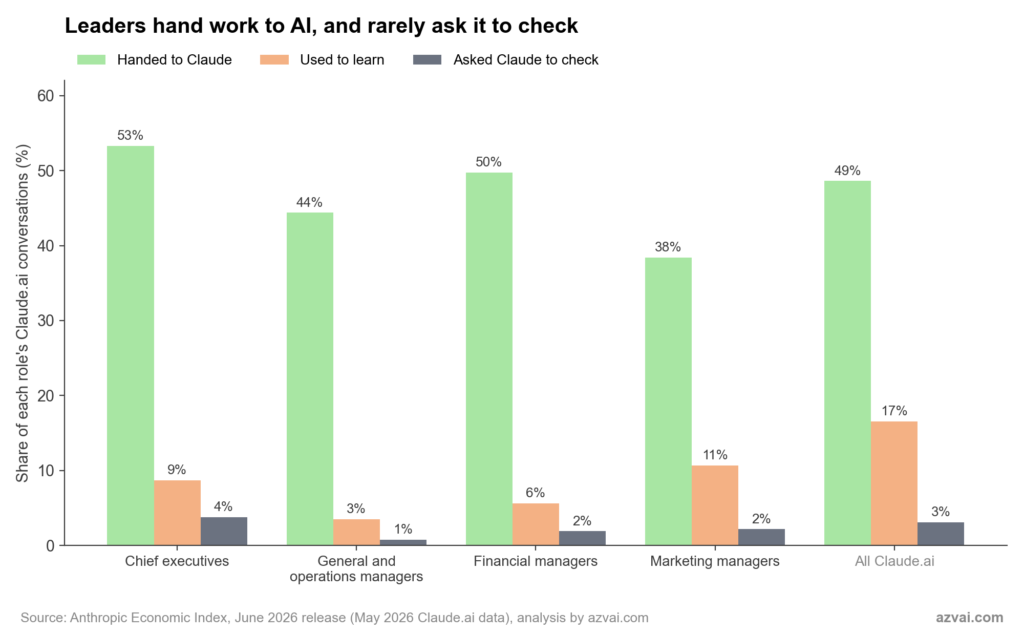
| Role | Main outputs | Handed to Claude | Asked to check | Used to learn | Faster with AI |
|---|---|---|---|---|---|
| Chief executives | Reports 26%, analyses 21%, plans 8%, charts 7% | 53% | 4% | 9% | 10x |
| General and operations managers | Plans and strategy 27%, marketing content 20%, reports 17% | 44% | 1% | 3% | 9x |
| Financial managers | Spreadsheets 23%, reports 21%, analyses 14% | 50% | 2% | 6% | 9x |
| Marketing managers | Plans and strategy 29%, reports 20% | 38% | 2% | 11% | 10x |
| All Claude.ai | Explanations 17%, reports 15% | 49% | 3% | 17% | 7x |
- Leaders delegate production. Reports, analyses, plans and spreadsheets are what executives bring to AI, and chief executives hand over 53% of those conversations. A task that would take an estimated 7 hours alone comes back in about 40 minutes.
- Almost nobody asks the model to check. Validation, where the person asks AI to review work they produced, is 3% of all Claude.ai conversations, 4% for chief executives and under 1% for general managers.
- Leaders rarely use AI to learn. Learning conversations are 17% of all usage, 9% for chief executives and 3% for general managers.
- Managers pile tasks into one conversation. 41% of general-manager conversations mix more than one task, against 23% across Claude.ai.
These patterns are solid for the roles shown, and the April data is almost identical. They describe Claude usage only, and the occupation label describes the work in a conversation, so a manager writing an email may be counted under another role.
Read together, the four patterns describe a leadership team that already delegates, checks little, learns little from the tool, and works in long mixed conversations. Each one points at something a programme has to build. The first is the system around the individual habits.
Leadership’s role in a system that learns
If adoption is exploration, leadership’s role is to design the conditions under which the organisation explores well. That comes down to three flows that have to start moving at the same time.
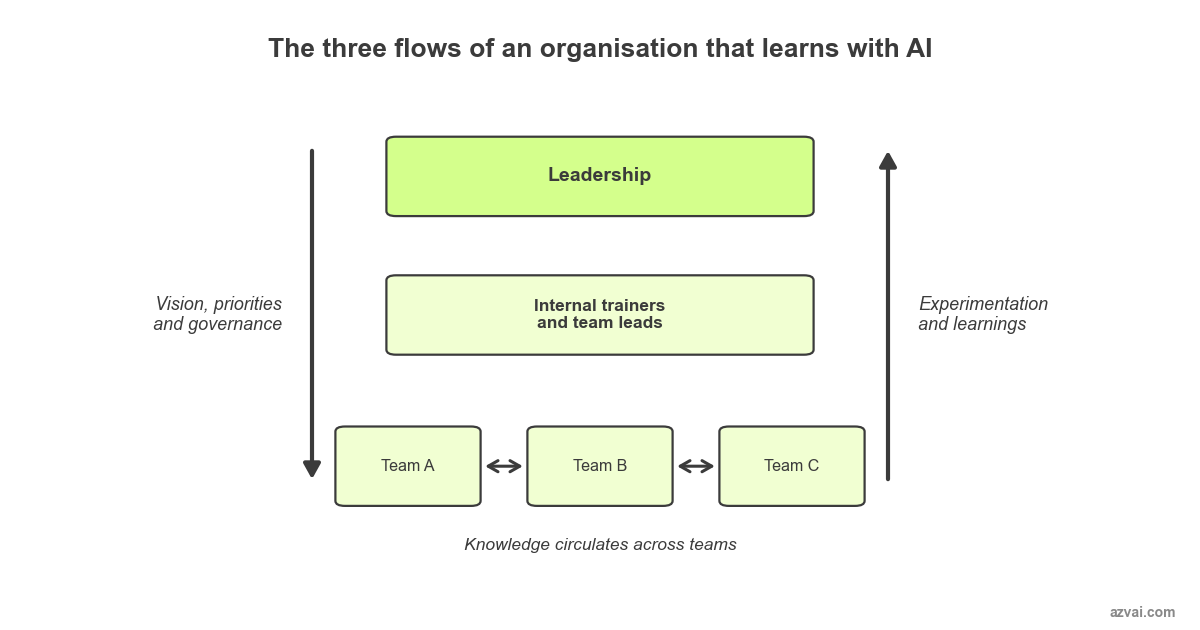
Top-down, vision and governance. Leadership defines what the company adopts AI for, what the priorities are, and which rules protect what must not be put at risk. Which data never leaves the company, which tools are approved, which decisions require human review. Designed well, this flow is the perimeter that makes the freedom of the other two safe.
Bottom-up, experimentation. The people who do a task every day know it best, so the valuable discoveries tend to come from the teams. The system needs experiments that are small, cheap and reversible, with explicit permission for some to fail. Leadership creates the conditions, watches the results, and amplifies what demonstrates value.
Sideways, knowledge that circulates. The biggest waste I’ve seen in real adoptions is the discovery that stays in the team that made it. A workflow that saves hours in one area usually transfers, with adjustments, to three others. Internal trainers, cross-team reviews and a shared library of working workflows turn local discoveries into organisational capability.
The three flows need each other. Vision without experimentation produces plans that age before they are applied. Experimentation without a perimeter accumulates risk in silence. And both without sideways circulation produce islands of excellence in an organisation that, as a whole, learns nothing.
What the leadership programme should include
A map of real workflows, step by step
Before anyone sits in a room, the team’s recurring work is mapped. Board papers, investment and bid screening, contract variations, permit files, regulatory monitoring, stakeholder communications. Each workflow is broken into steps, and each step gets an action type. AI does it, AI drafts and a person checks, or a person does it. A simple priority matrix (value against effort) then picks the first two or three workflows to work on.
This is where judgment about delegation becomes concrete. The data shows leaders already hand over half their AI work, so the skill that matters is choosing which steps to hand over and how to review them. That judgment transfers to every later decision, and it outlasts any particular tool.
Practice on real tasks, with the company’s own tools
The practice runs on those documents and those decisions, inside the tools the company already pays for, from the first session. Textbook examples are forgotten in a week. A board paper drafted in the team’s own environment is still in use a month later. This is also why the training has to come from someone who uses these tools in their own daily work. In my case, the sustainability research workflows I run are published and open, and the training draws directly on them.
Reusable instructions and checks built into the flow
Two building blocks turn good individual use into dependable team use. The first is reusable instructions (often called skills) for recurring tasks, so a board paper or a contract review starts from the same tested brief every time. They also fix the long mixed conversations the data shows, because each recurring task gets its own clean starting point.
The second is checks inside the workflow. With only 3% of conversations asking AI to review anything, checking will not happen by habit. It has to be part of the design. Source verification, required citations for every factual claim, and a second review by a person or a separate AI pass are simple to set up and catch most of the errors that damage trust. Agents that work on the company’s own documents make both building blocks more useful, and they make the perimeter below more important.
The governance perimeter, including the environmental ledger
Confidentiality, factual errors, bias and traceability are operational risks, and clear rules govern them well. The programme produces the perimeter inside which teams can experiment without case-by-case permission.
For companies operating in or selling into the EU, there is also an external obligation worth knowing. Since 2 February 2025, Article 4 of Regulation (EU) 2024/1689 requires organisations using AI systems to take measures to ensure, to their best extent, a sufficient level of AI literacy in their staff.
A serious perimeter also has an environmental side, where most AI training is silent. Two questions belong on the leadership agenda. First, what does our AI use cost in energy and carbon, and can workflow design reduce it? In my own practice, architecture choices like skills, caching and context isolation cut compute by roughly half on sustained work. Second, what do our vendors disclose about their own footprint? I’ve written an honest audit of what Anthropic discloses and what it doesn’t, which shows the kind of questions worth asking any vendor. A leadership team that asks them builds an adoption it can defend to its board, its clients and its own sustainability commitments.
Leaders as learners, and the design of the learning system
Leaders use AI to learn far less than everyone else (9% of chief-executive conversations against 17% overall). The programme builds that habit on purpose, because leaders who use AI to get up to speed on a regulation or a market set the example the rest of the organisation follows.
The programme also ends with the system running. Which two or three experiments launch and in which areas, who leads them, which internal trainers are developed to accompany and replicate, at what rhythm results are reviewed, and through which channel learnings circulate. That part turns the training into the start of a system that keeps working when the trainer has left.
What a programme looks like in practice
For a leadership team of a mid-sized company, a shape that works runs about eight weeks.
- Diagnosis (weeks 1 and 2). Processes, tools and priorities, mapped with the team.
- Workshop 1, foundations and opportunities. Strengths and limits of generative AI, how to prevent and correct errors, the capabilities already available in the company’s tools, and the workflow map with an action type per step and a priority matrix.
- Workshop 2, skills, agents and checks. Reusable instructions for recurring tasks, agents working on company documents, and checks inside the flows. Participants bring the exercises they ran between sessions.
- Workshop 3, results and strategy. Results from the first workflows, how to review and adapt them as models change, which automations and projects are worth evaluating, usage rules and compliance, and the roadmap for training the rest of the staff.
- Final report. Diagnosis, results and a prioritised roadmap.
The workshops are spaced about two weeks apart, with short follow-ups in between, because a new working habit needs weeks of practice on real work to settle.
What can wait
- Advanced prompt technique. It belongs in practitioner training, later, inside the experiments, for the people who need it.
- Exhaustive platform comparisons. The market changes every quarter. The programme builds the judgment to evaluate tools, which lasts longer than any market snapshot.
- Theory of how the models work. An executive needs to understand AI’s failure modes. The internal architecture can stay with the specialists.
- Detailed twelve-month roadmaps. In complex terrain, the detailed plan is a comforting fiction. The roadmap sets priorities and the next cycle, and each cycle’s results shape the one after.
- Days of slides. Habits form through practice on real work between sessions, so every workshop is hands-on.
Deployment, in cycles that learn
The deployment that follows uses a model I know well from continuous-improvement implementations in large organisations. A small group of leaders is trained, each one implements with their own team on real work, and an internal trainer co-facilitates from the first cycle so they can lead the following ones. The knowledge stays in the company, and each cycle costs less than the one before.
The cascade carries the downward flow, and each cycle must feed the other two as well. The teams implementing discover uses nobody predicted, and those discoveries travel up through cycle reviews and jump across areas through the internal trainers and the shared workflow library. The review that closes each cycle takes one of three decisions for every experiment. Amplify what works, correct what is promising, and retire without drama what did not demonstrate value. The cheap failure of a small experiment is part of the cost of learning.
In practice, cycles run three to four months for a mid-sized company, because a new working habit needs weeks of accompanied practice to consolidate. The rhythm of the system follows the rhythm of the people in it.
How to measure a system that learns
Workshop satisfaction is almost always high and tells you little. The honest metrics measure behaviour and flow.
- How many of the piloted workflows are still in use three months later.
- How many of them carry a built-in check, and how many errors those checks caught.
- How many experiments were launched from below, and how many died fast and cheap, which is a sign of health.
- How many discoveries from one area were reused in another.
- How many people have come through the internal cascade without the provider in the room.
- Whether the organisation can show, to anyone who asks, that its staff understand the tools they use, and, if sustainability commitments matter to you, what compute the adoption consumes.
If you are considering an AI training plan for your leadership team, or wondering whether your organisation’s AI use could be more deliberate, get in touch about your case. The research side of this practice is described in AI for sustainability research.
Frequently asked questions
How do executives actually use AI today?
In Anthropic’s June 2026 usage data, chief executives mostly use Claude to produce reports (26% of their conversations), analyses (21%), plans, charts and spreadsheets, and they hand 53% of that work to the model, above the 49% average. They ask the model to check their work in 4% of conversations and use it to learn in 9%, against 17% across all users. General and operations managers lean towards plans, strategy and marketing content.
Is AI training mandatory for companies?
For organisations using AI systems in or into the EU, Article 4 of Regulation (EU) 2024/1689 has required since February 2025 that they take measures to ensure, to their best extent, a sufficient level of AI literacy in their staff, according to their context and the systems they use. It does not mandate a specific course format, and it makes AI literacy an organisational obligation. The UK has no direct equivalent yet, but UK companies operating in EU markets fall within the regulation’s reach for those activities.
How long does leadership AI training take?
About eight weeks for the leadership programme itself. That covers a two-week diagnosis, three hands-on workshops spaced about two weeks apart with exercises in between, and a final report with a roadmap. The wider deployment then runs in cycles of three to four months. Be wary of programmes that begin and end in the room.
How do you encourage experimentation without losing control?
With a clear perimeter and checks built into the workflows. Define which data never leaves the company, which tools are approved and which decisions require human review, and inside that perimeter teams are free to probe. Experiments stay small and reversible, and they are shared in regular reviews so the learning reaches leadership and what works gets amplified. Control lives in the design of the perimeter and in watching the results.
Should sustainability-minded organisations use AI at all, given its footprint?
Use it honestly or not at all. The footprint is real, the vendor disclosure gap is real, and pretending otherwise undermines the credibility of everything else a sustainability-committed organisation says. In practice that means three things. Choose workflows that cut compute, ask vendors the disclosure questions, and count the AI ledger inside your own environmental accounting. An organisation doing those three things can defend its AI use.
When do technical teams come in?
After leadership, inside the first experiments. Once the priority workflows are decided and the governance perimeter exists, practitioner training has context, purpose and clear limits. In the reverse order you usually get plenty of scattered individual experimentation and very little organised capability.