

Most circular economy projects fail before launch because nobody mapped the system. The successful ones get tested again after launch, when the material starts looking valuable to outsiders. This article is about both phases.
In 2021 and 2022 I worked with the Government of Seychelles on the ReNeT project, a circular economy initiative for end-of-life fishing nets from the industrial tuna purse-seine fleet operating out of Port Victoria. The work was funded under the Republic of Seychelles’ Blue Economy framework and project-managed by Azvai.
The output of that work eventually became Brikole Ltd, a Seychellois company that today handles end-of-life nets, ropes and floats from the French and Spanish purse-seine fleets and ships the recovered material onward for recycling. The first shipment of 50 tonnes left Port Victoria in August 2022. The material eventually finds its way into products as varied as upholstery fabric for Japanese office furniture.
This article is not a project case study. It is a methodology piece that happens to use a real engagement as illustration. The questions, the diagnostic, the design choices and the cost structure all generalise to other circular economy interventions. If you’re working on one, the parts worth taking are the method.
Why Most Circular Economy Projects Stall
The temptation, when you walk into a circular economy brief, is to start designing solutions immediately. A processing plant. A take-back scheme. A new product line. Something tangible to point at.
The first thing the Seychelles work taught me was how much that instinct gets in the way. Almost every dysfunction we found in the fishing-net system was caused by something invisible, not something missing. Ownership ambiguity. No traceability. Storage incentives that nobody questioned. A regulatory gap that nobody felt responsible for. None of these have a hardware solution. None of them disappear when you build a plant.
The default failure mode of circular initiatives is to build the thing without first mapping the system the thing has to survive inside.
That’s what the diagnostic phase is for, and it is the phase most projects skip.
The Five-Question Diagnostic
Before you design any intervention, you need answers to five questions. These came out of the Seychelles work but I’ve used variations of them since on other circular economy briefs. They are deceptively simple. The depth comes from how thoroughly you answer them.
- Where does the material come from, and who actually owns it at each stage? Ownership is the first thing that breaks. In Seychelles, fishing nets passed through vessel owners, port agents, net repairers, and informal community uses, with no clear handover protocol. Material went missing. Some was sold. Some sat in the yard for years.
- What stops the material from moving to its highest-value next use? This is not always price. In the fishing-net case, the binding constraint was logistics, not economics. Export containers were sent to Europe full of un-processed bulk material at low transport efficiency, locking in low margins regardless of who bought it.
- Where is value being lost or destroyed, and to whom? Map the value leaks. We found leaks at five stages of the chain. The most consequential one was that virtually all the margin available in the material was being captured outside Seychelles, leaving the host country with the cost of storing the waste but none of the upside of processing it.
- What is the governance gap? Almost every circular economy intervention runs into a regulatory or governance gap that the existing rules don’t address. In Seychelles, there was no waste-management policy for the fishing industry, no recycling regulations, no extended-producer-responsibility framework for electronic buoys or floats. Without these, individual companies had no incentive to participate.
- What does the end-of-life look like, and who certifies it? A circular system is only as good as its weakest end-of-life path. If nets are exported but you don’t know which recycler receives them or to what standard, you have an open loop dressed up as a closed one.
The first three questions you can answer by going to the site and asking. The last two need conversations with the government and with potential downstream buyers. There is no shortcut.
Mapping the Current System
The first deliverable on the Seychelles project was a system map of the existing state. Not a process flow. A system map. Every actor and material flow visible at once, with the dysfunctions named on the diagram itself.
What we found, when we mapped it carefully, was a system that looked superficially functional but contained five compounding problems.
The storage yard had become a sink, not a transit point. Discarded nets accumulated in the net-repair area at Port Victoria, taking up space that could have been used for value-adding activities. Stocks built up because there was no clear protocol for removal, and nobody owned the decision to clear them. The natural state of the yard was full, not empty.

Material identity was being lost. Nets, ropes, floats and chains were intermingled in storage. Owner identity was unclear once a net had been discarded for a year or more. This made it impossible to negotiate with companies for waste-management agreements, because nobody could say which company’s material was sitting in any given pile.
The discard pattern produced environmental risk in itself. Cuts from net repair were left on the ground. Heavy rain washed plastic fragments toward the ocean. Floats sat in the sun and degraded. A storage facility intended as a buffer was producing pollution by inaction.
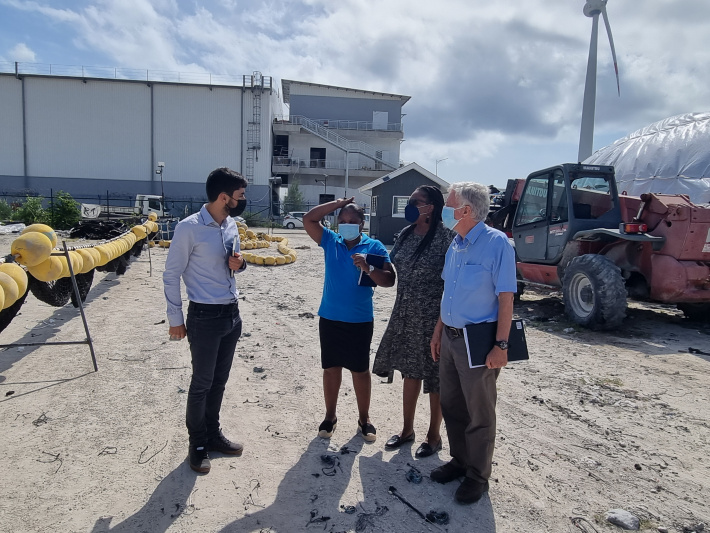
Existing reuse pathways were strong but isolated. The net repairers and community already had real circular practice. Nets were being repurposed as goal nets for football, as agricultural fencing, as coastal-erosion protection, as markers for marine parks. Some of these were ingenious. None of them were documented, communicated or scaled. The good practice was invisible.
Export was happening, but on the worst possible terms. Nets were being shipped to Europe in open-top containers, un-processed, in bulk. The shipping cost per tonne of useful material was high. The margin available at the European processor was correspondingly thin, and all of it was captured outside Seychelles.
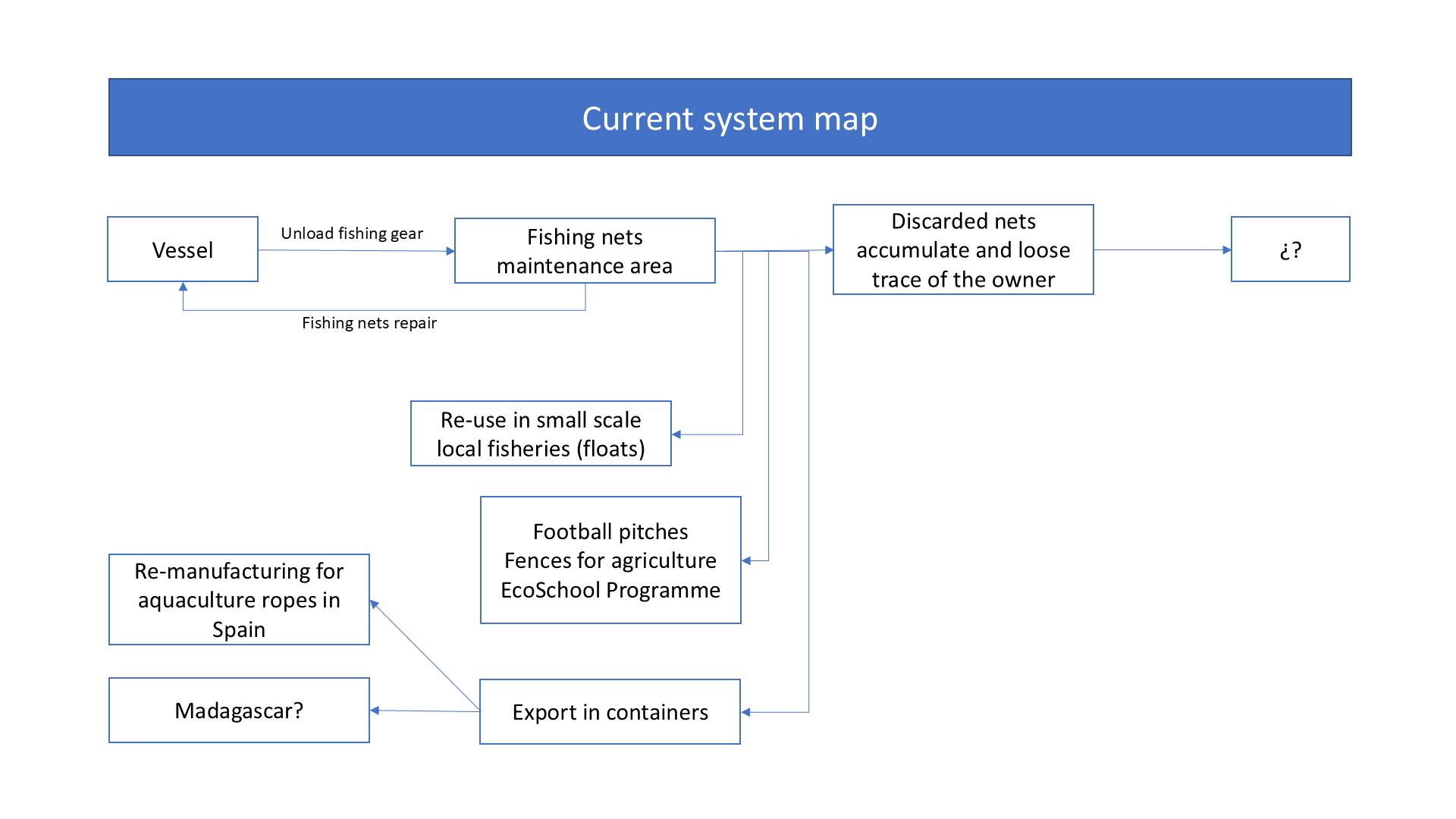
The system map made it visible that the problem was not “there is no recycling”. The problem was that recycling existed in fragments, none of which were optimised, and the host country was bearing the cost of a system whose upside was being captured elsewhere.
Designing the Future State
The intervention design followed the diagnostic, not the other way around. Once you’ve drawn the system honestly, the leverage points become much easier to see.
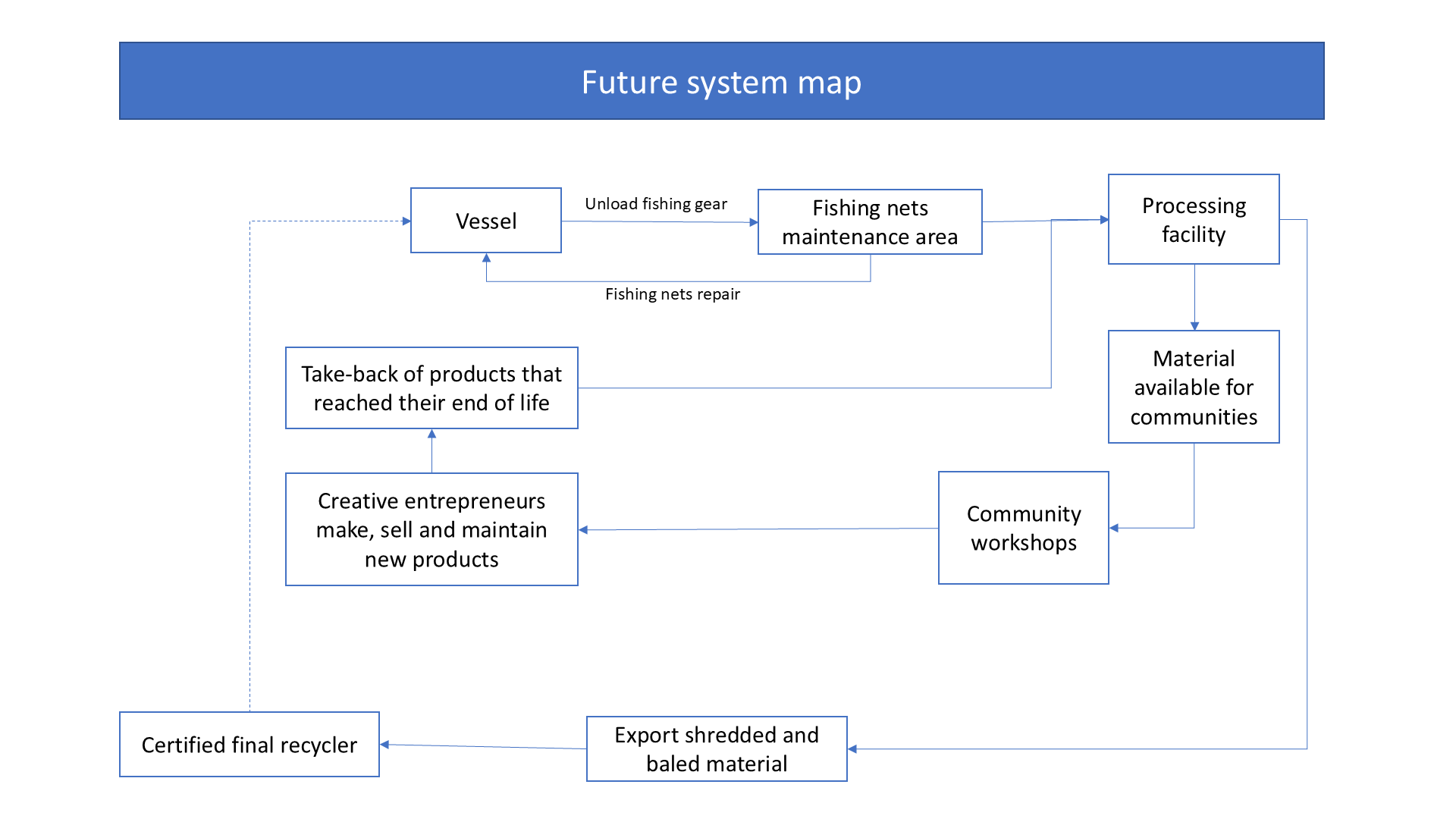
The future state we proposed had four components, designed to be deployed in sequence, not in parallel.
First, fix the yard. Before the processing plant could be built, the existing net-repair yard needed Lean Manufacturing principles applied. Reparation lanes. Allowed stocks of usable nets only. Material clearly tagged with owner, age and condition. Containers labelled for separate collection of nets, ropes, floats and chain. A simple traceability system. Concrete floors and waste-separation rules to prevent fragments reaching the ocean. None of this required heavy investment. It required clear rules and the political will to enforce them.
Second, build a processing facility. A facility for cleaning, shredding and baling the material so it could be exported in a value-added form rather than in bulk. Conservative sizing assumptions. Processing efficiency targets of 85% for nets and ropes and 40% for floats. Co-location adjacent to the net-repair yard to minimise internal logistics. Solar power. Water re-use. Pre-arranged off-take agreements with certified European recyclers.
Third, formalise community access to a defined share of the material. The community already had circular uses for the nets. The design preserved that. A defined percentage of incoming material would be set aside for community workshops, with the processing facility (not the net-repair yard) managing access. Training programmes around entrepreneurship, material science and product design, with access to equipment and space, to convert the existing informal practice into actual small businesses.
Fourth, close the loop on the materials the facility couldn’t handle. Yellow floats had no obvious recycling route at the time. Electronic buoys needed an Extended Producer Responsibility framework. Chain was already being collected by scrap-metal dealers. Each of these required a different governance solution, not a technical one.
The design was explicit about sequencing. The yard had to be fixed before the facility could be tendered. The facility had to be operational before community access could be formalised at scale. The governance solutions for floats and electronics ran in parallel and depended on legislative action.
Gardening, Not Engineering
Before we get to the numbers, there’s a deeper observation about how this kind of work actually changes a system. In the language of systems thinking, what we were doing in Seychelles is a form of action research. The act of engaging stakeholders in a structured conversation about the system is itself part of the change, not just preparation for it.
This works because shared awareness is the precondition for shared movement. When the net repairers, the fishing authority, the ministry, the community groups and the entrepreneurs all sat in the same room looking at the same map of dysfunctions, something happened that didn’t depend on the future facility being built. A common language emerged. Each stakeholder began to see their own role in the system rather than just their own corner of it. Quiet bilateral conversations started happening that the original design hadn’t anticipated.
Some of those changes followed the design we’d proposed. Others didn’t, and emerged in their own direction. That’s a feature, not a bug. Systems change is less like engineering and more like gardening. You don’t control the precise outcomes. You raise awareness, identify leverage points, plant a few interventions, and stay comfortable with what comes next. The garden ends up more abundant than the planting plan.
That’s part of why I’m wary of consulting frames that promise “implementation” as if circular economy interventions follow a project-management template. They sometimes do. They often don’t. The honest work is to design with enough rigour that the system can absorb surprises, and with enough humility to recognise the surprises as new information rather than failures of control.
If I were doing this work today with the AI tools that didn’t exist in 2021, the place AI would change the practice is on the desk side rather than the field side. Faster synthesis of stakeholder notes. Tidier comparative analysis between recommendations and what’s been done elsewhere. Quicker turnaround on draft reports. None of that replaces sitting in the net-repair yard with the people who actually move the material. It just frees more of the engagement budget for the part of the work that actually does the change.
Making the Numbers Work
A circular economy project that doesn’t pencil out doesn’t get built. Half the work in any system design like this is in the financial model, not the process design.
For the Seychelles facility we built a three-year financial model with conservative assumptions on material capture (25% in year one, 65% in year two, 95% in year three), realistic local costs for energy, labour and shipping, and Seychelles-specific corporate tax. The headline figures from that model, rounded for general use, gave a payback period of under two years and an internal rate of return that was strong enough to attract private capital alongside government land concession and strategic-partner contributions.
The structural insight from the modelling, more useful than the specific numbers, was this. A circular processing facility of this kind has high operational leverage and low marginal cost. The first 25% of capacity utilisation covers most of the fixed costs. Once the facility is operating, additional throughput contributes mostly to margin. This means the binding constraint on viability is almost always material supply, not market price for the processed output.
Which connects directly back to the diagnostic. Without governance agreements that guarantee material flow, the financial model doesn’t survive contact with year two. With those agreements, the model is robust to a wide range of price assumptions.
Most circular economy projects, in my experience, spend too much time on the technology side of the model and not enough on the material-supply side. The technology choices matter, but they are knowable and bounded. The supply side has political, regulatory and cultural variables that take longer to lock in and produce most of the project risk.
What Worked, and the One Thing That Surprised Us
Looking back at the work four years later, the design largely held. The diagnostic produced the right map. The intervention sequence worked. Brikole was set up, the first shipments left Port Victoria, the recovered material found its way into premium downstream products. The financial model proved roughly correct in its assumptions.
What worked best methodologically was spending the first three days of the engagement entirely on stakeholder conversations without proposing anything. By the time we sat down to design, we knew who would block what and who would champion what. The system map was correct on the first iteration because it had already been validated informally during the visit.
The other thing that worked was framing the community workshops as a defined-share carve-out rather than an afterthought. Most circular projects treat the community as a beneficiary or a stakeholder. The Seychelles design treated the community as a co-equal user of the material with a permanent share. That shifted the political conversation entirely and turned local groups into advocates rather than petitioners.
The one thing that surprised us came later. Once the fishing companies began to see the value of the recovered material in concrete terms, several started exploring whether they could sell their nets directly to European buyers, bypassing the Seychellois processing arrangement. That instinct was rational from their point of view. The material had value. They owned it. Why not capture the margin?
The reason this was a problem, and not just a competitive market dynamic, is that fragmented direct sales would have undone the economic logic of the entire system. Bulk export from individual companies recreates exactly the inefficiency the diagnostic had identified in the first place. Containers full of un-processed nets. Margin captured outside the country. No local jobs. No traceable end-of-life. No community share. The aggregation that made the processing facility financially viable depended on the same aggregation the system was designed to capture.
The fix had two parts and is worth surfacing because it generalises.
The governance side. The regulatory framework around the port was made explicit. On-site or company-level waste processing of end-of-life nets was not permitted as an individual-company activity. The aggregated channel became the only legitimate route.
The economic side, which is the more interesting half. Storage at Port Victoria is expensive. Port land is scarce. Keeping nets on company storage was a real cost that participants had not been pricing properly. The processing facility offered something every company actually wanted, which was material that left their books quickly, in volume, with no storage liability and no compliance risk. Once that was framed clearly, the direct-sales temptation diminished. The aggregated route became preferable not because companies were forced into it, but because the alternative was costing them money they hadn’t been counting.
The generalisable lesson is this. A circular economy system that depends on voluntary aggregation will be tested as soon as the material starts looking valuable. Designs that survive that test do two things at once. They back the aggregation with a governance constraint that closes off the fragmented alternative, and they make sure the aggregated route is genuinely the cheapest option for individual participants. Either alone is fragile. Together they’re stable.
A Working Method Anyone Can Use
If you are designing a circular economy intervention, in any sector, the method that emerged from this work generalises as follows.
- Start with the diagnostic, not the solution. Spend the first 20% of the budget on understanding the existing system before proposing any intervention. The leverage points are almost never the ones that are obvious from the outside.
- Draw the system map honestly. Include the actors, the material flows, the value leaks and the governance gaps on one page. Get the map validated by every stakeholder before you design anything. If the map is wrong, every downstream decision is wrong.
- Identify the binding constraint on viability. For physical-material circular projects, this is almost always supply, not market or technology. Lock the supply side first.
- Sequence the intervention. Most circular designs try to deploy all elements in parallel. The Seychelles design worked because the yard fix preceded the facility, which preceded the community programme. Each phase made the next phase easier.
- Build the governance framework alongside the operational design. Treat the two as a single deliverable. Operational designs that depend on goodwill are fragile. Operational designs that have governance backing scale.
- Model the financials with conservative supply assumptions. The mistake is usually to underestimate the difficulty of locking in supply, and to overestimate technology risk by comparison.
- Plan for one or two pathways the facility can’t handle. Every circular system has residual flows that need parallel governance solutions. Don’t pretend they don’t exist.
- Design for the success scenario, not just the launch. Anticipate that once the material starts looking valuable to outsiders, individual participants will try to capture value directly. The aggregation logic that made the system viable needs both a governance constraint that closes off the fragmented alternative and a clear economic case that makes the aggregated route the cheapest for individual participants. Either alone is fragile.
The whole method takes about six to ten weeks of focused work for a project of this size, including stakeholder engagement, modelling and report-writing. The output is a system map, a future-state design, a financial model, a governance proposal and a sequenced implementation plan. None of these are exotic deliverables. The discipline is in not skipping straight to the third one.
The same methodology has been applied at different scales elsewhere. See Designing a Coastal City Waste System for the municipal version applied to plastic waste in coastal Indonesia, and Scaling a Take-Back Programme Across European Markets for the multi-market corporate take-back version.
How This Analysis Was Put Together
This article was written in 2026 from project materials produced in 2021 and 2022, including the original system maps, financial model and stakeholder consultation notes. The Seychelles project itself was conducted in person, with field visits to the Port Victoria net-repair area, stakeholder interviews across the fishing industry, government, NGO and community sectors, and follow-up modelling and design work done remotely.
In 2026 I rebuilt that financial model from the same folder using purpose-built tooling, grading each driver by the strength of the evidence behind it rather than taking the numbers as given. It surfaced four things the original review did not, three of which were already sitting in the project documents. That rebuild is written up in A Claude Code Skill That Builds, Researches and Stress Tests Business Models.
The synthesis and re-framing for this piece was supported by AI workflows of the kind I now write about at azvai.com. Specifically, project materials were re-read and summarised using Claude Code skills for structured-document extraction, with the original primary documents retained for reference. The methodology recommendations, the case analysis and the four-year retrospective are mine. The AI work was on the desk side of the desk, not the field side, which is the position on AI in sustainability work that I’ve come to hold.
Project context can be cross-checked in the ECO Magazine write-up and in Seychelles News Agency reporting from 2021, and in the 2022 partnership announcement between the Seychelles, OPAGAC and ORTHONGEL. The downstream material use in furniture fabric is documented by Okamura.
If you’re working on a circular economy initiative and the diagnostic phase feels like a luxury you can’t afford, that’s almost always a sign you’re heading for the failure mode this article describes. The diagnostic is the cheapest insurance you’ll buy on a project of this kind. Skip it at your cost.