

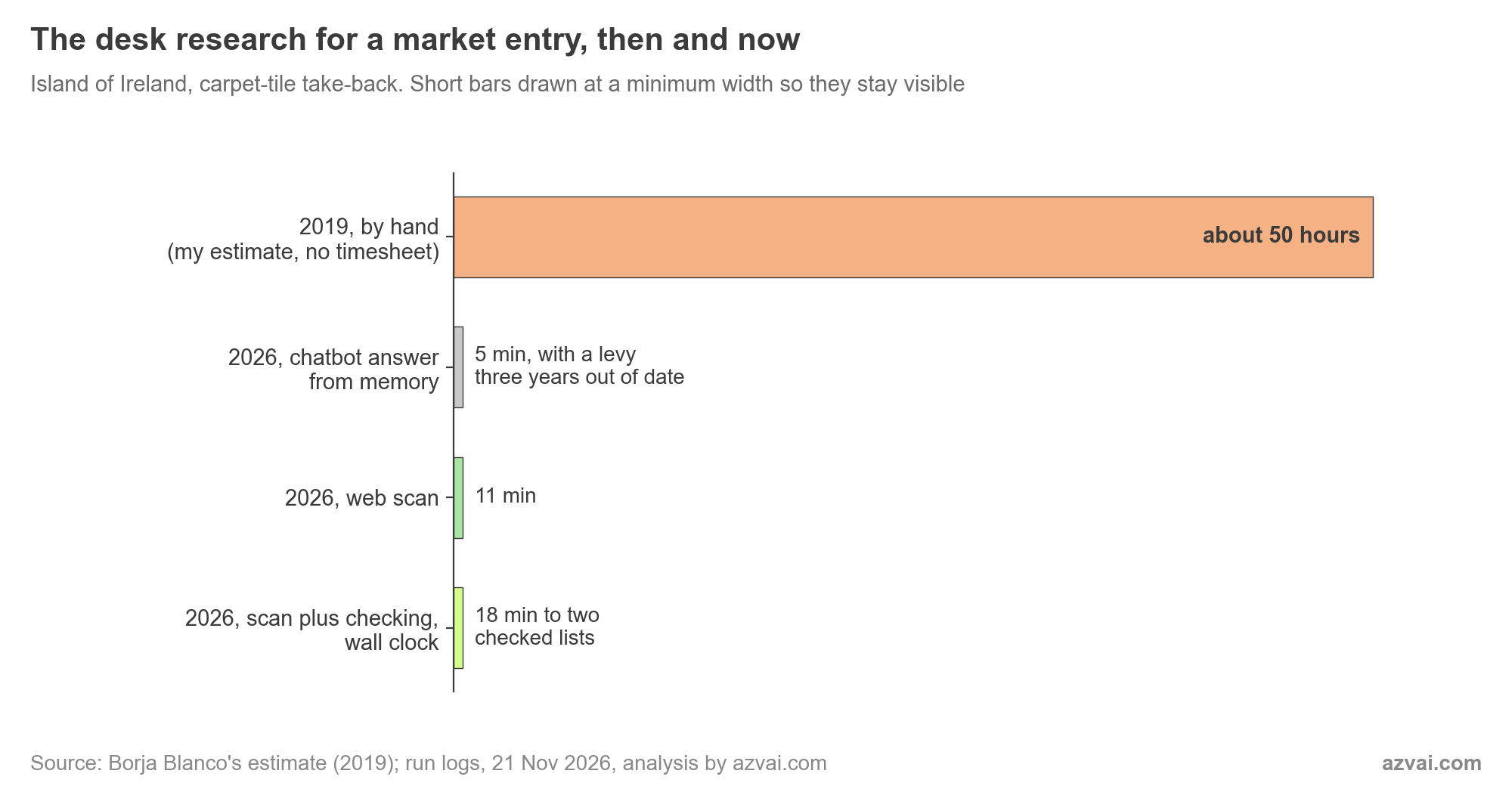
In early 2019 I led the Ireland relaunch of Interface ReEntry, the carpet-tile take-back scheme of the flooring maker Interface. Before launch, someone had to map the rules for used carpet tiles on the island, the permits a partner would need, who could take the tiles, what competitors offered and what disposal cost. By my own estimate, that desk work took about 50 hours.
On 21 November 2026 I gave the same desk research to Claude Code, for the island of Ireland as it stands today. I timed every run and checked every claim against the legal text, company registers and dated evidence.
The short answer is yes for the desk work, with checking built in.
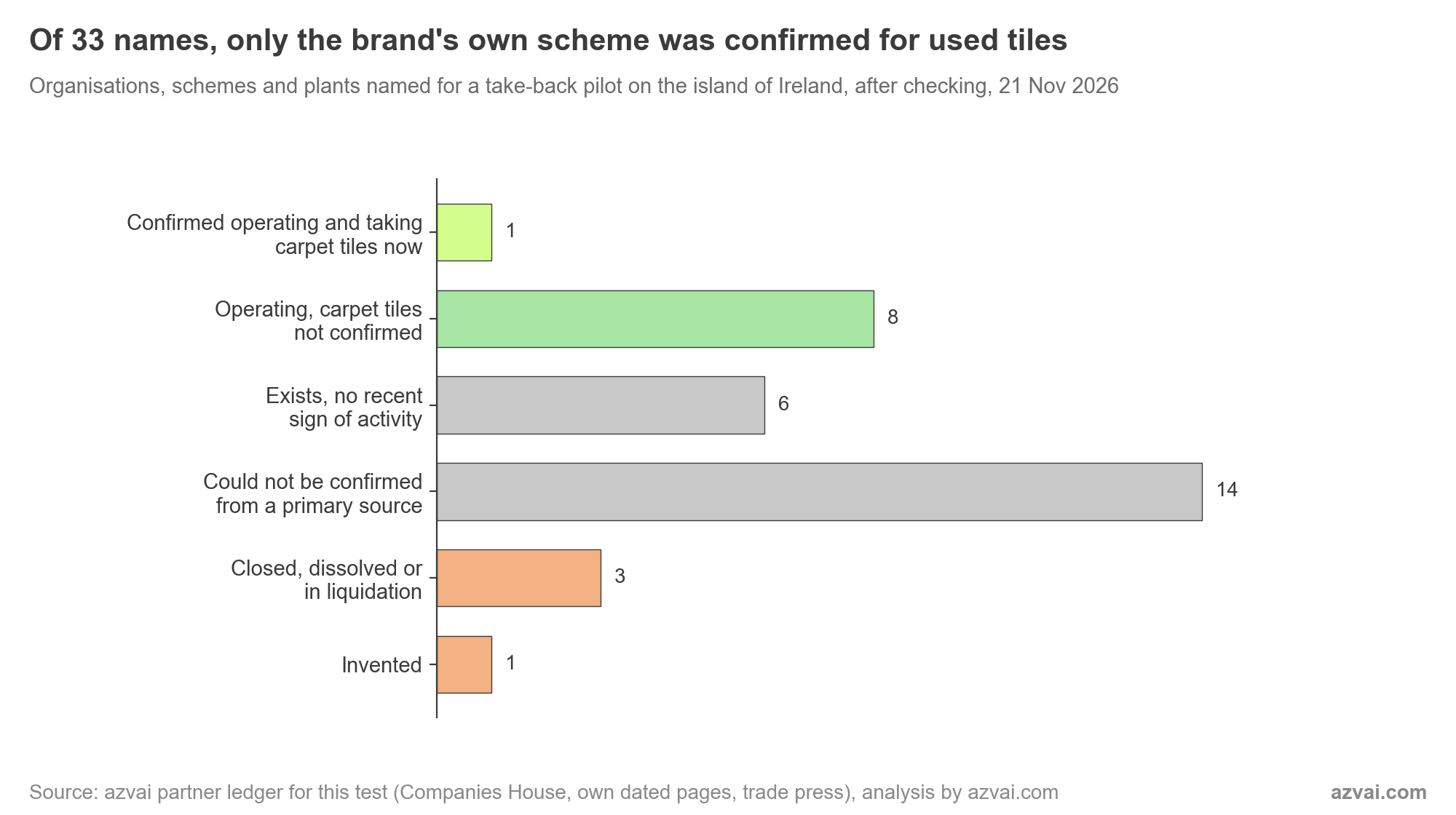
- About 50 hours became an 18-minute scan. That is the time from question to two checked lists, one of 19 legal claims tied to the instruments that make them and one of 118 claims about 33 organisations, schemes and plants.
- The 2019 read of Ireland still holds. Reuse capacity for carpet tiles on the island is thin, recycling means the Netherlands, and public-sector buyers are the best way in.
- The checks caught what the raw answers got wrong. Both runs listed a UK reuse enterprise that was dissolved in September 2026, and a register check dropped it before it reached the findings.
- Finding the partner still took people. Neither run named USEL, the Belfast partner we signed in 2019. The web scan found an unnamed 2019 article about the scheme, and a checker matched it to USEL.
- The strongest demand signal is the state’s buyer. It gave take-back 250 of the 1,300 evaluation points in its carpet-tile tender.
What a take-back scheme needs to know before entering a country
I wrote up the whole relaunch in scaling a take-back programme across European markets. Two of its lessons were to scan the partner ecosystem first and to start the legal track in month one, because licensing is the slowest workstream.
Both start as desk research, with the same four questions in every market.
- Rules. Which waste and producer-responsibility rules apply to used tiles?
- Permits. What does a partner need to collect, clean, recycle and ship them?
- Partners. Who could reuse, collect and recycle them?
- Competitors and prices. Who already offers take-back, and what does disposal cost?
Ireland is a demanding test, because the island has two legal systems. The Republic follows EU law. Northern Ireland has its own waste law and UK taxes, and EU waste-shipment rules still apply between Northern Ireland and the EU under the Windsor Framework.
How I did it in 2019
The Ireland work covered all four questions.
- Partners. I searched and shortlisted reuse and recycling partners on the island. The search ended with USEL, a disability-employment organisation in Belfast, contracted for 14,000 m² of tiles a year.
- Rules and permits. I read the waste rules and permit requirements on both sides of the border.
- Competitors and price. I analysed competing schemes and built a price model in which take-back cost the client less than landfill.
- Logistics. I designed the route from site to partner, down to what to do with pallets of tiles that arrive wet.
The relaunch went live on 25 March 2019. I don’t have timesheets from that period, so the 50 hours is my own estimate, given before I saw any AI output. It covers desk research only, without the visits, the reuse trial, negotiation or training.
How the AI scan was run
Four jobs ran side by side, which is why the whole scan took 18 minutes of wall-clock time. A tool call is one web search, page fetch or script run.
| Job | What it did | Time | Tool calls |
|---|---|---|---|
| Chatbot answer | The full question answered from memory, with no tools | 5 min | none |
| Web scan | The same question with web search, primary legal sources required and a source for every claim | 11 min | 99 |
| Checking | Two agents on a smaller model checking every named organisation against company registers and dated evidence | 3 and 5 min | 53 and 71 |
| Legal answer key | My main Claude session reading the instruments themselves, to grade the runs against | about 15 min | about 30 |
The four agent runs used about 720,000 tokens, plus my main session. My own review of the results comes on top of the 18 minutes.
What the scan found
The rules and permits
The web scan’s legal map was more complete than the chatbot’s, and after checking it gives a practitioner this.
| Rule | Republic of Ireland | Northern Ireland |
|---|---|---|
| Landfill cost set by law | Levy of €85 a tonne since September 2023 | Landfill tax of £130.75 a tonne, £136.70 from April 2027 |
| Incineration | Recovery levy of €10 a tonne (S.I. 406/2023) | Not covered by this test |
| EPR for carpet | None. The new EU textile EPR (Directive (EU) 2025/1892) leaves carpets out | None found |
| Collecting used tiles | Waste collection permit (S.I. 820/2007) | Carrier registration with the environment agency (SR 1999/362) |
| Sorting and cleaning | Waste facility permit from the council, up to 50,000 tonnes a year (S.I. 821/2007, Class 10) | Waste management licence, or a registered exemption if the agency counts carpet as textiles |
| End-of-waste | EPA decisions, none found for carpet | The agency suspended its end-of-waste service in February 2025 |
| Shipping to a recycler | Clean carpet waste is on the EU green list (B3035), so a movement document and a recycler contract are enough | EU rules for movements to the Republic and the EU. Movements to Great Britain need a regulator’s answer |
Most rows were checked in the instrument itself. A few rest on a regulator’s guidance page, and the list that ships with the skill marks which.
Three questions only a regulator can close, and they went on the call list.
- Which waste code applies to tiles collected separately for reuse, which also sets the levy timetable
- Whether cleaning carpet tiles fits a lighter registration or needs a full permit
- Whether clean, sorted tiles cross each border as green-list waste
The partners and competitors
Few organisations on the island could take used carpet tiles today.
| Organisation | What it is | What the checks showed |
|---|---|---|
| USEL (Belfast) | Disability-employment organisation, the 2019 ReEntry partner | Active company. Its website today lists mattresses, furniture and shredding. Whether it still takes tiles is a question for a call |
| Used Carpet Tiles Ireland (Dublin) | Small reseller | Its undated site offers free collection of palletised commercial tiles. No company or permit record found |
| Habitat for Humanity Ireland ReStores | Charity shops in nine towns, north and south | Its donation page lists carpet tiles. Suited to shop donations, with commercial volumes untested |
| Community Resources Network Ireland | Network of reuse social enterprises | Operating. No member doing carpet identified |
| Interface ReEntry | The brand’s own scheme, reuse first, then recycling in Scherpenzeel, the Netherlands | Described in its 2025 brochure. Irish terms not published |
| Tarkett ReStart | Competitor scheme that also takes other brands’ carpet | Ireland isn’t on its country list |
| Office of Public Works | Ireland’s state buyer of carpet tiles | Its tender gave take-back 250 of 1,300 evaluation points, naming Interface ReEntry and Tarkett ReStart |
The waste collectors the scans named are established companies, and none advertises a carpet stream.
That matches the 2019 assessment in my write-up of the relaunch, a thin ecosystem where a programme “has to either build partner capacity or accept a sort-only model”, with public-sector clients as the way in. Seven years on, the public buyer is the strongest reason to run a scheme in Ireland.
What the checks caught
Every claim went into a list with its source, the source’s date and a verdict. The raw answers contained errors of five kinds, and each was caught before it reached the findings.
| What the raw output got wrong | Example | How it was caught |
|---|---|---|
| Organisations that had closed or changed | A UK reuse enterprise dissolved on 5 September 2026; a brand’s UK reuse route through a firm now in liquidation; a trade body under its old name | Companies House |
| Out-of-date legal figures | Ireland’s landfill levy at €75 a tonne, three years old; a carrier fee at £180 where the agency now charges £191 | Reading the regulations and the agency’s fee page |
| Wrong citation | Carrier registration in Northern Ireland cited to the duty-of-care regulations | legislation.gov.uk |
| Claims with no source | A partnership between a flooring brand and a reuse enterprise; every gate fee and cost per square metre | No source found, so the partnership was dropped and the prices moved to the call list |
| Old web addresses | Two reuse organisations whose old sites now host unrelated businesses | Opening the sites |
The checking layer corrected itself too.
- Fourteen claims were marked confirmed from undated pages. The checking script rejected them and they were downgraded.
- A checker took a news report of a fire at a recycling plant as proof the plant was running. My main session downgraded it.
- My main session first quoted a permit limit from the 2007 regulations as made. Checking the amendments showed the 2008 change, which the web scan already had right.
What still needs a person
A scan ends with a call list, and in a market entry the calls are the work.
- USEL. Do you still take carpet tiles, and would you again?
- The regulators on both sides of the border, on waste codes, the cleaning exemption and border crossings.
- Habitat ReStores, network members and the Dublin reseller, on volumes, space, permits and appetite.
- Interface, Tarkett and Shaw, on whether Ireland is served and on what terms.
- Landfill and incineration operators, for real gate fees. Neither run found a current published figure for Ireland.
Whether a partner is the right one to put a client’s name next to comes from visiting, asking and building a working relationship over months. That was the core of the 2019 relaunch, and it is still a person’s job.
The verdict
For the desk part of a take-back market entry, AI turns more than a working week of research into minutes, plus a person’s review.
Three things keep that in proportion.
- The 50 hours is my estimate from memory.
- The 2019 work also produced a price model, a process and a signed partner agreement. The scan produces the evidence for those, and a person still builds them.
- The partner came from records and relationships, the two things a web search can’t reach.
Try the take-back market-entry scan skill
I turned the method into a Claude Code skill, takeback-market-entry-scan, free in my public skills repository next to the other Claude skills for sustainability work. It runs the scan the way this test ended up running it.
- Past partners first. It asks who has worked in the market before, and re-checks that list first.
- Jurisdictions before rules. One island can be two legal systems.
- A rules list tied to instruments. Every legal claim names its instrument and provision, and every rate the date it applies from.
- A partner list with dated evidence. One row per claim, checked against company registers.
- A checker that rejects legal claims confirmed only by a model, rates without dates and undated partner claims, and flags rules read only in guidance.
- A permits table and a call list for regulators, partners, competitors and disposal sites.
I tested it on a second case, used office furniture from offices in Glasgow and Edinburgh, with a fresh agent on a smaller model. Both of its lists passed the checker, and the gaps it found in the instructions, such as pointers for Scottish law, are now fixed.
Where to go next
- The first test in this series, a recycling market scan for fishing nets, is in can AI do recycling market research?
- What else AI does in reuse, repair and recycling is in the AI in the circular economy hub.
- The field method behind designing a circular system market by market is in designing circular economy systems.
- Scotland’s circular-economy policy and funding, for practitioners planning a scheme there, are in the Scotland circular economy map.
- What an AI-augmented consultant does all week is in this post on the field side of the work.
How this test was run
Times are wall-clock, from the logs of each run, on 21 November 2026. The chatbot answer, the web scan and my main session ran on Claude Opus 5.5, and the two checkers and the skill’s test on Claude Sonnet 5.5.
Legal claims were checked against EUR-Lex, the Irish Statute Book and legislation.gov.uk, rates against gov.uk and the Irish regulations, and regulators’ guidance where no instrument was read. Organisations were checked against Companies House, their own dated pages and dated trade press. The Irish company register couldn’t be reached by the agents, so Irish organisations rest on their own pages and dated news. The 2019 baseline comes from my records of the relaunch and my own estimate of the hours. No organisation was contacted for this post.
FAQ
What permits does a carpet take-back partner need in Ireland?
In the Republic, collecting used tiles needs a waste collection permit from the National Waste Collection Permit Office, and storing, sorting or cleaning them needs a waste facility permit from the local council, or an EPA licence above 50,000 tonnes a year. In Northern Ireland, a carrier registers with the Northern Ireland Environment Agency, and sorting or cleaning needs a waste management licence or a registered exemption. Confirm the exact class with the regulator.
Is there extended producer responsibility for carpet in Ireland or the UK?
The Republic of Ireland has no EPR scheme for carpet, and this test found none in the UK. The EU’s textile EPR, Directive (EU) 2025/1892, covers clothing, household textiles and footwear, with national rules due by June 2027. Carpets are outside its scope, and the directive says the European Commission will look at carpets and mattresses later.
Can AI find partners for a take-back or reuse scheme?
It finds candidates quickly and checks whether they still exist, which matters because reuse enterprises close and change hands. In this test the checks dropped a UK reuse enterprise dissolved eleven weeks earlier. The partner actually signed in 2019 came from records and relationships. Use AI for a checked shortlist and a call list, and visit the partners before you trust them.
I write more about using AI for desk research on field projects under AI for sustainability research.
