

In January 2026 the City of Edinburgh Council awarded £28.5m for furniture and white goods for its temporary accommodation and council tenancies, through Scotland Excel’s national furniture framework. The framework has a lot for reused furniture, but Edinburgh’s notice does not mention reuse, and both winners hold its lots for new furniture and kit-out. In August 2026 Angus Council awarded £516,000 for recycled furniture and starter packs from two local charities, for about 350 households a year. Only Angus’s notice asks for reused goods.
Reuse and repair procurement in Scotland is real but small, and most public contracts for waste streams that could be reused never ask for it.
I wanted to see what Scotland’s public bodies actually buy for reuse and repair, and who gets the money. So we read all 40,596 notices on Public Contracts Scotland, the portal where Scottish public bodies advertise their contracts, from 1 January 2023 to 7 November 2026. We kept every purchase whose main object, or a named part (a “lot”), is reuse, repair, refurbishment or waste prevention, and compared them with purchases for the same kinds of waste that never mention reuse.
- In the four waste streams where reuse is possible, contracts without reuse outnumber those with it by more than four to one. Bulky waste is the extreme case, at 50 to 2.
- New furniture gets at least ten times the money of reused. Scotland Excel’s framework sets aside £162m for new furniture and £9m for reused, and Fife’s own spend ran 91% new.
- Charities win the small reuse contracts. They took 1.8% of the money in single reuse and repair contracts, and companies won the large ones.
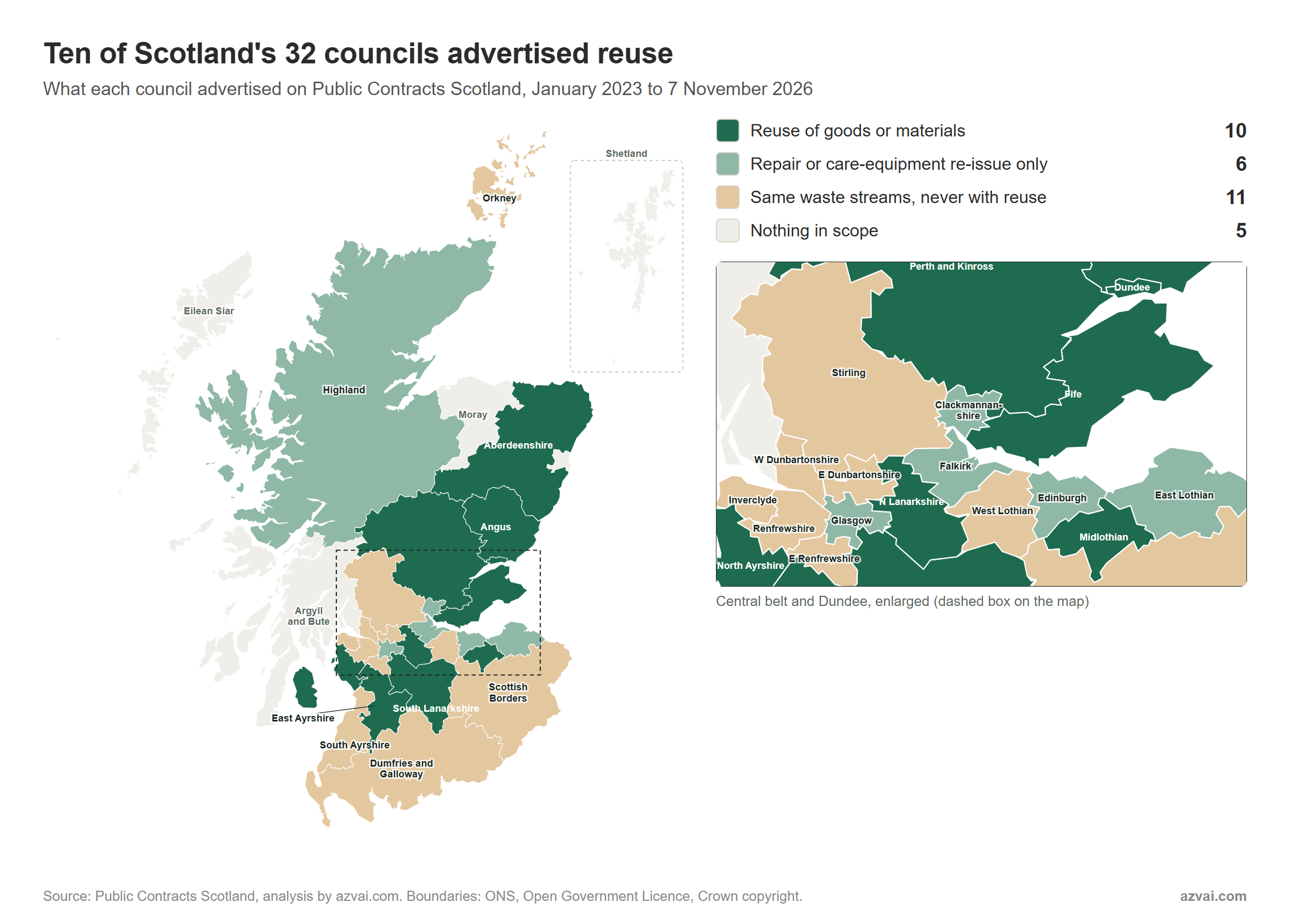
- Ten of the 32 councils advertised the reuse of goods or materials. Five advertised nothing in scope.
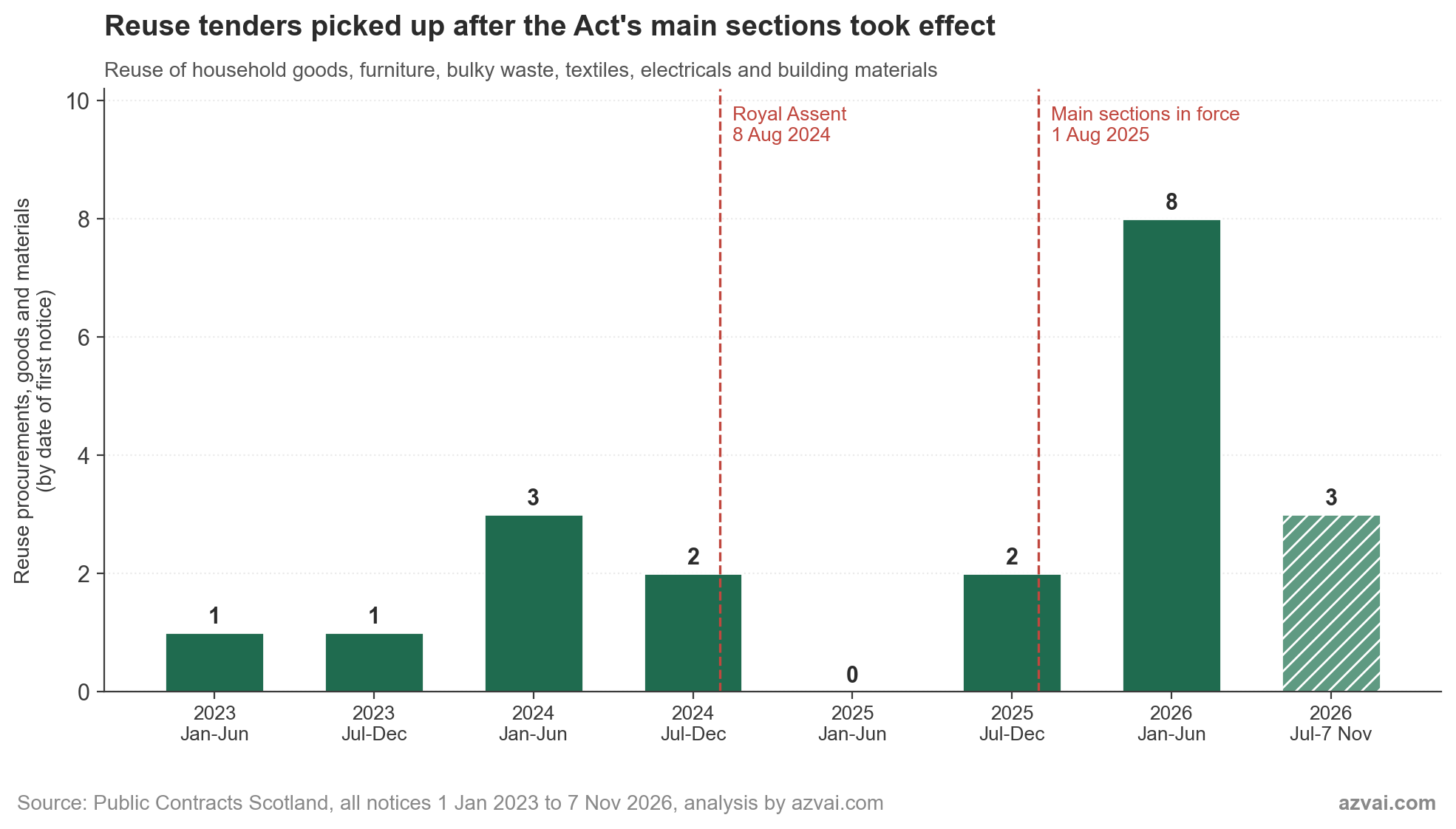
- Reuse tenders became more common after the Circular Economy (Scotland) Act 2024 took effect. The numbers behind the rise are small.
All 153 procurements are in a free CSV with links to the official notices. Each finding ends with an italic line on how far the evidence goes.
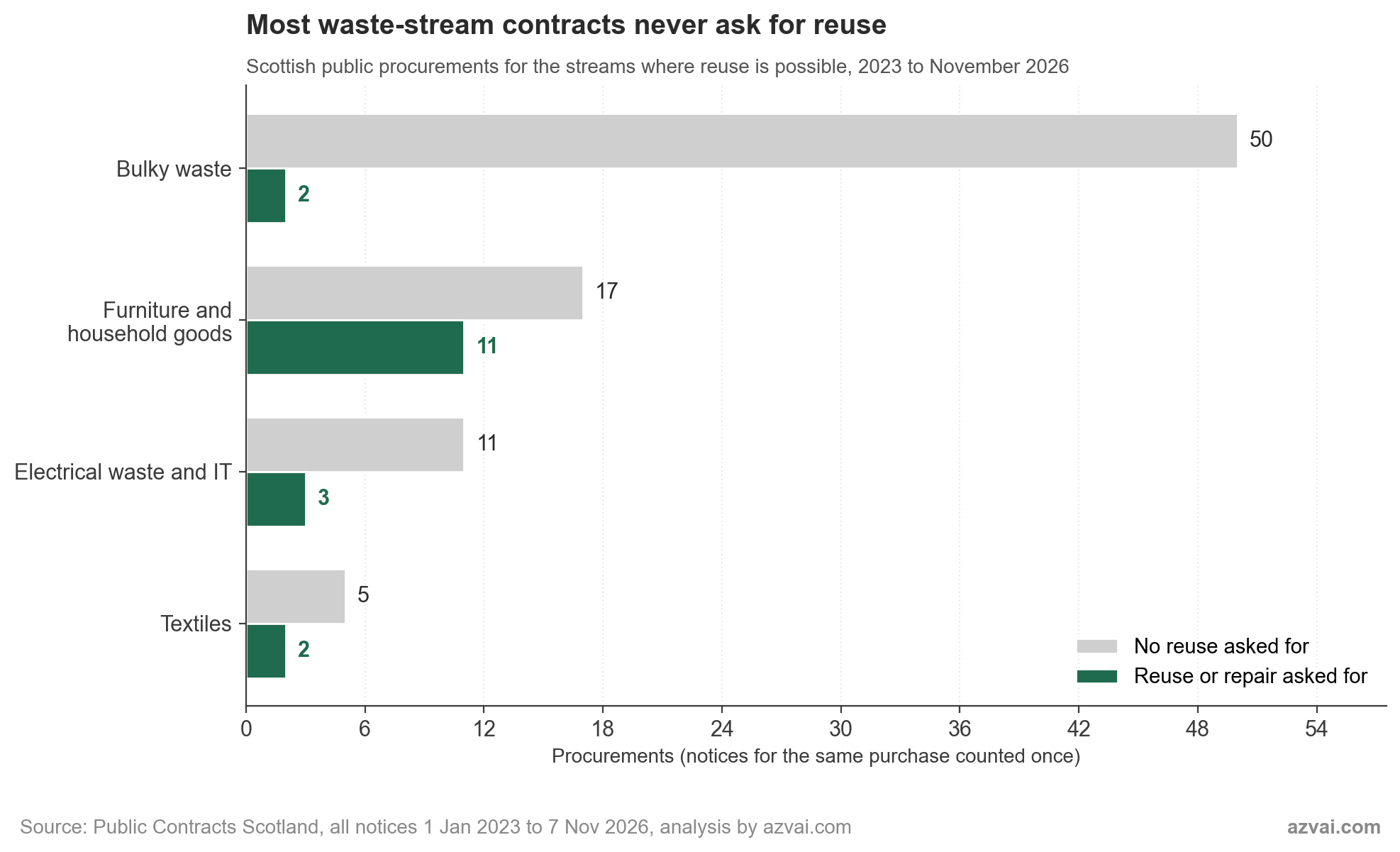
1. Most waste-stream contracts never ask for reuse
We found 40 procurements that buy reuse or repair, and 83 that buy the handling of a waste stream where reuse is possible without mentioning it. We count procurements, so a contract notice and its award count once. Of the 40, 18 fall in the four streams below, and the rest are repair, care equipment and other reuse.
| Waste stream | Reuse or repair asked for | No reuse asked for |
|---|---|---|
| Bulky waste (sofas, mattresses, large items) | 2 | 50 |
| Furniture and household goods | 11 | 17 |
| Electrical waste and IT | 3 | 11 |
| Textiles | 2 | 5 |
The bulky waste row is mostly collection, haulage, treatment or disposal. Since SEPA’s October 2023 guidance, upholstered seating that becomes waste must not be landfilled, and the guidance limits its treatment to destruction in an incinerator or cement kiln. Councils have run 13 procurements for this “WUDS” stream (waste upholstered domestic seating) since December 2023, from Highland to West Lothian. In my reading, once a sofa is in that stream it can only be destroyed, so any reuse has to happen before it is collected as waste.
Both bulky contracts that ask for reuse are North Ayrshire’s, from 2026. For waste electrical and electronic equipment (WEEE), South Ayrshire’s collection contracts went to producer compliance schemes, which collect and treat WEEE on behalf of manufacturers. Only North Lanarkshire, Midlothian and North East Scotland College ask for IT equipment to be repurposed or reused.
Strong for the direction, moderate for the exact ratios. “No reuse asked for” means the notice text does not mention it, and a contractor can still pass reusable items on in practice.
2. New furniture gets at least ten times the money of reused
Furniture for homeless households and new tenants is where reuse is easiest to compare. Councils mostly buy it through a framework, a pre-agreed list of suppliers they can order from without running a full tender each time, and Scotland’s national furniture framework offers both new and reused.
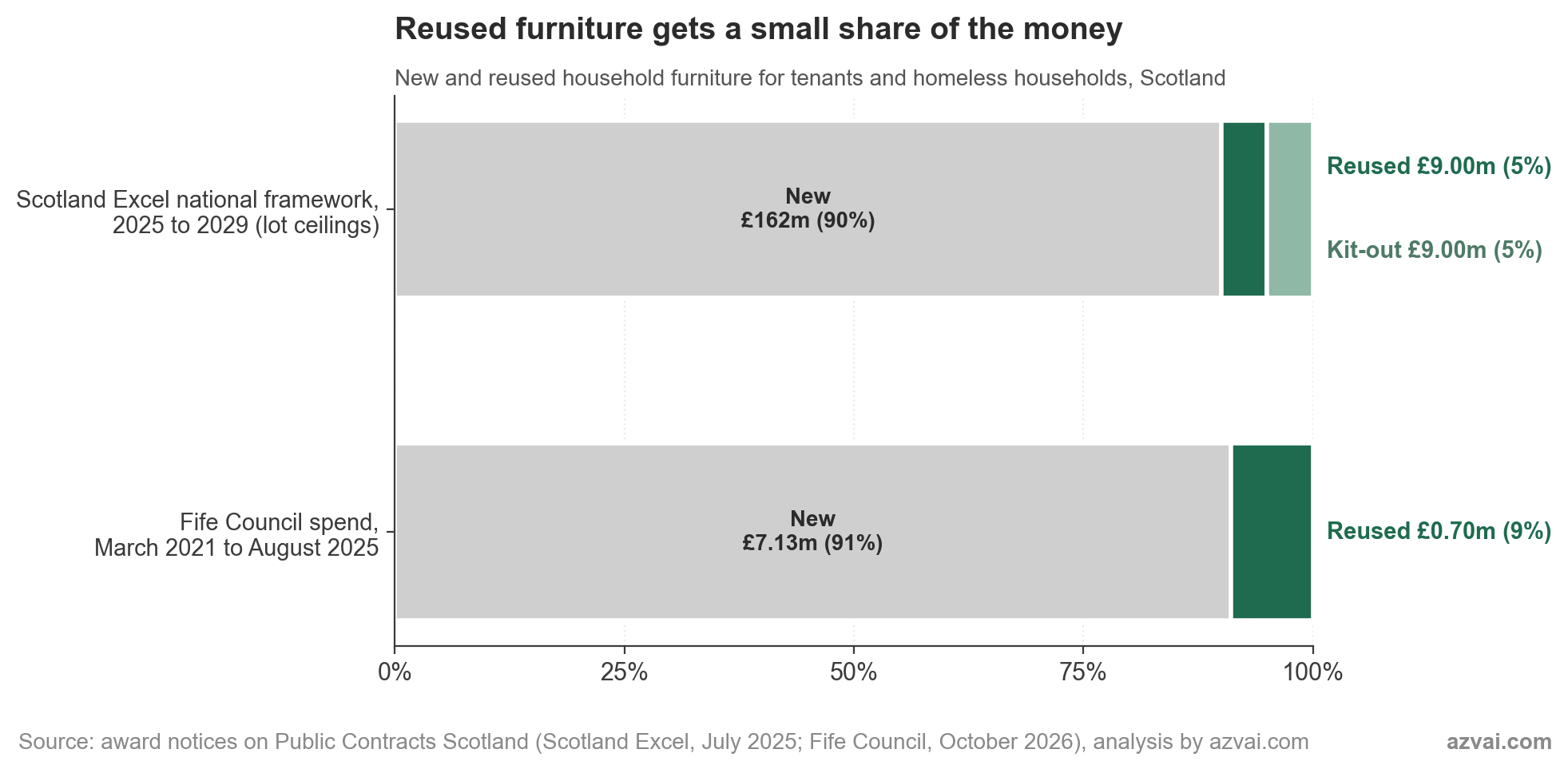
- Scotland Excel’s Domestic Furniture and Furnishings framework (June 2025 to May 2029) has lots worth £162m for New Furniture, £9m for Reuse Furniture and £9m for Furniture Kit Out. Two registered charities, Spruce Carpets and Circular Communities Scotland, hold the reuse lot. Lot values are ceilings on spend.
- Fife Council published its actual spend through the earlier national framework from March 2021 to August 2025, split into reused and new products. It spent £696,515 on reused products with Furniture Plus and Castle Furniture Project, and £7,130,038 on new with CF Services and The Furnishing Service. Reused was 9% of the total.
- Three large councils awarded furniture contracts whose notices do not mention reuse. Edinburgh’s £28.5m (January 2026) used the current framework without naming a lot. South Lanarkshire’s £18.2m (April 2025) used “Lot 1, New Furniture” of the earlier framework. North Lanarkshire awarded £17.25m in December 2024 for furnished temporary accommodation and “fast packs” for new tenants. All three went to CF Services or The Furnishing Service.
Angus is the exception, with its own framework for recycled furniture and starter packs from Forfar Resource Store and Furniture Recycling Project Angus (£216,000 in 2024, £516,000 in 2026). Fife added a £200,000 pilot for reused and new flooring in May 2026, with Spruce Carpets and, jointly, Second Opportunities and New Two. Midlothian’s new Scottish Welfare Fund framework, open in October 2026, has a named lot for reused furniture.
Strong. Every figure is a lot value or a published spend figure on its notice. Framework lots are ceilings, so the £162m and £9m show what was planned for.
3. Charities win the small reuse contracts and companies the large ones
Of the 27 reuse and repair procurements with a published award, 8 include a registered charity and 20 a company (a few include both). On single contracts, leaving frameworks aside, charities took £346,208 of the £18.98m awarded, about 1.8%. That figure includes Fife’s £200,000 flooring pilot, which also covers new flooring and includes a partner we could not classify.
Every community reuse organisation that won anything is a registered charity, among them Circular Communities Scotland, Spruce Carpets, Cunninghame Furniture Recycling Company, Tayside Re-Users, Furniture Plus and Forth Environment Link. Companies won the repair of school devices and care equipment, IT disposal and remanufactured printing. No community interest company appears among the winners.
North Ayrshire shows both sides. In January 2026 it awarded £136,268 to Cunninghame Furniture Recycling Company, which its notice describes as a social enterprise, for bulky household waste reuse with a showroom. In May 2026 it awarded £6.38m for bulky waste, with one lot for “Reuse, Recycling and Recovery” and one for upholstered seating, and Lowmac Alloys, a commercial waste firm, won both.
Textiles are concentrated too. Nathans Wastesavers won five of the six awarded textile contracts (Fife, Renfrewshire, North Lanarkshire, South Ayrshire, Perth and Kinross).
Strong for who won, because every supplier was checked against the OSCR charity register and Companies House. Moderate for the money share, because 13 of the 40 reuse procurements have no published award and 15 of 160 suppliers could not be matched with confidence.
4. Ten of the 32 councils advertised the reuse of goods or materials
Counting reuse of household goods, furniture, bulky waste, textiles, electricals, paint and building materials, 10 councils published at least one reuse procurement. Six more bought only repair, or the refurbishment of care equipment for re-issue.
| What the council advertised, 2023 to November 2026 | Councils |
|---|---|
| Reuse of goods or materials | Aberdeenshire, Angus, Dundee City, East Ayrshire, Fife, Midlothian, North Ayrshire, North Lanarkshire, Perth and Kinross, South Lanarkshire |
| Repair or care-equipment re-issue only | City of Edinburgh, Clackmannanshire, East Lothian, Falkirk, Glasgow City, Highland |
| The same waste streams, never with reuse | Dumfries and Galloway, East Dunbartonshire, East Renfrewshire, Inverclyde, Orkney, Renfrewshire, Scottish Borders, South Ayrshire, Stirling, West Dunbartonshire, West Lothian |
| Nothing in scope | Aberdeen City, Argyll and Bute, Comhairle nan Eilean Siar, Moray, Shetland |
I found Dundee’s 2026 tender for a Community Re-Use Hub the most complete example. A charity, Tayside Re-Users, takes in furniture, white goods, electrical appliances and bikes at two recycling centres, refurbishes what it can and provides the items to customers for reuse. For how the same councils do on recycling, our council-by-council recycling analysis has the SEPA figures.
Moderate. The portal shows what councils advertise. Orders from Scotland Excel’s reuse lot (call-offs) need no notice of their own, and many councils run reuse through grants, shops at recycling centres or partnerships that never reach a tender. Read “nothing in scope” as “no advertised purchase”.
5. Reuse tenders became more common after the Circular Economy Act took effect
Tenders for the reuse of goods and materials ran at 0.97 per 1,000 notices after 1 August 2025, more than twice the 0.41 before Royal Assent, with none in the year between. On 1 August 2025 the main sections of the Circular Economy (Scotland) Act 2024 came into force, including the duty to publish a circular economy strategy and to set targets. Royal Assent was on 8 August 2024.
| Period | Months | All notices | Reuse procurements (goods and materials) | Per 1,000 notices |
|---|---|---|---|---|
| January 2023 to Royal Assent | 19 | 17,133 | 7 | 0.41 |
| Royal Assent to 31 July 2025 | 12 | 10,067 | 0 | 0 |
| 1 August 2025 to 7 November 2026 | 15 | 13,395 | 13 | 0.97 |
The buyers widened too. Three councils were among the buyers before Royal Assent (the rest were the Scottish Parliament, a college and two purchasing bodies). After August 2025, eight councils ran 12 of the 13 procurements, among them Dundee’s re-use hub, Perth and Kinross’s recycled office furniture and Angus’s renewed framework. Purchases for the same streams without reuse held steady at about 2 per 1,000 notices, so councils added reuse next to their disposal contracts.
Weak to moderate. The rise rests on 13 procurements, one of which is Fife’s spend notice for 2021 to 2025. Other things changed in the same window, including Scotland Excel’s new framework with a reuse lot from June 2025, the Circular Economy and Waste Route Map of December 2024, the Circular Economy Strategy of March 2026 and packaging extended producer responsibility payments to councils. The data shows reuse tenders became more common, and cannot show that the Act caused it.
6. Some contracts have “re-use” in the title and no reuse requirement
Glasgow City Council’s £44m bulk waste contract, awarded in September 2026 to Dow Group and J & M Murdoch & Son, is titled “Collection, Reception, Re-Use, Recycling and Treatment/Diversion of Bulk Waste Services”. Its scope covers collecting, receiving, recycling and treating bulk waste, including upholstered seating, with no reuse requirement, so we did not count it.
We set aside 26 procurements like it, where reuse is a title word, an option, a disposal aim or the name of a framework lot whose contents the notice does not describe.
Strong for the Glasgow notice, which we read in full. The other 25 each have a written reason in our working files.
7. Councils buy repair for school devices and loaned care equipment
Repair appears in the data mostly where public bodies keep their own equipment, or equipment they lend to people, in use.
- School devices. Edinburgh set up a £1.86m repair framework for its fleet of about 44,000 school iPads and 3,500 iPhones, expecting 60 to 90 iPad repairs a month. Falkirk awarded £85,253 for about 1,685 tablet repairs.
- Care equipment for re-issue. Fife buys the refurbishment and repair of medical aids and wheelchairs, and NHS Highland the repair of returned environmental aids for deaf people before they are lent again. Glasgow’s £3.17m track hoist contract includes reconditioning removed hoists for re-installation, and Edinburgh’s loan service buys reupholstery for specialist seating (£101,524).
- Bikes. Clackmannanshire paid £9,940 for “Dr Bike” sessions in primary schools and bike repair workshops for adults, run by the charity Forth Environment Link. The Cairngorms National Park Authority’s cycle hubs include bike repairs.
No repair café appears as a purchase. Our article on why Europeans repair looks at what drives repair in households.
Solid with caveats. We counted repair only where the notice states it for products, and left out routine servicing of buildings, vehicles and plant.
8. Zero Waste Scotland and the Scottish Government buy circular-economy research
22 procurements are circular-economy research, policy or programmes, almost all from Zero Waste Scotland and the Scottish Government. They include behaviour trackers, consultation analysis for the Route Map and Strategy, the co-design of the household recycling code of practice under the Act, a feasibility study for circular construction hubs and a study of reuse retail for electricals. Most went to consultancies such as Eunomia, Miller Research and Resource Futures.
Strong for the list of what was advertised. Smaller research call-offs under Zero Waste Scotland’s frameworks may not all be published.
What this means if you work in reuse and repair
If you run a reuse charity or social enterprise
The council contracts charities won directly are small and local, such as Angus’s framework, Dundee’s hub and North Ayrshire’s bulky reuse award. The larger bulky waste contracts, even the one with a reuse lot, went to companies. In my reading, a reuse organisation that wants council work needs either a council that writes reuse into its own tender, as Angus and Dundee did, or a partnership with the company that wins the waste contract.
If you are a council waste, housing or procurement officer
Fife’s spend notice shows reused and new furniture bought through the same national framework, with reused at 9%. The large contracts in Edinburgh, South Lanarkshire and North Lanarkshire do not mention reuse. If your council furnishes temporary accommodation, Scotland Excel’s reuse lot is already in place and may not need a new tender.
If you advise on the circular economy
The research contracts go mostly to consultancies, and the operational reuse contracts are small and local. Our Scotland circular economy system map shows where the Act, the Route Map and the funding sit. Our analysis of who buys AI for waste and environmental work found no AI purchase for reuse or repair, and our overview of AI in the circular economy covers the deployments that do exist.
What this data can’t tell you
- Purchases with no notice. Framework call-offs, grants, in-house reuse shops and partnership agreements are invisible here.
- What the contract documents say. We did not read the specifications, which can require reuse when the notice does not, or the reverse, as with Glasgow.
- Actual spend on frameworks. Only Fife, Scottish Borders and North Ayrshire published it.
- Small numbers. The timing finding rests on 20 procurements in total.
- Who is a social enterprise. We classed suppliers from the charity register and Companies House, so a social enterprise registered as an ordinary company counts as a company here.
How we put this together
We downloaded all 40,596 notices on Public Contracts Scotland from 1 January 2023 to 7 November 2026, across all 21 notice types, including Quick Quote awards (the route Scottish bodies use for small purchases). A rule picked the notices that mention reuse, repair, refurbishment, remanufacture, second-hand goods, bulky waste, textiles, electrical waste, take-back, waste prevention or the circular economy, and ignored common false matches such as building refurbishment, road repairs and data reuse. That left 591 candidates.
An AI model (Claude Haiku) coded each candidate against a written codebook without seeing the supplier. A larger model (Claude Opus) reviewed every positive code and settled 107 notices by eight written rules. It audited 60 random codes (all held) and coded a random 250 of the 5,043 notices that used a looser word, such as “furniture” or “repair”, without passing the rule. That check led us to widen the rule.
Notices for the same purchase were grouped into 405 procurements. 40 buy reuse or repair, 83 buy the same waste streams without reuse, 22 are research and policy, and 8 are second-hand vehicles, vessels and aircraft, reported apart because they are about cost and availability. Another 26 were kept aside as borderline. The 160 suppliers of the reuse and same-stream purchases were checked against the OSCR Scottish Charity Register and Companies House on 8 November 2026. The full table (CSV) has the 153 procurements in the first four groups, with their official notice links.
Twelve procurements that show the market
| First notice | Buyer | What was bought | Value | Supplier |
|---|---|---|---|---|
| Feb 2023 | Scottish Parliament | Furniture supply with reuse, refurbishment and recycling | £2.1m awarded | Flexiform Business Furniture |
| Dec 2023 | Fife Council | Refurbishment and repair of medical aids | Framework | W Munro (Rehab) |
| Mar 2024 | Angus Council | Recycled furniture and starter packs | £216,000 framework | Forfar Resource Store, Furniture Recycling Project Angus |
| May 2024 | Scotland Excel | National furniture framework with a reuse lot, running from June 2025 | £9m reuse lot of £180m | Spruce Carpets, Circular Communities Scotland (reuse lot) |
| Jul 2024 | North Lanarkshire Council | IT disposal with repurposing and a staff buy-back scheme | £150,000 estimated | Re-Tek UK |
| Dec 2024 | North Lanarkshire Council | Furniture for temporary accommodation | £17.25m awarded | CF Services |
| Jul 2025 | Falkirk Council | Repair of school tablets | £85,253 framework | North Wales Technologies |
| Nov 2025 | Aberdeenshire Council | Textile collection and sorting for reuse and recycling | Prior information notice | Not yet awarded |
| Jan 2026 | North Ayrshire Council | Bulky household waste reuse with a showroom | £136,268 awarded | Cunninghame Furniture Recycling Company |
| Jan 2026 | City of Edinburgh Council | Furniture and white goods for temporary accommodation and council homes | £28.5m awarded | CF Services, The Furnishing Service |
| May 2026 | Dundee City Council | Community Re-Use Hub at two recycling centres | Not published | Tayside Re-Users |
| May 2026 | North Ayrshire Council | Bulky waste with a reuse lot | £6.38m awarded | Lowmac Alloys |
The Bottom Line
In my reading, Scotland’s public bodies buy reuse as a thin layer on top of disposal. Most contracts for streams where reuse is possible never ask for it, and the reuse lot of the national furniture framework is about a twentieth of its planned value. The councils that buy reuse directly, such as Angus, Dundee and North Ayrshire, do it locally and with charities, and since the Act took effect a few more have joined them.
If you work on reuse in Scotland, or spot a purchase we missed, write to me at borja@azvai.com.
FAQ
Do Scottish councils buy reused furniture?
Some do, through the reuse lot of Scotland Excel’s national framework or, as in Angus, their own framework with local charities. Reused furniture still gets a small share, about 9% of Fife’s published spend from 2021 to 2025.
Do social enterprises win council reuse contracts in Scotland?
Mostly small ones. Every community reuse organisation that won a contract in our data is a registered charity, and at least one, Cunninghame Furniture Recycling Company, is described in its notice as a social enterprise. Charities took about 1.8% of the money in single reuse and repair contracts.
Has the Circular Economy (Scotland) Act changed council procurement?
Reuse tenders rose from 0.41 to 0.97 per 1,000 notices after its main sections came into force on 1 August 2025. The numbers are small and other changes came at the same time, so the data cannot show the Act caused it.
Where can I find reuse and repair tenders in Scotland?
On Public Contracts Scotland, which carries both large tenders and small Quick Quote awards. Reuse is rarely in the title, so search for bulky waste, furniture, textiles and electrical waste too.
