

I use Claude every day. Most of my consulting work runs through it, and the workflow patterns I’ve been writing about, like using Claude Code for sustainability research and cutting per-query energy with skills and caching, are real and useful. None of that changes the question I keep getting from clients, peers, and people I meet at sustainability events.
Is Claude sustainable? Is Anthropic sustainable as a company? Can I credibly advise a client to build an AI workflow on a tool whose maker doesn’t publish an environmental report?
The honest answer takes longer than a yes or a no. Anthropic’s per-query efficiency is genuinely strong, the best of any major lab on the most rigorous independent benchmark I’ve seen. At the same time, Anthropic discloses less environmental information than its peers, and in May 2026 the company made an infrastructure choice that materially worsens its footprint. These two things sit alongside each other. Neither cancels the other. The work, for anyone advising clients on AI adoption, is to hold both in view.
This article is my attempt to lay out what’s actually known, what’s missing, and where I’ve landed personally. It’s not a defence of the tool I use, and it’s not a takedown of the lab I work with. It’s the kind of read I wish had been available when I was first asked the question.
- 12 Aug 2026. Bloomberg reports Anthropic is measuring its company-wide footprint with Watershed and has hired for sustainability reporting and infrastructure energy accounting. Still no published report or target. California SB253 requires Scope 1 and 2 reporting from November 2026. Source.
- 17 Jun 2026. Anthropic joined the Frontier Climate carbon removal coalition as the first AI startup, part of a $915M tranche. Individual share undisclosed. First public climate-related action. See What Changed in June 2026 below.
- 12 Jun 2026. SpaceX (containing xAI after the February merger) completed its IPO with a public S-1. Anthropic and OpenAI filed confidential S-1s for autumn listings. See The IPO Wave Forces the Question.
- 6 May 2026. Anthropic took over all of xAI’s Colossus 1 data centre in Memphis. See What Changed in May 2026.
Key Takeaways
- Anthropic discloses less than its peers. No formal environmental report, no verified Scope 1, 2, or 3 emissions, no public climate target through major reporting frameworks. Google and Microsoft both publish detailed reports with third-party assurance. OpenAI sits roughly where Anthropic does.
- Per-query, Claude is the most efficient major model. The independent “How Hungry is AI?” study scored Claude 3.7 Sonnet at 0.886, the highest in the field as of its May 2025 measurement. Claude 3.7 with extended thinking uses about 17 Wh on long-form input, less than half what o3 uses.
- The Colossus 1 deal worsens the infrastructure picture. Anthropic took over all 300 MW of compute at xAI’s Memphis facility in May 2026. The site is powered almost entirely by combined-cycle natural gas. Its history includes 35 unpermitted methane gas turbines, removed only after legal threats.
- Per-query efficiency is necessary but not sufficient. When inference scales to 220,000 GPUs, the infrastructure mix dominates the total footprint. Microsoft’s own report shows this pattern. Scope 1 and 2 emissions fell almost 30% since 2020 while total emissions still rose 23.4% because of Scope 3 from data centre build-out.
- The work is to hold both pictures at once. Use less, batch more, choose smaller models for routine tasks, push vendors for disclosure, stay willing to switch.
- The IPO wave makes the choice visible, not mandatory. SpaceX (which absorbed xAI in February 2026) IPO’d June 12 with a thin S-1 that acknowledged gas-turbine data centres qualitatively and provided no quantified emissions. Anthropic and OpenAI filed confidential S-1s for autumn listings. Federal SEC rules don’t compel quantified Scope 1, 2, or 3 figures. California’s SB 253 will, from 2026.
- The first public climate action arrived in June 2026. Anthropic joined the Frontier Climate carbon removal coalition as the first AI startup, part of a $915M tranche. Individual share undisclosed. Notable as a first move, but offsetting before reducing or disclosing is the reverse of standard sustainability sequencing.
This piece is one of four. The synthesis, with a side-by-side comparison of Anthropic, OpenAI, xAI and Google, is Is Generative AI Sustainable?
Where Anthropic Actually Sits on Disclosure
The first thing a sustainability advisor wants to do, faced with a vendor question, is compare disclosure. Not because disclosure equals performance, but because disclosure is the precondition for any honest assessment. A company that publishes verified Scope 1, 2, and 3 emissions, an infrastructure mix breakdown, and a third-party-assured climate transition plan is signing up for scrutiny. A company that publishes none of those is asking to be trusted.
Here’s how the five companies most relevant to AI workloads compare, based on what each has published as of June 2026.
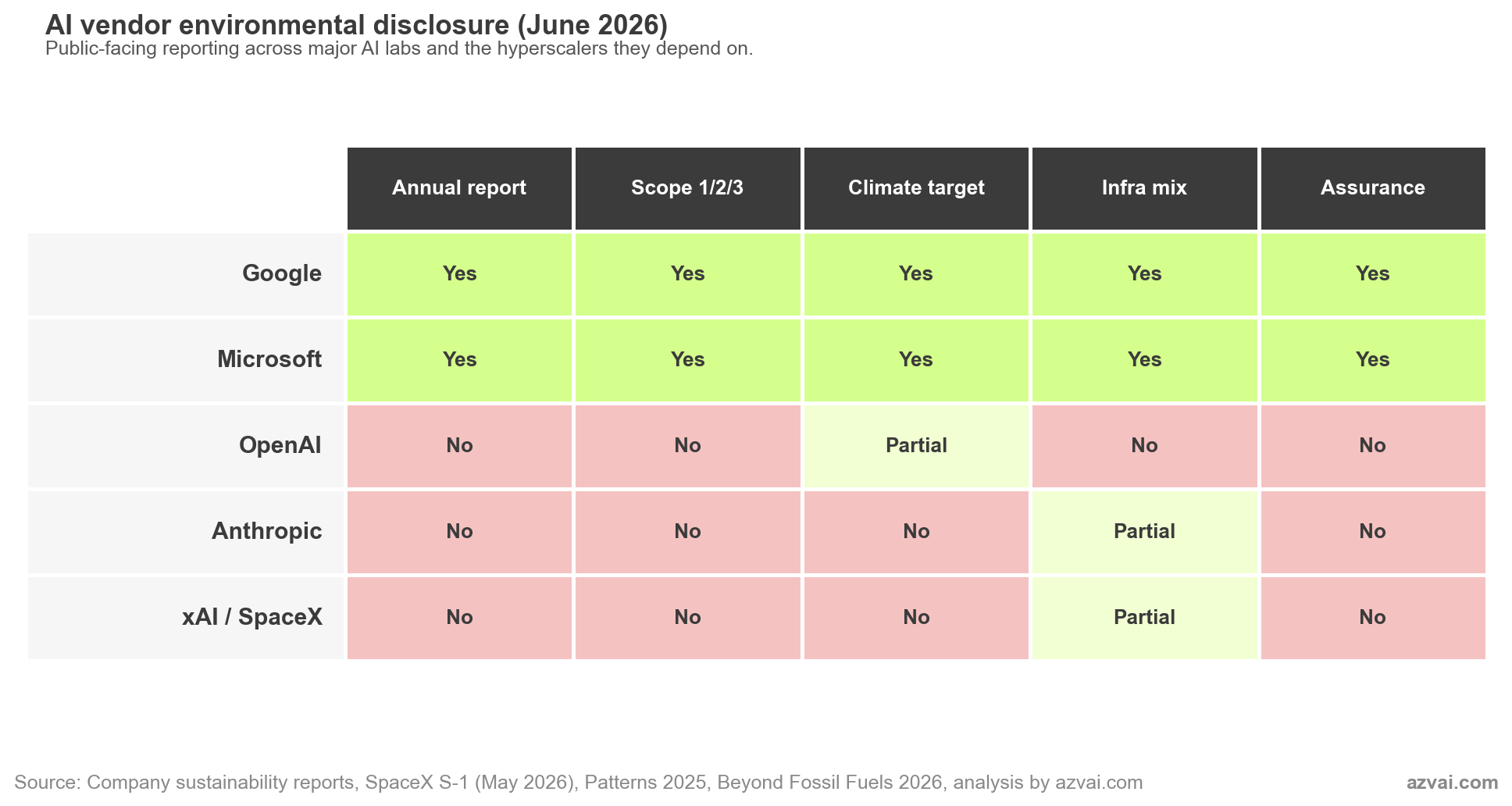
xAI’s first publicly filed climate-related material arrived buried in the SpaceX S-1 filed on 20 May 2026. The filing acknowledges its data centers “currently run significantly on natural gas and gas turbine technology” but provides no quantified energy mix, no Scope 1, 2, or 3 figures, no climate target, and no third-party assurance. That earns Partial on infrastructure mix only, and No on the four other criteria. It is the first AI-lab disclosure on the public record, and it is thin.
The pattern is uncomfortable to look at if you use Claude. Google and Microsoft, the hyperscalers Anthropic and OpenAI depend on, both publish detailed environmental reports with verified emissions data, named climate targets, and third-party assurance. The two leading AI labs, on the other hand, publish almost nothing on a standalone basis. They rely on their cloud partners’ disclosures to imply a footprint, and that implication is partial at best.
It’s worth being honest about where this disclosure gap comes from, because the framing matters for what to do about it. Google and Microsoft are publicly listed companies. They sit under shareholder pressure, EU CSRD reporting requirements for their European operations, and a wave of state-level rules in the US. Anthropic and OpenAI have been privately held until now, exempt from most mandatory climate disclosure obligations. xAI merged into SpaceX in February 2026 and is now part of a publicly traded company. The gap is closing fast (see The IPO Wave Forces the Question below).
“Yet” is the operative word. California’s SB 253 and SB 261 already apply to private companies. Any US-based company with over $1 billion in annual revenue doing business in California has to report Scope 1 and 2 emissions starting in 2026, with Scope 3 from 2027.
Anthropic’s revenue, by its own statements and recent reporting, comfortably clears that threshold, as does OpenAI’s. Both companies are headquartered in California. The legal obligation is months away, not years.
Which means the current silence is mostly a choice about timing, not a question of capacity. Anthropic could publish a verified environmental report today and front-run the obligation. It hasn’t. The federal SEC climate disclosure rule that would have forced US-listed companies to report consistently was terminated by the SEC in 2025 after the change in administration, which weakens the comparison to public peers somewhat.
But CSRD applies to anyone with significant EU operations, California’s rules apply to anyone doing business in the state at the revenue thresholds, and 35 other countries are developing similar regimes. The regulatory floor is rising. The IPO process itself isn’t what closes the disclosure gap, since federal SEC rules don’t compel quantified emissions; California’s SB 253 (Scope 1 and 2 from 2026, Scope 3 from 2027) and EU CSRD do. What the IPO wave does is make each lab’s voluntary disclosure choice publicly visible.
The IPO Wave Forces the Question
The disclosure question is shifting from voluntary to publicly visible. Between June 1 and June 12, 2026, the three largest US AI labs all entered the IPO process.
- SpaceX (containing xAI after a February 2026 merger) completed its IPO on June 12. The S-1 filed May 20 is publicly readable.
- Anthropic confidentially filed its S-1 on June 1, targeting an autumn listing at roughly $965 billion.
- OpenAI confidentially filed on June 8, targeting September or Q4 2026.
The S-1s reveal each lab’s voluntary choice, not a regulatory floor. Federal SEC rules don’t compel quantified Scope 1, 2, or 3 figures (the 2024 climate rule was terminated by the SEC in 2025). What appears in any given S-1 is the company’s own materiality call. SpaceX’s prospectus set a low bar with a single qualitative line acknowledging gas-and-turbine data centres, no quantified emissions, no climate target, no third-party assurance.
For Anthropic specifically, the IPO doesn’t compel new disclosure. California’s SB 253 does (see the previous section). What changes is that Anthropic’s choice about what to disclose now becomes part of the permanent public record, in the S-1 first and in the annual 10-Ks that follow. The internal will to disclose, or not, becomes visible to any procurement team or sustainability advisor reading the filing.
I plan a follow-up series reading each S-1 directly. xAI through the SpaceX filing first, then Anthropic and OpenAI once theirs clear SEC review, then a comparison piece once California’s SB 253 numbers land in mid-2026. The rest of this article reflects the May 2026 picture; read it with the imminent transition in mind.
What Changed in June 2026: The Frontier Investment
On 17 June 2026, Anthropic became the first AI startup to join the Frontier Climate buyers coalition, as part of a $915 million Growth AMC tranche. Anthropic’s individual share is undisclosed.
The investment is Anthropic’s first public climate-related action since founding. The sequence is unusual. Standard sustainability practice is to disclose emissions first, reduce them where possible second, and use market-based instruments (offsets, removals, certificates) third for what remains. Anthropic has gone directly to step three without doing the prior two publicly.
The magnitude is also modest in context. At Frontier’s historical pricing of around $390 per tonne, the full $915M tranche covers about 2.3 million tonnes over 8-to-10-year contracts. Anthropic’s portion is some fraction of that, set against an AI infrastructure footprint where the Colossus 1 facility alone is generating annual emissions in the seven-figure range of tonnes CO2e.
The Frontier mechanism itself is a real piece of climate infrastructure. The advance market commitment model has helped accelerate genuinely high-quality removal projects (direct air capture, mineralisation, enhanced weathering) that would otherwise lack early demand. Removal is meant to be the last resort, not the first signal. Anthropic could still build out the rest of the portfolio. Worth watching.
Even the Leaders Aren’t Disclosing Enough
Holding up Google and Microsoft as the disclosure standard is fair as a relative comparison. It’s also incomplete. Academic and advocacy research has flagged that even the hyperscalers’ reporting has significant gaps once you look closely, particularly on the AI-specific environmental impact.
A February 2026 analysis by Beyond Fossil Fuels and Stand.earth reviewed Big Tech’s claims about AI’s climate benefits and found that 74% of them were unproven. The reviewers couldn’t identify a single example where consumer-facing generative AI products like ChatGPT, Gemini, or Copilot were producing material, verifiable, substantial emissions reductions in line with what was being claimed.
The narrative of “AI as climate solution” turns out to be largely aspirational at this stage.
Specific reporting gaps include:
- Methodology shifts that obscure trends. Microsoft now estimates water withdrawals using water-use-efficiency metrics rather than direct measurement, which makes year-on-year comparisons harder to interpret cleanly.
- Aggregation that hides growth. Google’s water consumption rose 28% in a single year, with 28% of total withdrawals coming from regions with medium or high water stress. The headline number is easy to miss in a 70-page report.
- Blurred categories. Sustainability reports often bundle generative AI’s footprint with classical AI applications, which makes the genuinely energy-intensive part of the business look smaller in the aggregate.
- Missing model-level data. The 2025 Patterns analysis of thirteen AI companies (including Google’s AI divisions) found that ten disclosed none of the key model-specific environmental metrics. Energy, carbon, or water on a per-model basis, the level a procurement question actually needs, is still absent.
The point isn’t to dismiss Google and Microsoft’s reporting. The methodology is real, the targets are credible, the third-party assurance is meaningful, and the trajectory is broadly in the right direction. The point is that “they disclose, the AI labs don’t” is the floor of the argument, not the ceiling. What the field actually needs is per-model, third-party-assured, standardised AI energy and water reporting. Nothing currently in production at any major lab meets that bar.
The Two Pictures of AI Sustainability
There are two ways to measure the environmental cost of an AI tool, and they tell different stories about Anthropic. Both stories are true. Most of the public conversation conflates them, which is why the question of whether Claude is sustainable feels harder to answer than it should be.
The first picture is per-query efficiency. How much energy, water, and carbon does a single inference cost? This is what the “How Hungry is AI?” inference study measures. The study integrates API performance, infrastructure carbon multipliers, and statistical inference to assess real-world environmental cost across thirty-plus models. On this benchmark, Claude 3.7 Sonnet scored 0.886, the highest in the field.
Claude 3.7 with extended thinking consumes about 17.045 Wh for long-form input, less than half the energy of OpenAI’s o3 model. Those figures are a May 2025 snapshot of the Claude 3.7 and o3 generation. No comparable independent measurement has since been published for the current Claude 4 and 5 models, and Anthropic still discloses no first-party per-query figures, so this remains the most recent like-for-like benchmark.
That’s a real and durable advantage. Anthropic has prioritised inference efficiency, and the choice shows up in independent measurement. For a consultant who runs hundreds of Claude calls a week, the per-query story matters.
The second picture is infrastructure-level reality. Where does the inference physically run, what powers that facility, and what’s the environmental record of that infrastructure? This is the story that a per-query benchmark can’t fully capture, because it uses aggregate cloud carbon multipliers rather than facility-specific data, and because new infrastructure decisions can change the picture faster than any benchmark can refresh.
On this second picture, Anthropic’s story in May 2026 got materially worse. To understand why, you have to look at the Colossus 1 deal in detail.
What Changed in May 2026: The Colossus 1 Deal
On 6 May 2026, Anthropic and SpaceX announced a compute partnership giving Anthropic access to all of xAI’s Colossus 1 data centre capacity in Memphis. The deal covers more than 300 megawatts of compute, distributed across more than 220,000 Nvidia GPUs including H100, H200, and GB200 accelerators. Anthropic explicitly stated that the new capacity will “directly improve capacity for Claude Pro and Claude Max subscribers.” The lease is projected to generate $5 to $6 billion in annual revenue for SpaceX/xAI.
This matters environmentally because of where Colossus 1 sits and how it’s powered. Before the Anthropic deal, the facility was best known for one of the most contested environmental records in current US AI infrastructure.
According to the Southern Environmental Law Center, when Colossus 1 began operations in mid-2024 it ran on as many as 35 methane gas turbines that operated without Clean Air Act permits, classified as “temporary” installations via a regulatory loophole. After the SELC filed a notice of intent to sue on behalf of the NAACP, xAI removed all but 15 of those turbines and obtained permits for the remaining units from the Shelby County Health Department.
The site now receives 150 MW from MLGW (Memphis Light, Gas and Water), with the remainder from on-site gas generation. Given Colossus 1’s proximity to a 1.1 GW Allen Combined Cycle plant, the facility is, in the Southern Alliance for Clean Energy’s words, “powered almost exclusively by combined cycle natural gas.”
That’s the facility Anthropic is now occupying in full.
The picture gets worse if you look at xAI’s adjacent facility. Colossus 2, in Southaven, Mississippi, currently operates 27 methane gas turbines (with 46 portable units on the site overall) generating up to 495 MW of power. None of them have Clean Air Act permits. The NAACP, SELC, and Earthjustice are actively suing xAI for Clean Air Act violations, alleging the facility has the potential to emit more than 1,700 tons of nitrogen oxides per year, which would make it the largest single industrial source of smog-forming pollution in the greater Memphis area.
The area already fails to meet national air quality standards. Inside Climate News and local advocacy groups have linked the cumulative facility footprint to elevated pollution exposure in predominantly Black neighbourhoods of South Memphis.
To be precise about what Anthropic is and isn’t responsible for here, Colossus 2 is xAI’s own facility, not Anthropic’s. The unpermitted turbines at Colossus 1 were removed before Anthropic moved in. Anthropic is not directly operating illegal pollution.
What Anthropic chose to do, with full visibility into the public record, is scale a substantial slice of Claude’s inference onto a Memphis-area natural gas infrastructure with a documented permit-violation history, owned by a company being actively sued for ongoing illegal emissions at the adjacent site.
The announcement made no reference to the facility’s environmental record, no commitment to renewable PPAs, no carbon accounting for the new capacity, and no climate impact assessment. Simon Willison, in his notes on the deal, captures the awkwardness by quoting Andy Masley, a data centre defender who generally rejects environmental criticism of AI compute, saying he himself “would simply not run my computing out of this specific data center.”
The point is not that Anthropic has done something illegal. The point is that the company published none of this context to its users, made no acknowledgment of the environmental cost, and continues to operate without the kind of disclosure that would let an enterprise buyer assess the footprint. For a tool that is increasingly embedded in research, advisory, and analytical workflows across the sustainability sector itself, that’s a significant gap.
Why Per-Query Efficiency Is the Small Story
When a sustainability advisor or a procurement lead asks whether Claude is sustainable, the per-query story is what they’re usually shown. Anthropic’s per-query benchmark result. A microwave-for-five-seconds analogy. Some chart comparing inference energy to ChatGPT or Gemini.
That framing makes Anthropic look good, and the underlying numbers aren’t wrong. They’re just not the part of the equation that scales.
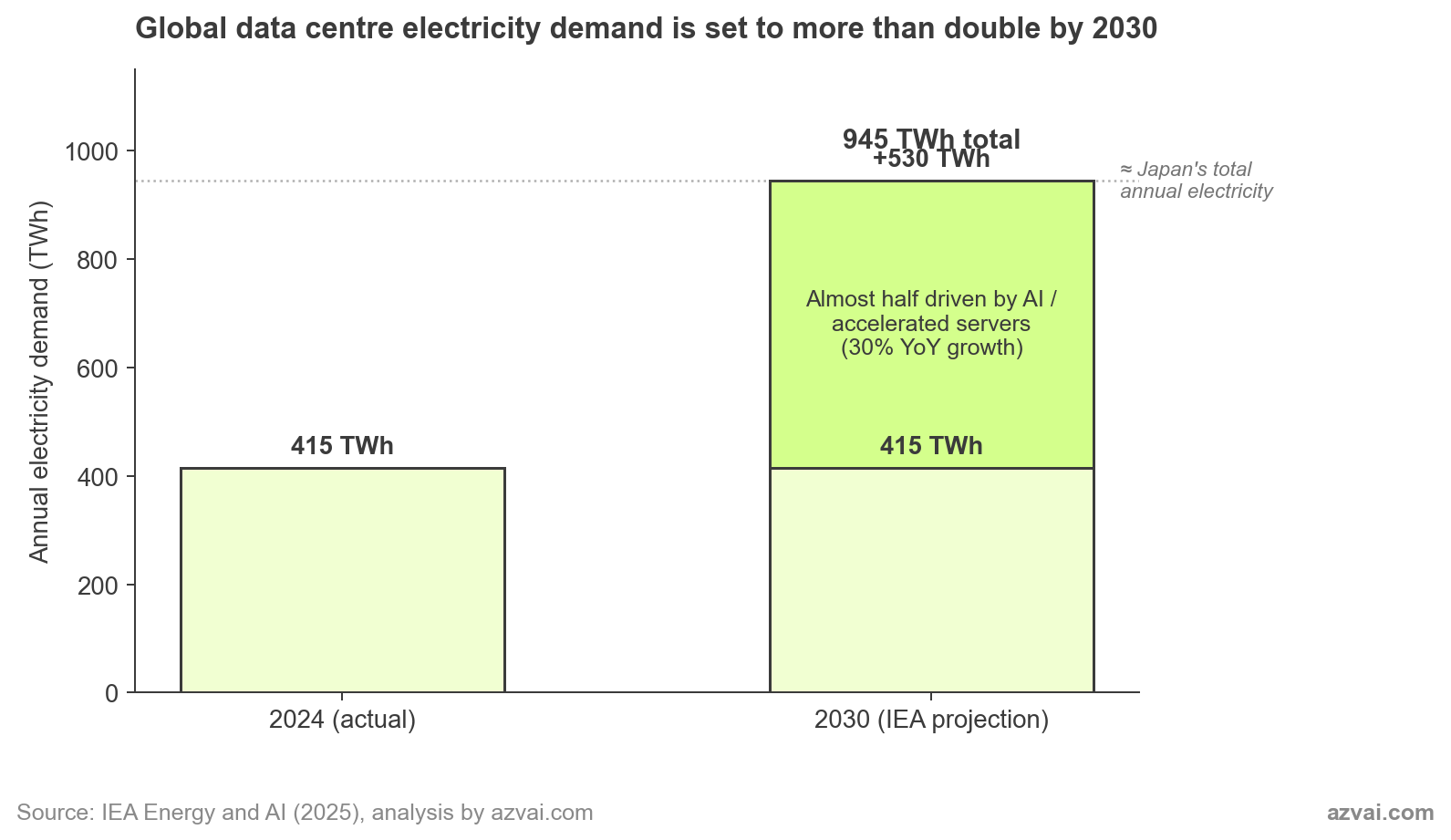
The total environmental footprint of an AI vendor is roughly the product of four things. Per-query energy. Volume of inference. Infrastructure mix (grid carbon intensity, water source, PPAs in place). Growth rate of compute capacity. Improving one factor while another grows can leave total impact flat or rising. Microsoft is the clearest published example.
Microsoft’s 2025 Environmental Sustainability Report documents a 29.9% reduction in Scope 1 and Scope 2 emissions from a 2020 baseline, driven by 34 GW of contracted carbon-free electricity. Despite that, total emissions across Scope 1, 2, and 3 rose 23.4% over the same period, because the build-out of AI data centres added Scope 3 emissions faster than operational improvements could offset.
Google shows a similar pattern. Google’s 2025 Environmental Report records a 12% year-on-year reduction in data centre emissions despite a 27% increase in electricity consumption from AI. The data centre footprint per unit of compute genuinely improved. Total company emissions still rose 11%, because Scope 3 grew 22%, driven again by AI-related infrastructure.
The lesson for vendor selection is that per-query benchmarks are necessary but not sufficient. A model that’s 30% more efficient per inference, scaled into a 300 MW gas-powered facility that didn’t previously exist, produces more absolute emissions than the same workload running on an older facility powered by a wind PPA. The math doesn’t bend that way for any plausible efficiency gain.
Per-query efficiency is the easy part of AI sustainability. It’s measurable and optimisable. It’s also where the smallest share of the total environmental harm sits. The infrastructure choices, the growth rate, and the disclosure quality matter more.
The Position I’ve Landed On
I’ve landed on the following. I keep using Claude. The reasoning quality is real, the per-query efficiency is genuinely better than the alternatives I’ve tested, and the workflow patterns I’ve been writing about produce better consulting outputs than I could without them. I think the case for using AI well in sustainability work is stronger than the case for refusing to use it on environmental grounds, given the marginal energy cost relative to the alternatives most consultants substitute for AI in practice.
And I think Anthropic’s environmental position right now is the worst among the major AI labs by disclosure standards, and that the Colossus 1 deal makes it worse. I don’t think those two beliefs cancel. They sit alongside each other, and the tension is real.
What I do about it, in practice:
- Use less. The fastest way to reduce the environmental cost of a Claude session is to have a shorter session. Tighter prompts, clearer goals, fewer rounds of revision when the first output is good enough. This sounds obvious. It’s also the most-ignored lever.
- Batch and cache. The patterns from the energy article still apply. Prompt caching, skills, sub-agents, and programmatic image generation cut compute by roughly half on sustained work. Per-query efficiency at the workflow level is something I control, and I should.
- Choose smaller models for routine tasks. Haiku for triage and routing, Sonnet for synthesis, Opus only when reasoning genuinely needs it. This is the cleanest model-selection discipline and the one most consultants skip.
- Push for vendor disclosure in client conversations. When I’m advising on an AI tool selection, the disclosure question goes on the procurement checklist. Not as a deal-breaker, as a data point. If Anthropic wants to be the preferred vendor for sustainability work, the price of that should be disclosure.
- Stay willing to switch. If a peer lab publishes a verified environmental report, names a credible climate target, and matches Anthropic’s quality, I would change my default. The switching cost is non-zero but it’s not infinite, and the comparison should be live, not foreclosed.
For consulting clients in sustainability-adjacent sectors, I’d say roughly the same thing with one addition. The vendor disclosure gap is a risk worth naming explicitly in any AI procurement memo. Not because Anthropic is uniquely bad, but because the gap is real, and pretending otherwise sets up an awkward conversation when the question eventually comes from procurement, sustainability, or a board sub-committee.
Anthropic Is Transparent About Almost Everything Else
There’s a specific awkwardness to Anthropic’s environmental silence that’s worth naming directly. Anthropic positions itself as the safety-focused, responsibility-led AI lab. It’s the company that publishes more detailed material on the risks, capabilities, and societal impact of its models than any of its peers. Against that backdrop, the absence of environmental disclosure looks less like an oversight and more like a category they have chosen to address only through market-based instruments rather than through disclosure or reduction commitments. The June 2026 Frontier investment is the first public step in that pattern.
A non-exhaustive list of what Anthropic does publish:
- The Anthropic Economic Index, now in its third edition, analysing millions of anonymised Claude conversations to map how AI is being used across occupations and tasks. This is original research, made publicly available with the underlying dataset on Hugging Face. I’ve spent enough time with the data to say this is real, useful work.
- The Responsible Scaling Policy, now at version 3, documenting how Anthropic assesses catastrophic-risk capabilities of new models before release. This includes the AI Safety Level framework and the evaluation methodology used for each model release.
- Detailed system cards with each new model, covering capability evaluations, safety testing, and known limitations. Claude Opus 4.5 launched under ASL-3, and the reasoning for that decision is public.
- A compliance framework for California’s SB 53 (the Transparency in Frontier AI Act), published proactively to show how Anthropic plans to meet new state-level frontier AI safety reporting obligations.
- A voluntary commitments hub covering responsible deployment, security and privacy, and other transparency areas.
That’s a lot of disclosure. It’s specifically the disclosure that supports Anthropic’s brand position as a safety-first, transparency-led AI lab. The environmental gap stands out against the rest of the picture because it’s the only major category where the same company has chosen not to publish.
This matters for two reasons. First, capability-wise, a company that runs an Economic Index research program and a Responsible Scaling evaluation pipeline clearly has the internal data-gathering apparatus to produce an environmental report. The infrastructure is there. The decision not to publish is strategic, not logistical.
Second, and more uncomfortably for anyone who buys the “ethical AI” framing, the disclosure gap sits in tension with the brand. A company whose market position is built on responsibility is being asked, fairly, why responsibility apparently stops at the boundaries of environmental impact. The honest answer is probably some combination of “we haven’t gotten to it yet” and “it’s a less favourable story than safety alignment.” Neither is unreasonable. But neither is publishable, which may be why the question doesn’t get answered.
For context, the AI Energy Score initiative is worth noting. Hugging Face, Salesforce, Cohere, and Carnegie Mellon launched it in February 2025 as a standardised framework for benchmarking inference energy across both open-source and proprietary models. Proprietary labs can submit their models via a containerised, privacy-preserving submission process that publishes only aggregate metrics. Anthropic and OpenAI have not appeared on the leaderboard as of May 2026. They could, on terms that would protect their internal infrastructure detail. The barrier is willingness, not infrastructure.
Five Questions to Ask Any AI Vendor
Most enterprise AI procurement processes don’t yet have a sustainability section. The categories of question they need are easy to write down, harder to find good answers to. Here’s the short version I use, which I’d encourage any sustainability advisor or procurement lead to adapt.
If you ask these five (or six) questions of the major AI labs today, the answers are mostly “no” or “not yet.” That’s a useful baseline. The point isn’t to use the answers to reject vendors. It’s to make the gap legible to the client, document the trade-off, and put pressure on the vendor to close it over time.
What Better Disclosure Would Look Like
It’s easy to criticise disclosure gaps without naming what good disclosure would actually contain. For AI labs specifically, the bar I’d hold them to has five elements.
- Verified Scope 1, 2, and 3 emissions on an annual basis, with third-party assurance, against a recognised framework (GHG Protocol at minimum, ideally SBTi-aligned).
- Per-model environmental data for both inference and training. Energy, water, and carbon, on a per-1,000-tokens or per-image basis, refreshed when models change. This is the gap independent academic work has been flagging since at least 2023.
- Infrastructure mix disclosure. Which clouds, which facilities, what grid carbon intensity in each, what fraction is covered by direct PPAs versus RECs versus residual grid mix. The aggregation hides too much.
- A time-bound climate target at the company level, covering operational and value-chain emissions, with an explicit infrastructure transition plan as compute capacity scales.
- Material event disclosure. When the vendor enters a compute partnership that materially changes the environmental footprint, that change should be disclosed alongside the announcement, not left for journalists and law-centre press releases to surface.
Market-based instruments like carbon removal credits are useful additions to this list but not substitutes. The five elements above are the foundation; removal credits are what you buy for the residual after you have done that foundation work.
None of this is technically difficult. Google and Microsoft already publish most of it. The question for Anthropic, OpenAI, and the rest of the AI lab category is whether sustained pressure from enterprise buyers, regulators, and the sustainability advisory community will be enough to make disclosure the norm.
I think it will, eventually. The question is how quickly, and whether it happens before or after the next round of high-emissions infrastructure decisions.
Where This Is Heading
The conversation about AI sustainability is shifting. For the past two years, most of the public attention has been on per-query energy, often via the misleading framing of “one ChatGPT query equals X smartphone charges.” That framing is useful for getting the topic onto front pages, but it’s not where most of the actual environmental harm sits. The harm sits at the infrastructure level. In facility decisions, in PPA quality, in growth rates that outpace clean energy procurement, in regulatory enforcement that hasn’t caught up with the build-out.
That’s where vendor scrutiny is moving, and it’s where AI labs are most exposed. Per-query efficiency is a story Anthropic can tell well. Infrastructure disclosure is a story Anthropic, currently, cannot tell at all.
For sustainability consultants advising clients on AI adoption, this shift is the one to prepare for. California’s SB 253 (mandatory Scope 1 and 2 reporting from 2026) and the IPO disclosure choices compress the timeline. What I previously expected over twelve to twenty-four months is now playing out over months. The vendors who can answer “where does the inference physically run, what powers it, and what does your annual environmental report look like?” credibly will have a real procurement advantage. The vendors who can’t will be increasingly visible.
For Anthropic specifically, the path forward isn’t complicated. Publish a Scope 1, 2, and 3 environmental report. Set a credible climate target. Disclose infrastructure mix. Be transparent about the Colossus 1 footprint and what’s planned to offset it. The technical capacity to do this exists. The internal will to do it was the open question.
The June 2026 Frontier investment shows that some internal will now exists. The question is whether it stays narrow to market-based instruments or extends to the disclosure and reduction work that should sit underneath. The S-1 Anthropic files will show what answer it chose voluntarily, since federal SEC rules don’t compel quantified disclosure. California’s SB 253 deadline in mid-2026 will set the harder, mandatory test.
In the meantime, the honest answer to “is Claude sustainable?” is that it depends on what you mean. Per-query, it’s better than most. As a vendor, with the current disclosure gap and the current infrastructure choices, it isn’t. The work for those of us who use it is to hold both pictures at once and to keep asking for the disclosure that would let us evaluate it more cleanly.
If you found this useful, the companion pieces cover ground this one does not. The same audit applied to xAI works through the SpaceX S-1 disclosure and the Colossus data-centre footprint. The Anthropic Economic Index analysis looks at how sustainability consultants actually use Claude in practice, not how vendors say we do. And the CSRD workflow piece shows what a Claude-based compliance architecture looks like when it has to survive limited assurance. The same audit applied to ChatGPT and OpenAI completes the vendor series. Together they’re the closest thing I have to an honest position on how to work with AI in sustainability consulting without pretending the trade-offs don’t exist.
Using AI in sustainability work, without the greenwash. I run these footprint audits with the same rigour I bring to a materials audit, and I use these tools every day in circular-economy consulting. If your team is working out where AI actually fits, and where it does not, that is the work I do. See how I work.