

More than half of UK charities, 56%, say a lack of skills is their biggest barrier to using AI, according to the Charity Digital Skills Report 2026. Anthropic names the same barrier in its October 2026 expansion of Claude for Nonprofits, although it gives no figure for it.
I write about sustainability and AI here at Azvai. I also cofounded Earth.fm, a nonprofit registered in Estonia that streams nature recordings from field recordists in more than 100 countries, and I sit on its board. In October 2026 we moved our small team, never more than five people, onto Claude’s nonprofit plan and its new plugin, and we kept notes on every decision.
This is what we set up, what it costs outside the US, and what happened when we checked every grant lead the connectors returned.
Key findings
- Most European and UK nonprofits pay $8 per seat a month. The $3 tier is only for countries the World Bank classes as low- or middle-income.
- If you already have your own skill (a saved set of instructions) for a job, the plugin’s version steps aside and its safeguards go with it, so we copied its rules into ours.
- The grant connectors, which plug Claude into funder databases, gave us 21 leads. After checking each funder’s own website, 5 were worth pursuing, two of them with conditions.
- The policy came first, and it draws a hard line around sound, stories and images.
- The GDPR paperwork is already in Anthropic’s terms, and it still leaves you two jobs.
What Claude for Nonprofits Includes Now
Much of what you can read about Claude for Nonprofits still describes the December 2025 launch and its “up to 75%” discount. The October 2026 expansion changed what a small team gets on day one, mostly through a plugin that installs itself. Skills tell Claude how to do a job, and connectors let it read the tools where that job already lives.
| What you get | What it means for a small team |
|---|---|
| Team plan at nonprofit pricing | The same models as the standard Team and Enterprise plans, from two seats |
| The Claude for Nonprofits plugin | 14 skills, installed automatically once your organisation is verified on Team or Enterprise |
| Connectors | 20 bundled, including Google Drive, Gmail, Microsoft 365, Slack, Candid, Kindora, Granted, Instrumentl and Blackbaud |
| Claude Code | Included at no extra cost |
| Training | The free AI Fluency for nonprofits course, built with GivingTuesday, and webinars on 10 and 12 November 2026 |
Anthropic’s nonprofits page sorts the 14 skills into four areas:
- Knowing your organisation.
where-things-livemaps where your files are,org-voice-guidesets your voice andai-use-policy-lookupanswers from your own AI policy. - Marketing.
campaign-planning,content-reviewanddeck-planning. - Your team.
job-post-builder,new-hire-onboarding,hr-policy-lookupandboard-recruitment. - Fundraising.
funder-and-grant-research,grant-proposal-writing,grant-reportinganddonor-and-funder-relations.
Anthropic says more than 25,000 nonprofits now use Claude and that more than 75% of them have fewer than 10 seats. It gives no method for either figure, but the second suggests a plan built for teams our size.
What It Costs and Who Qualifies Outside the US
“Up to 75% off” is the figure that travels. What you actually pay depends on a detail that is easy to miss, the World Bank income class of the country where you are registered.
Anthropic’s nonprofit pricing has two Team tiers:
| Tier | Price per user per month | Who pays it |
|---|---|---|
| Nonprofit standard | $8 | Verified nonprofits in high-income countries |
| Nonprofit access | $3 | Verified nonprofits in low- or middle-income countries |
| Enterprise | Through sales | Organisations above 150 seats |
Team takes 2 to 150 seats and prices exclude tax. There is no nonprofit discount on the individual Pro or Max plans. The $3 tier is the “~90%” discount Anthropic announced for low- and middle-income countries in September 2026.
Eligibility covers “registered 501(c)(3) organizations and their international equivalents”. Government agencies, political campaigns, higher education and healthcare systems are excluded.
Verification runs through Goodstack and takes two to three minutes, by Anthropic’s estimate. The catch for small groups is that Goodstack needs recognition by the regulator in your country of registration, and says it cannot verify organisations that don’t have to register to operate. Very small groups that sit on no national register should check this before they plan around the discount.
Earth.fm is registered in Estonia, which the World Bank classes as high-income, so we pay $8 a seat. Most of the EU and the UK sit in the same class.
Why We Wrote the AI Policy Before Anything Else
Would your supporters be comfortable seeing exactly how you use AI? For an environmental nonprofit, a written policy is where that answer becomes rules.
The sector is uneasy. In a Climate Advocacy Lab survey of 152 climate advocates, published in September 2026, 83% were concerned about the environmental impacts of AI, and 64% even among daily users. Only 40% worked for an organisation with an AI policy. Apolinar Gonzales, the Lab’s executive director, told the Chronicle of Philanthropy that environmental nonprofits are “incredibly resistant” to AI-generated long text, images and video.
The Walton Family Foundation’s guide for small conservation groups also puts the policy before the tools, then starts with one activity and one tool.
We built ours on the six decisions in Anthropic’s data handling and AI policy tutorial:
- Purpose.
- Encouraged, ask-first and not-permitted uses.
- Data handling.
- Human review, plus AI Fluency training within 30 days.
- Tools (the organisation account, approved connectors and skills, memory).
- An owner, with a review every 90 days.
Earth.fm’s human line. Our policy, version 1.0 from 27 October 2026, does not permit:
- generating sounds or editing recordings with AI, including AI noise reduction and restoration
- AI-written blog posts, recordist stories or social media captions
- AI-generated images
- uploading recordings to an AI tool, because our recordist terms do not cover AI use
- sensitive information about anyone, such as health, ethnicity, religion or immigration status
It encourages grant research and drafting, IT, security and website work, replies to listeners, recordists and partners, data analysis, and research for the blog and podcast with every source checked by a person. In its own words, “Claude drafts, and people send, submit and publish.” My consulting work runs on similar rules, published in How we use AI.
The settings follow from the policy:
- Memory on, so Claude keeps Earth.fm’s context between chats. Deleting a chat leaves its memories in place, so we remove those separately.
- Feedback buttons off (the GDPR section explains why).
- Approved connectors only.
- Every team skill reviewed by the policy owner before it is published.
On footprint, the CLEER dataset from the Sustainable AI Group estimated a typical chat with Claude Opus 5 at about 1.6 watt-hours in October 2026, with agentic tasks using many times more. Those figures change with every model generation, and we track them in Is Claude sustainable? The water side has its own piece, How much water does AI use? A policy this strict suits nonprofits whose supporters care how creative work is made. A team with no public creative output can keep it shorter.
The GDPR Questions an EU Nonprofit Should Ask
Data protection is where many European nonprofits stall, or quietly skip ahead. On 27 October 2026 we read Anthropic’s Commercial Terms and its Data Processing Addendum with an Estonian nonprofit’s questions in mind.
| Question | What the terms say |
|---|---|
| Who do we contract with? | Anthropic Ireland, Limited, for customers in the EEA |
| Do we need to sign a DPA? | No. It is “incorporated into these Terms by reference” |
| Who is responsible for the data? | You are the controller and Anthropic is the processor |
| Does Anthropic train on our content? | “Anthropic may not train models on Customer Content from Services” |
| How are transfers covered? | EU standard contractual clauses, in the versions for controller-to-processor and processor-to-processor transfers, plus UK and Swiss addenda |
| Where is data stored? | In the US. Processing may run in the US, Europe, Asia or Australia |
| What if there is a breach? | Notice “within 48 hours” |
| What happens when we leave? | Data returned or deleted within 30 days of termination |
| What about new subprocessors? | You have 15 days to object |
Two details changed how we work. First, the DPA lists the special categories of personal data it covers as “None”, so we keep health, ethnicity, religion, political views and similar data out of Claude entirely.
Second, the terms say “Anthropic may use that feedback”, so we switched the thumbs buttons off for everyone.
The terms also leave you two jobs:
- Add Anthropic Ireland to your list of processors in your record of processing activities.
- Mention AI processing and the US transfer in your privacy notice before any supporter, donor or volunteer data goes in.
This is our own reading as a small nonprofit. Treat it as general information and check your obligations with your data protection adviser.
Grant Research: 21 Leads, Five Worth Pursuing
Our first lesson about the Claude for Nonprofits grant tools had nothing to do with funders. Its research and writing skills open with “If the organization has its own skill for this job, use theirs.”
Earth.fm had a grant-research skill, so the plugin stepped aside and took its safeguards with it. We copied its rules into ours (our guide to Claude Skills explains how skills load):
- A source beside every funder, amount and deadline. Search results and other listings count only as leads, and the funder’s own website is the source.
- No wealth screening of individuals, and current funders labelled as current.
- A mode that checks a single grant call against its rules, marking each one met, not met or can’t tell yet.
We then ran the connectors twice on 27 October 2026. The European run used Kindora’s open grants with the country set to Estonia, plus one peer-funder lead. The US run used Kindora’s “funders of organisations like yours” and open programmes, plus Granted.
| Run | Leads | Worth pursuing | The rest |
|---|---|---|---|
| Europe | 8 (7 European) | 3 | 2 unclear, 1 invitation-only, 2 country-locked |
| United States | 13 | 2 | 1 to watch, 3 low priority, 7 ruled out |
| Total | 21 | 5 |
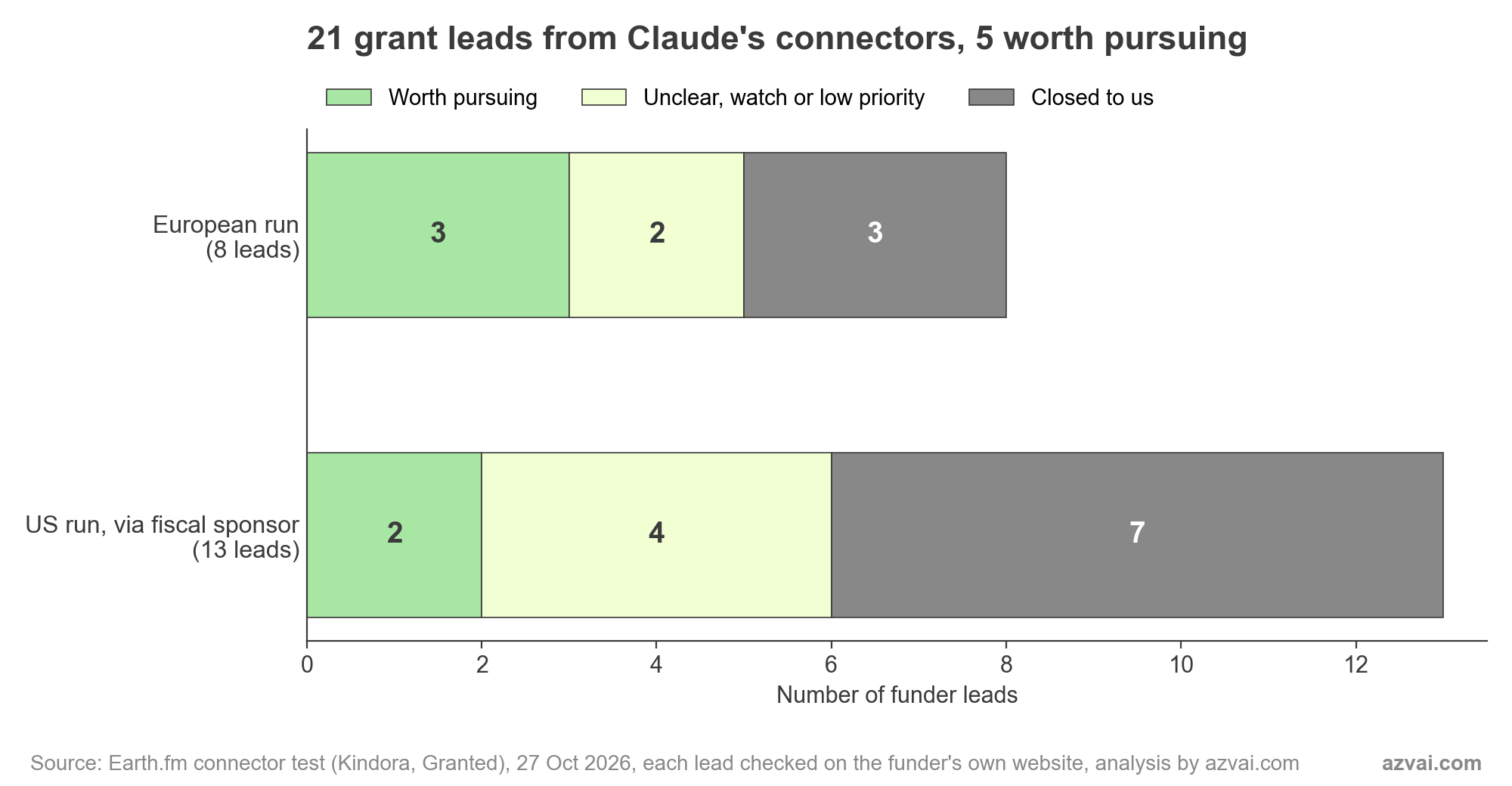
The open doors in Europe are a Finnish foundation taking expressions of interest at any time, a French foundation with rolling applications and a French corporate foundation giving €1,000 to €3,000. In the US, a California family fund takes letters of inquiry year-round through a fiscal sponsor, but its international environment goal centres on primary forests and Indigenous communities, so we would need a forest partner. An Iowa foundation funded a biodiversity-data platform and excludes organisations based outside the US, so our eligibility is pending.
Four patterns stood out.
- A country filter is not an eligibility check. Two Estonia results are closed to us. Stiftung Corymbo funds only Swiss-seated organisations and excludes publishing audio recordings, Earth.fm’s core work. Fondation Lemarchand funds activity in France only, and its real deadline is 15 December, two weeks before the 31 December the database showed.
- Connectors don’t know who you have ruled out. The raw output also included Oak Foundation and the Conservation Leadership Programme, which we had ruled out months earlier, so they are not among the 21. Our funder ledger, a running list of past decisions, now filters every run.
- Peer funders are mostly closed doors. Kindora’s peer results were mostly donor-advised funds, local community foundations and invitation-only family foundations, and the European run’s one peer lead, the Patrick J. McGovern Foundation, is invitation-only too. Of the seven US funders we ruled out, Tides Foundation takes no unsolicited requests, Santa Barbara Foundation funds its county only, The Pollination Project gives $500 to $1,000 to groups with no paid staff, and Colcom Foundation funds southwestern Pennsylvania.
- The US route runs through a fiscal sponsor. We checked all 13 US leads assuming The Biodiversity Group, our US fiscal sponsor, applies for us. Both US leads worth pursuing depend on it.
The connectors were strongest at discovery, since none of the seven European funders was in our research files. Verification stayed separate. Our skill read every funder’s own website, and a person checked its verdicts before anything reached our pipeline.
The Connectors a Five-Person Team Needs
On the Team plan, a connector you add is available to everyone in the organisation. That single fact kept our list short.
| Connector | Decision | Why |
|---|---|---|
| Google Drive | Connect now | The org map and the policy lookup both read from it |
| Gmail and Google Calendar | Connect now | Funder replies and deadlines. Claude drafts, people send |
| Slack | Connect now | Team context and quick questions |
| Kindora | Connect now | Free tier, with no account needed when we tested it |
| Granted | Connect now | Free according to its maker, and useful for the US fiscal sponsor route |
| Candid | Connect now | Basic search works without a Candid account. The connector is in beta |
| Instrumentl | Skip | Needs a paid subscription |
| Blackbaud, Salesforce | Skip | Only useful if they already hold your donor records |
| Stripe | Later | Holds donor and payment data. Read-only, once the privacy notice covers it |
Drive matters most. The where-things-live map and the ai-use-policy-lookup skill both read from it, so your policy only works inside Claude once it is stored there.
Connect the tools where your files already live, add the free grant connectors, and check that each connector works for your account before you rely on it. Send every other request through your policy owner.
What We Plan Next
Anthropic’s Academy lists 21 items in its nonprofit collection, and the plugin adds 14 skills. For a team our size the harder question is what to do first. What follows is a plan built from Anthropic’s recommended uses, and none of it is a result yet.
We already use Claude for IT and security, customer management and UX work. Claude Code stays our tool for the technical side, and it now comes with the plan.
| When | What we plan to do | Skill or use case |
|---|---|---|
| Next | Impact reporting from our listening data and the Field Recording Grant Program | Anthropic’s “visualize program data” and “write an impact report” use cases |
| Next | Review human-written pieces before they go out | content-review |
| Next | Plan the next Field Recording Grant Program call | campaign-planning |
| Next | Grant reports with a source for every figure | grant-reporting |
| Later | A skills matrix for the board | board-recruitment |
| Later | Onboarding plans for volunteers and recordists | new-hire-onboarding |
| Later | Donation summaries for grant reports | Stripe connector, read-only |
Content review is the planned use that fits our human line best. Claude would check a piece a person wrote before it goes out, without writing any of it.
Training runs alongside all of this. Everyone with a seat will complete Anthropic’s free AI Fluency for nonprofits course within 30 days, as our policy requires. We also plan to join Anthropic’s admin and staff guide webinars on 10 and 12 November 2026.
For the data-heavy items we plan to follow the approach in Claude Code for research workflows, with a source beside every figure.
If We Set It Up Again, This Is the Order
With hindsight, the order matters more than any single feature. This is the sequence we would follow next time:
- Check your regulator listing, then verify. Make sure your organisation is on your national register, then verify through Goodstack.
- Write the one-page policy. Use Anthropic’s six decisions and draw your human line before anyone starts.
- Set the admin settings. Name one or two owners, turn memory on, turn the feedback buttons off, set skills publishing to “Requires review” and restrict organisation creation so staff can’t open separate Claude accounts for work. Plugin access sits in Organization settings > Plugins & skills.
- Map where your files live. Run
where-things-liveso the other skills know where to look. - Add a short connector list. Start with file storage, email and the free grant connectors, and add the rest only when someone needs them.
- Merge your own skills with the plugin’s rules. Any skill you already have switches the plugin’s version off for that job.
- Book the training. AI Fluency for nonprofits within 30 days, plus the November webinars.
Steps 2 and 3 carry the most weight, because every later choice goes back to the policy and the settings that enforce it.
Through Azvai, my own practice and separate from Earth.fm, I help small environmental and circular-economy nonprofits with this setup, from the policy to the connector list, alongside my AI research work for sustainability teams. You can reach us through the Azvai contact page.
How We Put This Together
This article comes from Earth.fm’s own setup of the Claude Team plan at nonprofit pricing in October 2026, written from inside the organisation by a cofounder and board member. We wrote the AI policy with Anthropic’s guidance and finalised it as version 1.0 on 27 October 2026, and read Anthropic’s Commercial Terms and Data Processing Addendum the same day. Both connector runs also took place on 27 October 2026, and every lead was checked on the funder’s own website. Funders we are pursuing are described without their names. Prices and programmes change, so check Anthropic’s nonprofit page before you budget.
FAQ
Is Claude for Nonprofits free?
No. Claude for Nonprofits is a discounted Team plan at $8 per user per month, or $3 in low- and middle-income countries, with a minimum of two seats. The plugin, its 14 skills, the connectors and Claude Code come at no extra cost. Some connected tools, such as Instrumentl, need their own paid subscription.
Can UK charities and European nonprofits use Claude for Nonprofits?
Yes, if their national regulator recognises them. Anthropic accepts the “international equivalents” of US 501(c)(3) organisations, and Goodstack verifies them against the register in their country. Groups that don’t have to register can’t be verified. Most UK and EU organisations pay the $8 tier, because the World Bank classes their countries as high-income.
Does Claude train on our nonprofit’s data?
Anthropic’s Commercial Terms say it may not train models on customer content from its services. Feedback is treated differently. If staff use the thumbs up and down buttons, Anthropic may use that feedback, which is why Earth.fm switched them off. See The GDPR Questions an EU Nonprofit Should Ask above.
Can we keep our own skills alongside the Claude for Nonprofits plugin?
Yes, and your skill takes over that job. The plugin’s research and writing skills step aside whenever you have your own skill for the task, and their sourcing and privacy rules go with them. Copy those rules into your own skill, as Earth.fm did for grant research.
Can a two-person charity use Claude for Nonprofits?
Yes. Two seats is the minimum, so a two-person charity pays $16 a month before tax in a high-income country, or $6 in a low- or middle-income one. The plugin, its connectors and Claude Code come at no extra cost.
