

In September 2026 the London Borough of Lewisham awarded £50,000 for a pilot of six AI cameras that detect fly-tipping. In March 2025 Greece’s Information Society company awarded a €21.7m framework for AI fire-detection systems for its civil protection service. One is a borough watching its streets, the other a state watching its forests. Neither is about closing a material loop.
Public bodies buy AI to watch the environment and to run networks, from fire and floods to water pipes and bins, and they almost never buy it for the circular economy.
I wanted to see what AI waste management tenders, and public AI buying for environmental work more widely, actually look like. So we read every public notice that mentions AI in the UK and the EU from January 2023 to 20 October 2026, and kept the purchases whose main object, or a named part, applies AI to waste, water, nature, emissions or environmental risk. That left 97 procurements from 17 countries plus ECMWF, Europe’s intergovernmental weather centre.
- It is a small slice. About 2 in every 100 public AI notices are for environmental work, a little more in the EU and a little less in the UK.
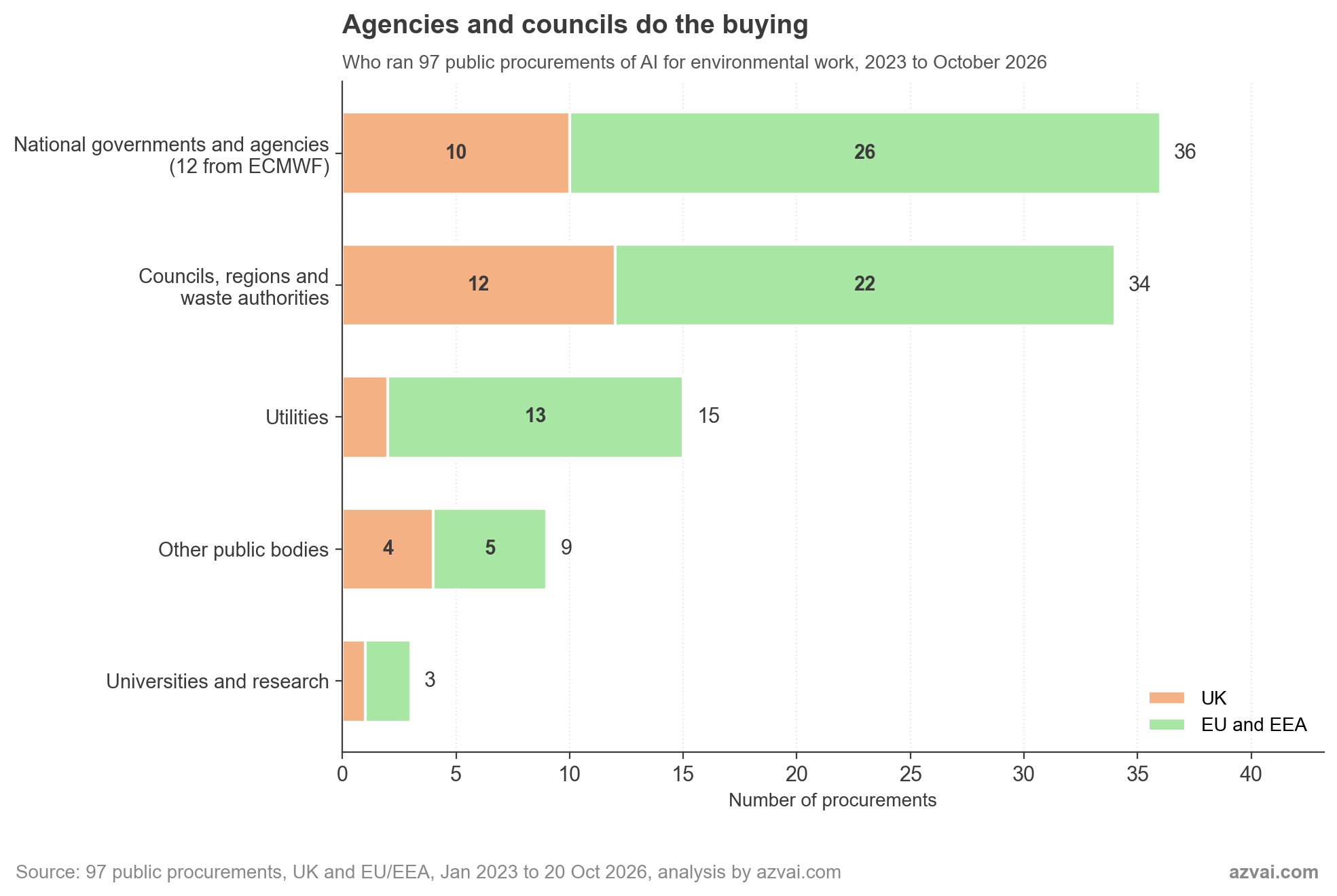
- Agencies and councils do the buying. Between them they ran 70 of the 97 procurements.
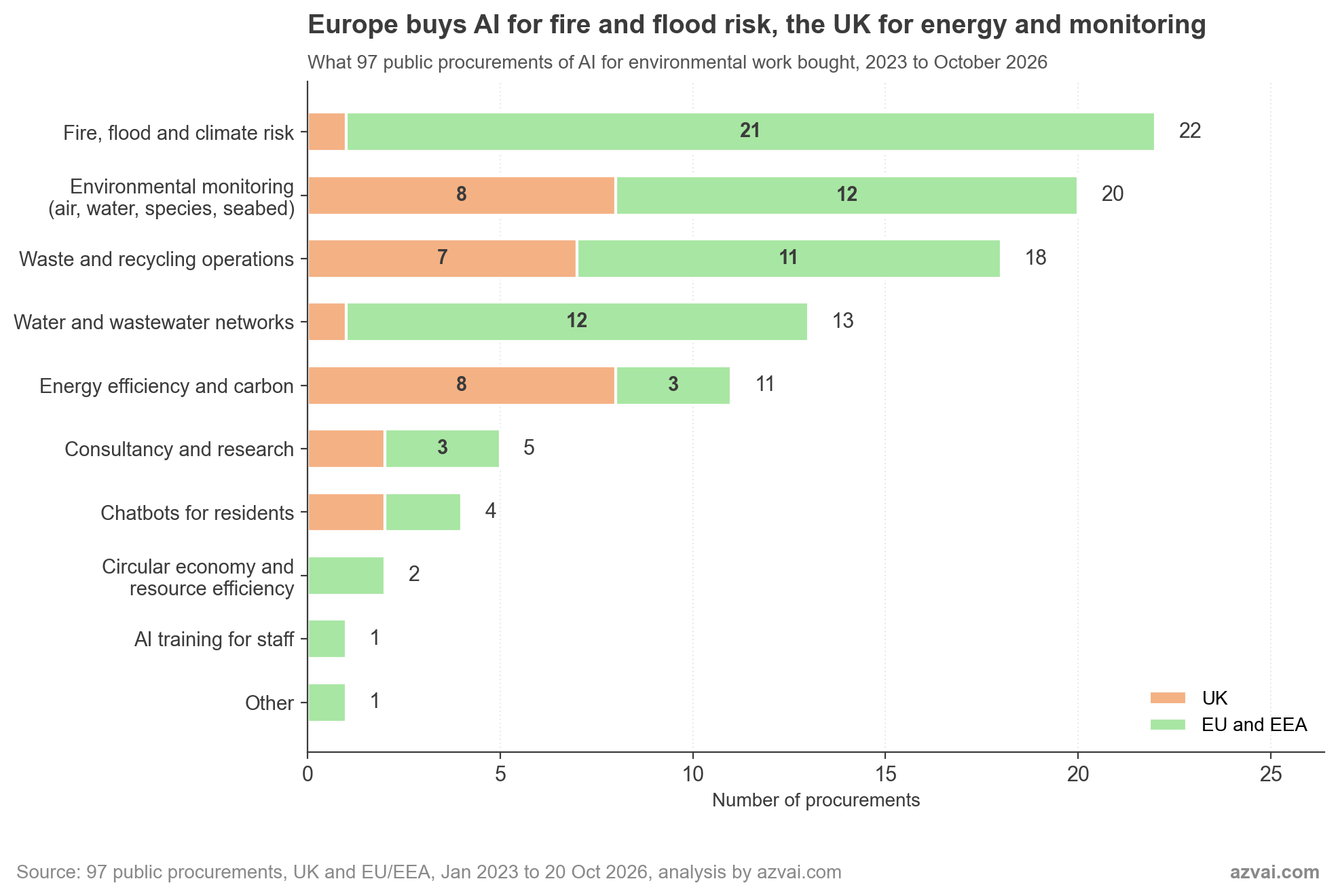
- Europe buys against hazards and for water networks. Fire, flood and climate risk lead in the EU. The UK buys most for energy, monitoring and waste.
- The circular economy barely shows up. 15 procurements touch it, mostly sorting robots and contamination checks, and none is about reuse or repair.
- Scotland buys AI for roads, notes and contact centres. Its one environmental purchase counts bycatch on fishing-vessel CCTV.
All 97 are in our free AI for Environmental Work Tender Explorer, with a link to every official notice. Each finding ends with an italic line on how far the evidence goes.
1. AI for environmental work is a small slice of public AI buying
Of the 8,284 public notices that mention AI in this period, 204 are about environmental work. That share has held at about 2 or 3 in every 100 in the EU and 1 or 2 in the UK, with no steady rise.
By year first published, the EU and EEA (with ECMWF) had 12, 12, 26 and 18 procurements from 2023 to October 2026, and the UK 5, 4, 12 and 8.
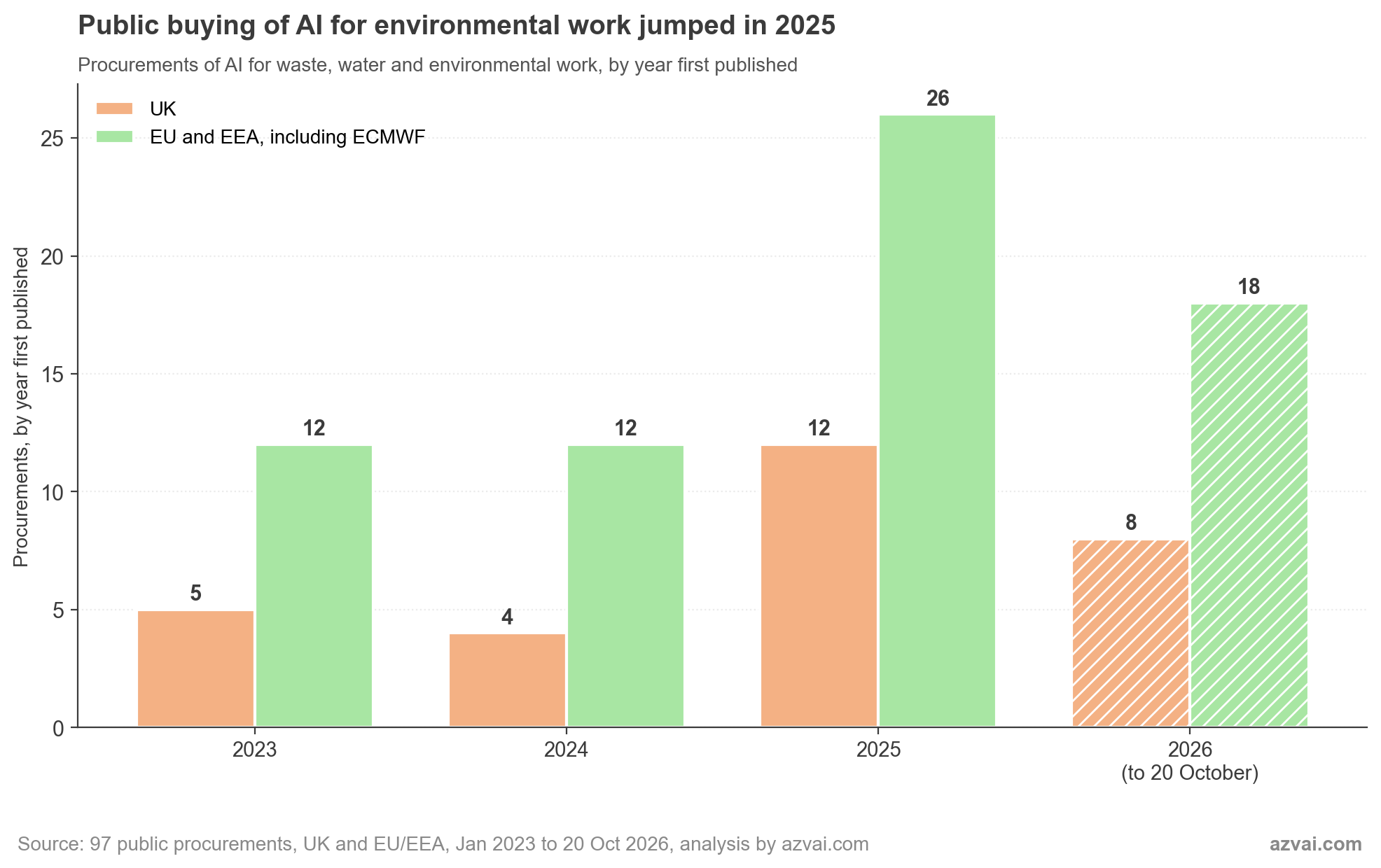
The 2025 jump follows the rise in AI buying overall. For scale, the same data and method found 390 procurements for AI in education and training, about four times as many.
Solid with caveats. It rests on notices that say “AI” or an equivalent in their own text, so tools with AI inside that never use the word are missed.
2. Europe buys AI against fire, floods and climate risk
Natural hazards and climate adaptation is the largest category, with 22 procurements, 21 of them European. Greece’s Information Society company alone tendered four AI early-warning and civil-protection systems. Three were awarded at €21.7m to €32.1m each, and the fourth was estimated at €15.8m.
Wildfire is the clearest cluster, with six procurements.
- France. An AI camera network across Côte-d’Or (a framework estimated at €1.2m), and an early-detection system for the Alpes-Maritimes (€400,000).
- Spain. AI-equipped drones for early fire detection (€1.44m), and AI detection of firebreaks in Castilla y León (€294,370).
- Greece. The national fire-detection framework above, and a forest-fire camera network in Patras.
Spain’s Secretary of State for the Environment also bought an AI digital twin of the coast for climate adaptation (€3.76m). North Rhine-Westphalia’s environment ministry tendered flood-wave estimates for up to 220 dams and asked for machine-learning methods.
ECMWF, which we report as its own buyer, ran 12 contracts for Destination Earth and the Copernicus climate service, the EU’s climate modelling and data programmes. They range from machine-learning climate emulators to an AI chatbot for climate data, and 7 of them are among the 21 European hazard procurements. The UK has one, Northumberland County Council’s pilot of an AI flood warning system for Alnmouth (£1.53m).
Solid with caveats. The topic codes are a model’s reading checked by a reviewer, and a third of the European hazard procurements come from one buyer, ECMWF.
3. Councils and utilities buy it for bins, litter and pipes
National governments and agencies ran 36 procurements (12 of them ECMWF’s), councils and waste authorities 34, utilities 15, other bodies 9 and universities 3.
Europe’s councils buy for their own networks
Of the 22 EU council procurements, eight are about waste and six about water networks.
- Rennes Métropole. A framework for AI control of its sewage treatment plants (€6m).
- Rouen and Béthune. A digital twin of Rouen’s drinking-water network that ranks pipes for replacement, and an AI tool for drinking-water network performance in Béthune (€250,000).
- Toulon. AI cameras that check sorting quality in household waste collection vehicles (€103,600).
- Grand Besançon. Sorting-error detection on bin lorries with AI-assisted analysis (a framework estimated at €2.1m, open on 20 October 2026).
- The Nola area in Italy. AI remote sensing of illegal dumping (€1.35m).
UK councils buy pilots and one plant
Of the 12 UK council procurements, five are energy and carbon tools (Surrey, Bassetlaw, Nottingham and two at the City of London) and five are about waste.
- Fly-tipping and litter cameras. Lewisham’s six-camera pilot, and Wolverhampton’s planned smart cameras for litter thrown from vehicles.
- A resident reporting tool for waste and cleansing issues, bought through the capitalEsourcing portal.
- Market engagement by West London Waste Authority on AI cameras that spot recycling contamination on collection vehicles.
- Greater Manchester’s new materials recovery facility equipment (£20m estimated), whose tender asks bidders to use AI to raise capture and purity rates.
The other two are a fly-tipping chatbot in Cambridgeshire and Northumberland’s flood pilot.
Water operators sit mostly in Spain, France and Italy
Water and wastewater networks account for 13 procurements, 12 of them in Europe. Five are Spanish, among them Seville’s water-cycle analytics platform (€2.5m) and network software in Cádiz and Chiclana, and four are French. Italy’s Publiacqua bought machine learning to cut network losses (€1.2m), and Bydgoszcz in Poland an AI system to control its stormwater tanks. In the UK only Yorkshire Water is in scope.
Strong for the split between councils, agencies and utilities. The UK council list is short (12), so read it as a set of examples.
4. UK government buys AI to watch the sea and the land
Cefas, Defra, the Environment Agency and the Scottish Government’s marine work account for 9 of the 10 UK government purchases, and 8 of the 10 are environmental monitoring.
- Seabed images. Defra bought deep learning to automate the analysis of seabed imagery for marine ecosystem monitoring (£107,280).
- Pig farms from space. The Environment Agency bought deep-learning satellite detection of outdoor pig farms across the country to assess environmental risk (£49,965).
- Marine litter. Cefas paid for about 7,000 labelled Ghanaian beach images (£46,500) and labelled drone survey images (£47,933) to train litter detectors.
- Bycatch. The Scottish Government is developing computer vision to count bycatch on fishing-vessel CCTV (£75,000 estimated).
Five of the eight with a value cost between about £46,000 and £75,000. I read them as agencies testing a model on one monitoring task at a time.
Strong for who buys. The sizes are directional, because only 18 UK single contracts state a value.
5. The circular economy barely shows up, and reuse and repair not at all
15 of the 97 procurements touch circularity, 11 in the EU and 4 in the UK. Eleven are recycling operations, mostly AI sorting robots and contamination checks, from waste companies in Latvia and Slovenia to council collections in Toulon and Grand Besançon and Greater Manchester’s recovery facility.
Two are chatbots, one from WRAP for a Hampshire council food-waste and recycling pilot and one for the Balearic Islands’ circular economy directorate (€27,165). The last two belong to one programme, the Green-AI Hub Mittelstand, run by ZUG for Germany’s federal environment ministry to develop AI for material savings in smaller firms. Its 2.0 framework is worth €19.6m (2026).
None of the 135 in-scope or borderline procurements is about reuse, repair, refurbishment or second-hand goods, in any language.
My reading is that AI money follows sensors, cameras and networks, where data already flows in volume. Reuse and repair run on people, relationships and small, varied volumes, which is where most field circular-economy work sits.
It is the side of the work I know, from designing a waste system for a coastal city on Project STOP in Indonesia, and from a field methodology for designing circular economy systems. I am unsure what the gap means. AI may have little to add to repair work, or nobody may yet have framed a public purchase around it.
Strong for the absence of reuse and repair, since every notice in the pool was read. Directional for the count of 15, because “circular” was a yes or no call on short descriptions.
6. Scotland buys AI for roads, notes and contact centres
We read all 40,096 releases on Public Contracts Scotland from January 2023 to 20 October 2026. Of those, 149 mention AI, about 4 in every 1,000.
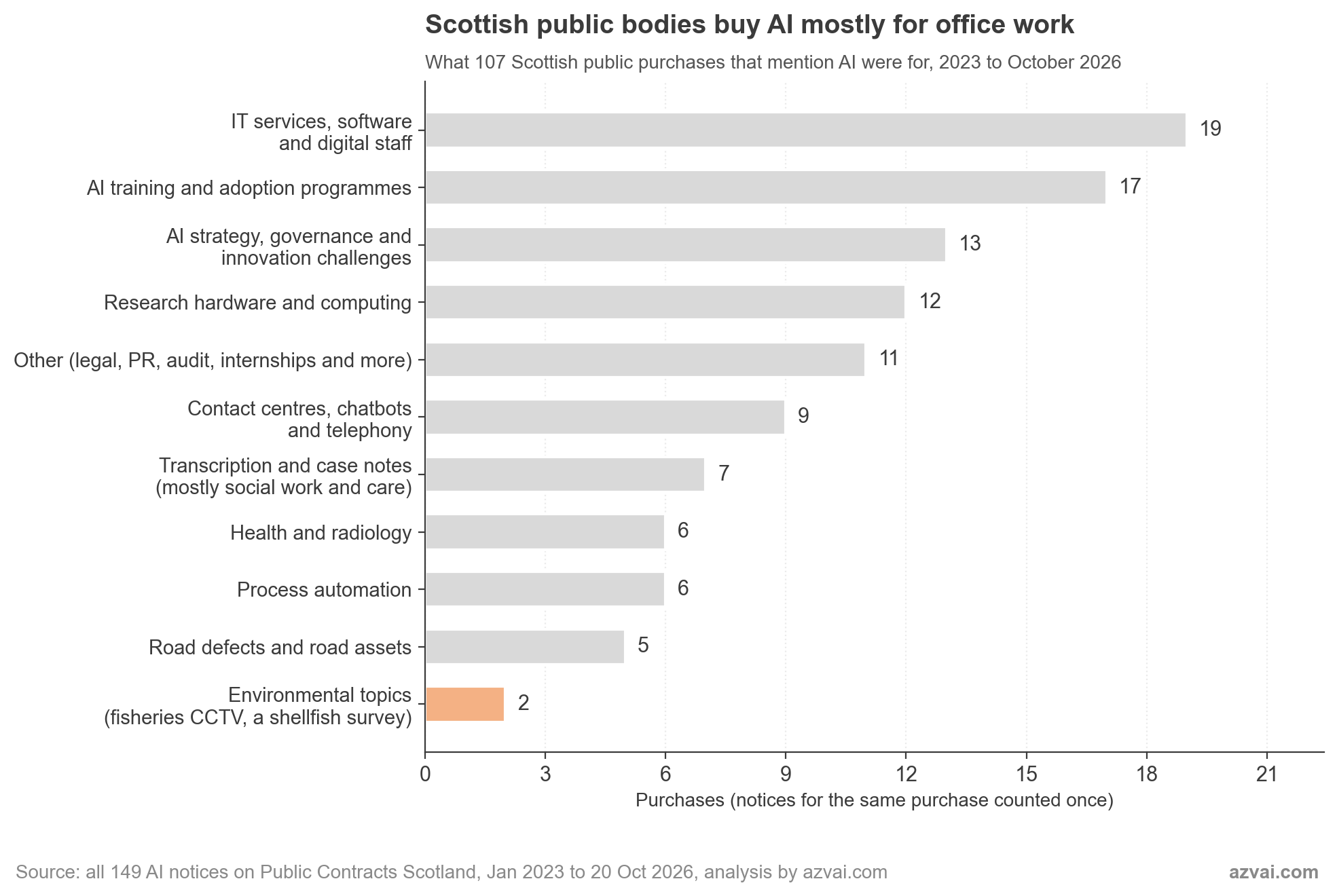
One is in scope, the Scottish Government’s computer vision to count and classify bycatch on CCTV from pelagic fishing vessels (£75,000 estimated, 2026). Three more are borderline, including an AI knowledge assistant mainly for Energy Saving Trust’s own staff (£260,000 estimated).
What I find more telling is who is absent. SEPA, Zero Waste Scotland and NatureScot published no notice that mentions AI on any of the four portals, and no AI notice anywhere mentions the Circular Economy (Scotland) Act 2024.
Scottish councils do buy AI, for other jobs.
- Road defects. Argyll and Bute, North Ayrshire, East Ayrshire and Fife.
- Transcription and case notes, mostly in social work and care. Six bodies, including Highland and Fife councils and NHS Highland.
- Contact centres and chatbots. Dundee, Fife and Renfrewshire councils, among others.
For context, see our system map of Scotland’s circular economy and household recycling by council.
Strong for Scotland, since every notice on the portal was read. Wales and Northern Ireland are not covered.
7. UK contracts are small, EU contracts much larger, and few suppliers repeat
75 of the 97 procurements state a value. Typical below means the middle value. Framework ceilings sit apart, because a framework only caps what may be spent through it. Seven values in other currencies are left out.
| Typical single contract | Middle half of contracts | Typical framework ceiling | |
|---|---|---|---|
| UK | About £91,000 (18 with a value) | £50,000 to £260,000 | Only two state one (£1m and £32m) |
| EU and EEA | About €920,000 (36 with a value) | €280,000 to €2.3m | About €2m (12 with a value) |
Greater Manchester’s £20m plant is the one large UK value, and a typical EU council contract is about €320,000.
In the EU, 39 of the 68 procurements went to open tender. The rest were 13 new frameworks, 4 restricted or negotiated procedures, 3 direct awards and 1 dynamic purchasing system, and 8 state no route. In the UK, 14 of the 29 state no route. Of the others, 6 were direct awards, 3 open tenders, 2 quotes below threshold, 2 new frameworks, 1 a call-off from an existing framework and 1 a restricted procedure.
Suppliers are spread thin. 65 procurements name a supplier, and none appears more than three times. Arup won three UK procurements (Northumberland’s flood pilot, National Highways’ litter-camera trial and early work on a geospatial AI platform for the Environment Agency).
Directional. About one procurement in four states no value, estimates and awards are mixed, and about half the UK procurements give no route.
What this means if you work on waste, reuse or environmental projects
If you run a small circular-economy consultancy
Where a UK route is stated, direct awards and quotes outnumber open tenders by eight to three, and several notices are market engagement for pilots not yet tendered. My guess is that pilots of this size suit a small team working alongside a technology supplier.
A camera on a bin lorry can flag a contaminated bin. Knowing why contamination rises on one round, and how to talk to residents about it, is field knowledge. In my reading, that is where a consultancy adds value next to the supplier, though the data says nothing about who wins.
If you are a council waste or environment officer
Lewisham’s £50,000 fly-tipping pilot and Grand Besançon’s €2.1m sorting-error framework tackle related problems at very different scales. The explorer lets you filter by country, buyer type and topic to find the purchases closest to yours.
If you fund or run reuse and repair programmes
I read the empty reuse and repair row as the most useful result here. I would like to know whether it marks a gap worth filling or a sign that these services need other tools first.
What this data can’t tell you
- Notices that never say AI, and long notices. We matched AI terms in 24 languages, and source descriptions stop at 3,000 characters, so an AI lot mentioned later is missed.
- What counts as AI. Our rules count chatbots as AI even when a notice does not say how they work, as with WRAP’s WhatsApp chatbot.
- Wales, Northern Ireland and small purchases. Sell2Wales and eTendersNI were not searched, and TED, the EU’s tender journal, only carries notices above EU thresholds.
- Spend and timing. Framework ceilings overstate spend, and 2026 is a partial year.
- Motives and results. The notices cannot show why a buyer chose AI or whether a pilot worked.
- The footprint of AI itself. That was out of scope, and our article on whether generative AI is sustainable covers it.
How we put this together
We started from every notice that mentions AI on UK Contracts Finder, UK Find a Tender, Public Contracts Scotland and TED (all 24 official EU languages), from 1 January 2023 to 20 October 2026. That gave 8,284 AI notices.
A rule set in 21 languages picked the ones that mention waste, water, emissions, nature or similar topics. An AI model (Claude Haiku) coded 1,343 notices blind against a written codebook. A larger model (Claude Opus) then acted as lead reviewer, working to seven written rules.
It settled every unclear case, audited 80 random codes (77 held) and read the AI passage of 196 long notices that the first model only saw in part, which added 7 procurements. A check of 150 random AI notices outside the topic pool found none in scope, and all 149 Scottish AI notices were coded.
Notices for the same purchase were grouped into 97 procurements (204 notices). Another 38, mostly smart-city bundles that list AI next to environmental sensors without linking the two, were kept aside as borderline. The full table (CSV) and the tender explorer carry every procurement with its official notice links.
Twelve procurements that show the market
| First published | Buyer | Country | What was bought | Value | Route |
|---|---|---|---|---|---|
| Aug 2023 | Publiacqua | Italy | Machine learning to cut water losses | €1.2m awarded | Restricted or negotiated |
| Dec 2023 | Rennes Métropole | France | AI control of sewage treatment plants | €6m framework, awarded | New framework |
| Apr 2024 | Defra | UK | Deep learning to analyse seabed images | £107,280 awarded | Not stated |
| May 2024 | ECMWF | Intergovernmental | Machine-learning climate emulator | €1.07m awarded | Open tender |
| Aug 2024 | Information Society company | Greece | AI fire detection and early warning | €21.7m framework, awarded in 2025 | New framework |
| Feb 2025 | Nola area development agency | Italy | AI remote sensing of illegal dumping | €1.35m awarded | Open tender |
| May 2025 | Greater Manchester Combined Authority | UK | Recycling plant equipment, with AI to raise capture and purity | £20m estimated | Restricted or negotiated |
| Sep 2025 | Secretary of State for the Environment | Spain | AI digital twin of the coast | €3.76m awarded | Open tender |
| Jan 2026 | Scottish Government | UK (Scotland) | Computer vision to count bycatch | £75,000 estimated | Open tender |
| Feb 2026 | ZUG, for the federal environment ministry | Germany | Green AI Hub 2.0 for resource efficiency | €19.6m framework, awarded | New framework |
| Feb 2026 | Toulon Provence Méditerranée | France | AI cameras checking sorting quality in waste collection vehicles | €103,600 awarded | Open tender |
| Sep 2026 | London Borough of Lewisham | UK | Six AI cameras to detect fly-tipping | £50,000 awarded | Direct award |
The Bottom Line
Public AI buying for environmental work is a small, steady slice. Most of the money goes to watching hazards and running water and waste networks, and the circular economy appears only at the sorting end. Reuse and repair do not appear at all.
If you are working on something close to this, or spot a purchase we missed, write to me at borja@azvai.com.
FAQ
How are UK councils using AI for waste and recycling?
Mostly through cameras and small pilots. Lewisham bought a six-camera fly-tipping pilot, Wolverhampton is planning cameras for litter thrown from vehicles, and West London Waste Authority asked the market about cameras that spot recycling contamination. The one large purchase is Greater Manchester’s £20m recovery facility, whose tender asks for AI to raise capture and purity.
Do councils buy AI for the circular economy?
Rarely, and only at the recycling end. Of the 15 procurements that touch circularity, 11 are recycling operations, mostly sorting robots and contamination checks on council collections and at waste companies. None of the 135 in-scope or borderline procurements is about reuse, repair or second-hand goods.
What does a public AI contract for environmental monitoring cost?
In the UK, monitoring contracts often cost about £46,000 to £75,000, such as the Environment Agency’s pig-farm detection (£49,965) and the Scottish bycatch tool (£75,000 estimated). Across all topics, a typical UK single contract is about £91,000 and a typical EU one about €920,000.
Where can I find tenders for AI in waste and environmental work?
In the UK, on Contracts Finder, Find a Tender and, for Scottish bodies, Public Contracts Scotland. In the EU, on TED, which only carries notices above EU thresholds. Our explorer lists all 97 procurements here with links to the official notices.
