
I wrote two Claude Code skills that build, research and stress test business models, published them under an MIT licence, and pointed them at a project I ran myself.
In 2021 I worked with the Government of Seychelles on ReNeT, a circular economy project for the industrial tuna fleet’s end-of-life fishing nets. The system design behind it is a separate story. This one is about its folder, which held what every project folder holds. Field interviews, fleet data, a system-map deck, a report, a financial model. The skills rebuilt the model from that evidence.
The first thing it surfaced was a cost formula pointing at an empty cell.
A financial model is an argument about the future wearing the costume of arithmetic. The arithmetic was never the hard part. AI has made the costume nearly free, which makes the argument the only thing that matters.
For a venture that does not exist yet, that argument is assumptions nobody sourced. It decides whether a sustainable project is financially viable and scalable in front of a funder.
The published guidance assumes startups and PE deals. Anthropic’s reference workflow pulls historicals from Daloopa, comparables from S&P Global and a template from Box, presuming an institutional data room a pre-revenue circular venture does not have. A mismatch of starting conditions, not bad advice.
Circular-economy public-equity funds grew 22-fold to USD 6.6bn by December 2023, with USD 350bn deployed since 2019, per the Ellen MacArthur Foundation. The committee is growing.
What follows is that rebuild. Four things the skills surfaced, two failure modes, and a method. Three of the four came from the folder disagreeing with itself, not from the internet.
Key Takeaways
- The model was competent and still wrong. Driver-based, itemised CAPEX, real field interviews, and 98% of its 316 formulas reproduce exactly. These findings hide in good models, not bad ones.
- Three of the four findings came from the project’s own folder, not from the internet. The deck contradicted the model by four times on CO2. An interview quoted a price 40% below the one used. A container quote sat in the same directory as a shipping figure three times too low.
- One empty cell made the venture look 143k better off. A bug that deflates profit gets found because somebody is disappointed. A bug that inflates it does not, because nobody audits a number going their way.
- Sensitivity analysis cannot rank your assumptions. A driver model is a chain of multiplication, so the levers tie. Only evidence quality breaks the tie, which makes provenance the whole game.
- Priced on the folder’s own evidence, year three moves from +406k to -165k. Same project, same facts, no new research.
Start with the empty cell.
The Empty Cell That Made a Recycling Business Case Look Better
The project’s financial model charged the venture to bury 100% of its recovered nylon in a Seychelles landfill. On the same sheet, it sold 85% of that same nylon to a buyer. The cost side and the revenue side were describing two different physical realities, and had been for a long time.
One empty cell did that.
The direct-cost line was written as (1-D21)landfill + D21shipping. Cell D21 was meant to hold the share of nylon shipped to a reprocessor rather than landfilled, and the logic is correct. Whatever fraction we ship, charge shipping on that, and charge landfill on the rest.
But D21 was empty, and an empty cell reads as zero. So the formula quietly resolved to ship nothing, landfill everything. No error, no warning, and a perfectly plausible number at the bottom of the column.
The direction of the error matters more than its size. Shipping the nylon to a European reprocessor, and there is a small, identifiable set of them, cost 170 EUR per tonne in the model. Landfilling cost 80. Charging the cheaper option on 85% of the material made the venture look roughly 143k better off than its own assumptions said it should be.
The empty cell broke the model’s coherence while flattering its result.
That is the frightening version. A bug that deflates your profit gets found, because somebody is disappointed and goes looking. A bug that inflates it does not, because nobody audits a number that is going their way.
Notice what did not happen. The spreadsheet was not broken. Every cell computed exactly what it had been told to compute. The arithmetic was flawless and the argument was incoherent, and no amount of formula-checking would have caught it, because there was no formula error to catch.
That is the exact seam AI-built models sit on. Structure that computes, meaning that does not hold.
The 2021 model was a good model, and that is load-bearing rather than a courtesy. Driver-based rather than hardcoded. Itemised CAPEX. Real field interviews behind the physical parameters. 98% of its 316 formulas reproduce exactly against a clean rebuild.
This is not an article about a bad spreadsheet. It is about what hides inside a good one that has been reviewed, discussed and used for months. If your model is fine, you are the reader at risk.
Three More Numbers the Project’s Own Folder Already Disagreed With
The rebuild surfaced three more disagreements. What they have in common matters more than what any one costs.
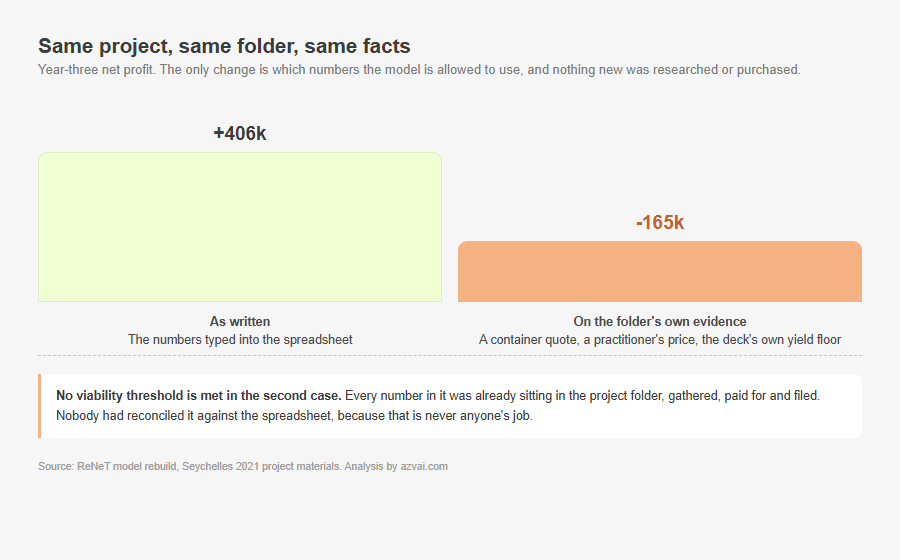
Priced on the evidence the folder actually contains rather than the numbers typed in, with no new research and no data purchased, year-three net moves from +406k to -165k and no viability threshold is met. Same project, same facts, same folder, and a business case that flips from fundable to not. These are the findings that hide in competent work.
Three of the four came from the project’s own documents disagreeing with each other. Not from the internet. Not from a research agent.
The evidence had been gathered, paid for, filed, and never reconciled against the spreadsheet it was supposed to inform. On most projects the gap between what a project knows and what its model says is wider than the gap between what it knows and what the world knows.
That is nobody’s fault, which is why it keeps happening. Documents accumulate over months. The deck gets updated for a pitch, the model for a board paper, an interview lands in someone’s inbox in week three. Nobody sits two of them side by side, because that is never anyone’s job.
A funder’s analyst reads both. That is why the method below starts from the folder rather than from a search.
Benchmark Laundering, a Failure Mode This Article Is Naming
Nobody lied and nobody was careless. Trace the PA 6.6 price back along its chain. A real index, published by a real exchange, tracking real transactions in a real polymer, read correctly and entered accurately. Every step survives inspection. The conclusion was fiction.
That pattern needs a name, so I am giving it one. Benchmark laundering. I went looking for an existing term and could not find one, and the phrase has no established usage in this sense. The nearest adjacent hit is an unrelated machine-learning concept called data laundering, which is about contaminating a model with benchmark test data.
Benchmark laundering is a real statistic about a sector, quietly promoted into a venture-specific assumption. The metaphor earns itself, because the number enters as sector data and leaves as a project fact, and by the time it reaches the model its origin is no longer visible or questioned.
The test takes ten seconds and runs against any sourced number in your model.
- Population. Does the source measure what you are measuring? A PA 6.6 market is not a PA 6 output.
- Period. Does the date still apply? A 2019 gate fee is not a 2026 gate fee.
- Unit. Per tonne of what exactly, at what moisture, at what purity, before or after dismantling?
Fail any one and the number is laundered, however good the source is. Source quality is not the defence.
The plasticker index is an excellent source. Its excellence is the trap, because a good source is precisely what stops anyone asking the next question.
AI industrialises this. A research agent is superb at finding a real, well-sourced, correctly-quoted statistic about an adjacent thing. It has no way to know your output is PA 6 rather than PA 6.6 unless someone tells it, and no instinct to ask.
Speed multiplies the failure rate, not the accuracy. The tool that finds you thirty sourced benchmarks in a minute is the same tool that launders thirty benchmarks in a minute.
Why Sensitivity Analysis Cannot Rank Your Assumptions
I built the tornado chart expecting a ranking and got a row of identical bars. Six drivers, tied at exactly 234k of swing each. My first assumption was a bug in my own code.
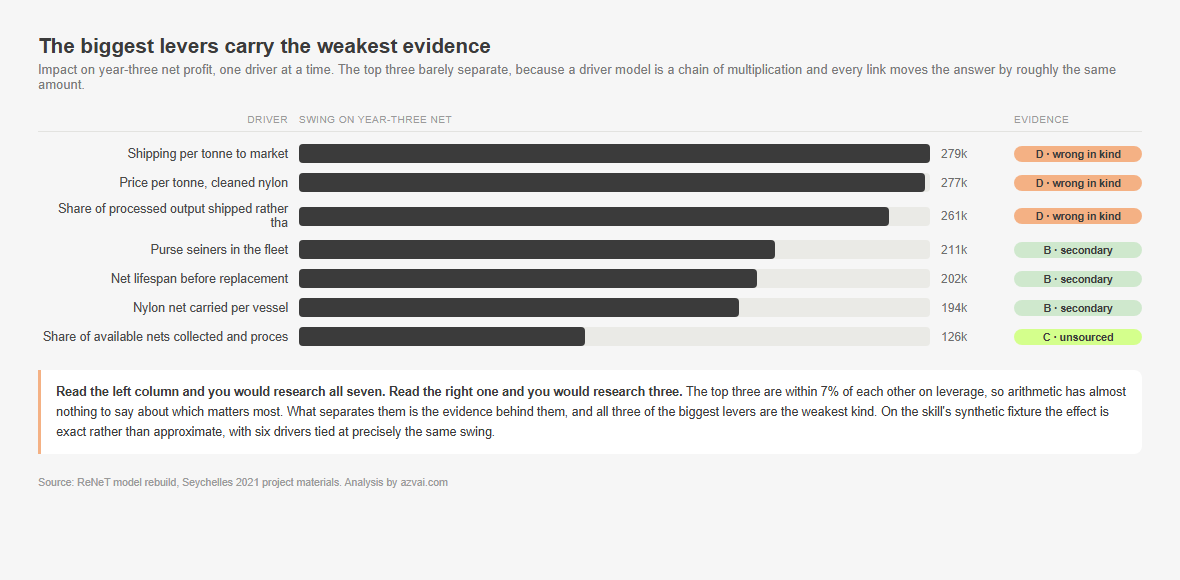
It was not a bug. It was arithmetic, and once you see it you cannot unsee it.
A driver model is a chain of multiplication. Tonnes collected, times share recovered, times price per tonne, gives revenue. Pull any one link by plus or minus 20% and the output moves by 20%, because multiplication does not care which link you pull. The drivers are structurally interchangeable.
So the tornado chart, whose entire purpose is ranking assumptions by leverage, hands back a tie. The tie is not noise and not a modelling mistake. It is the true answer. Arithmetic cannot tell you which of those six numbers to worry about, because arithmetically they are the same number.
The published guidance treats sensitivity as a feature that works as advertised. Anthropic’s reference workflow offers it across 25 combinations. Finro, a startup-modelling consultancy, gets closest to the problem, complaining that AI-built scenarios move only headline growth rates rather than the assumptions underneath them. That is the right target and it stops one step short, because the reason those scenarios are hollow is that nothing told the modeller which assumption was worth moving.
The general literature notes an established limitation, that a tornado chart tests one variable at a time and cannot capture interactions or correlations. That much is consensus and I cite it as such. The multiplicative-tie framing is my own observation and did not appear anywhere in the research for this piece.
Here is where it turns. If arithmetic cannot rank the six tied drivers, something else has to, and only one candidate is left standing. Evidence quality.
Two drivers with identical leverage are not equally dangerous. One is 600 EUR per tonne from a practitioner who physically handles the material, quoted in an interview sitting in the folder. One is a laundered PA 6.6 index. Same swing, completely different risk.
So the ranking that matters is leverage times evidence weakness, not leverage alone.
That changes what the tool is for. Sensitivity analysis is a shortlisting tool, not a ranking tool. And provenance, which the whole category ignores, is not a tidy-consultant discipline you skip under deadline. It is the only thing that can break the tie.
The 234k result reruns on a synthetic fixture shipped in the published skills repo, so you need not take it on trust.
Independent Tests Find the Same Weakness in AI Built Models
One consultant, one five-year-old spreadsheet, one obscure sector, one convenient story. Fair objection, and I would make it myself. Here is what happens when other people test this properly.
SumProduct, an Excel and financial-modelling consultancy, did the work hands-on and did it well. They wrote a deliberately detailed 11-page expert-persona prompt, opening with “You are an expert FMCG CFO and financial modeller with deep experience in beer manufacturing and distribution”, and got back a fully integrated 10-year monthly three-statement model.
Their audit found it “very strong on structure but weaker on maintaining economic meaning across the entire model, with some relationships being mathematically correct but financially fragile, and others relying on hidden assumptions that were not clearly documented”. Their site blocks automated fetches, so that quote reached this article via a search-indexed snippet, not a direct read.
Read that against the empty cell. They arrived from a generic FMCG beer model with a maximal prompt. The Seychelles rebuild arrived from a 2021 spreadsheet with no prompt at all. Same destination.
Structurally sound, economically incoherent, assumptions undocumented. Two routes, one thesis, and it survives both.
What this piece adds is narrow. Theirs is one generic FMCG run, no circular-economy angle, no document-grounded start, nothing a reader can rerun.
Anthropic’s own Help Center advises against using Claude for Excel for audit-critical calculations without verification, or as a final client deliverable without human review. That is the fairest citation here. It is the vendor arguing against its own marketing, and a useful correction to the habit of assuming these tools are good at everything.
The category’s headline number deserves scrutiny too. Sid Saladi’s Substack piece opens on nine days to 18 minutes, a flat assertion with no study, no benchmark, no named source, and no word on whose nine days.
Which leaves the question nobody asks. Can a model produced in 18 minutes be defended for an hour in front of a committee? That is the only test this audience ever faces.
A Document Grounded Method for Building the Model With AI
Every guide starts the same way. Describe your venture, let the AI build the model. Start somewhere else.
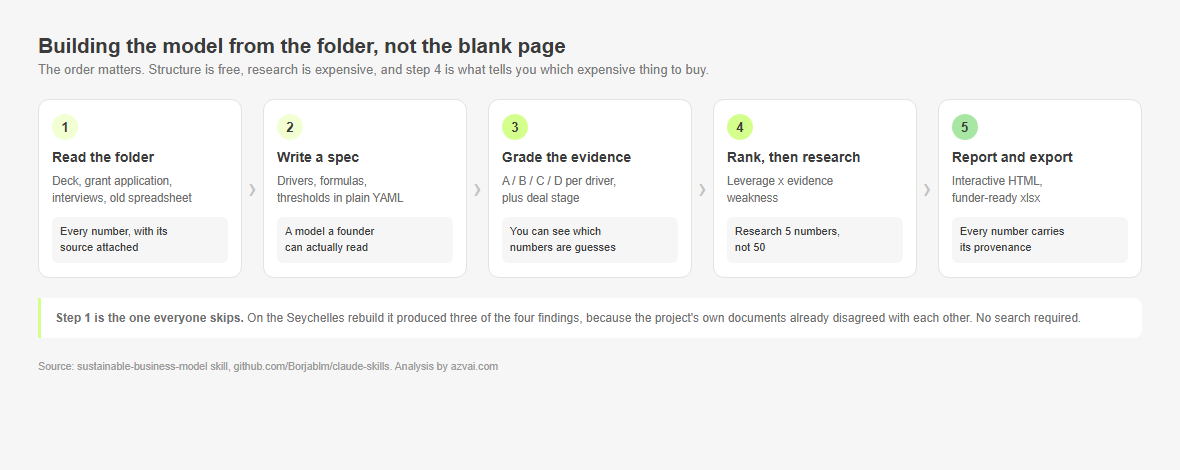
The first research task is not a search. It is reading your own folder.
That disagreement list is the highest-yield artefact in the project and almost nobody produces one. It is also the step AI is unambiguously good at, worth saying after five sections on what it is bad at. Reading forty documents and tabulating every number with its source is exactly the job.
Skills get treated across the whole category as saved templates. A DCF format, a credit-memo layout. Step three above is the one that makes them something better, because a skill that keeps the arithmetic in code and the language model on judgement is a skill whose output you can check.
This is where external research belongs and where an agentic research workflow earns its cost.
Both skills are published at github.com/Borjablm/claude-skills, MIT licensed. One builds a model from a folder like this one, reading the documents, drafting the spec, grading each driver’s evidence, ranking what to research and rendering the report. The other audits a spreadsheet model that already exists, which is where most people actually are. They ship with synthetic fixtures, so every methodological claim in this article can be rerun by someone who does not believe it. There is also a worked example of a repair-café network you can open and change the numbers in, which lands the leverage-times-evidence point faster than reading about it.
Where External Research Finds What Your Folder Never Could
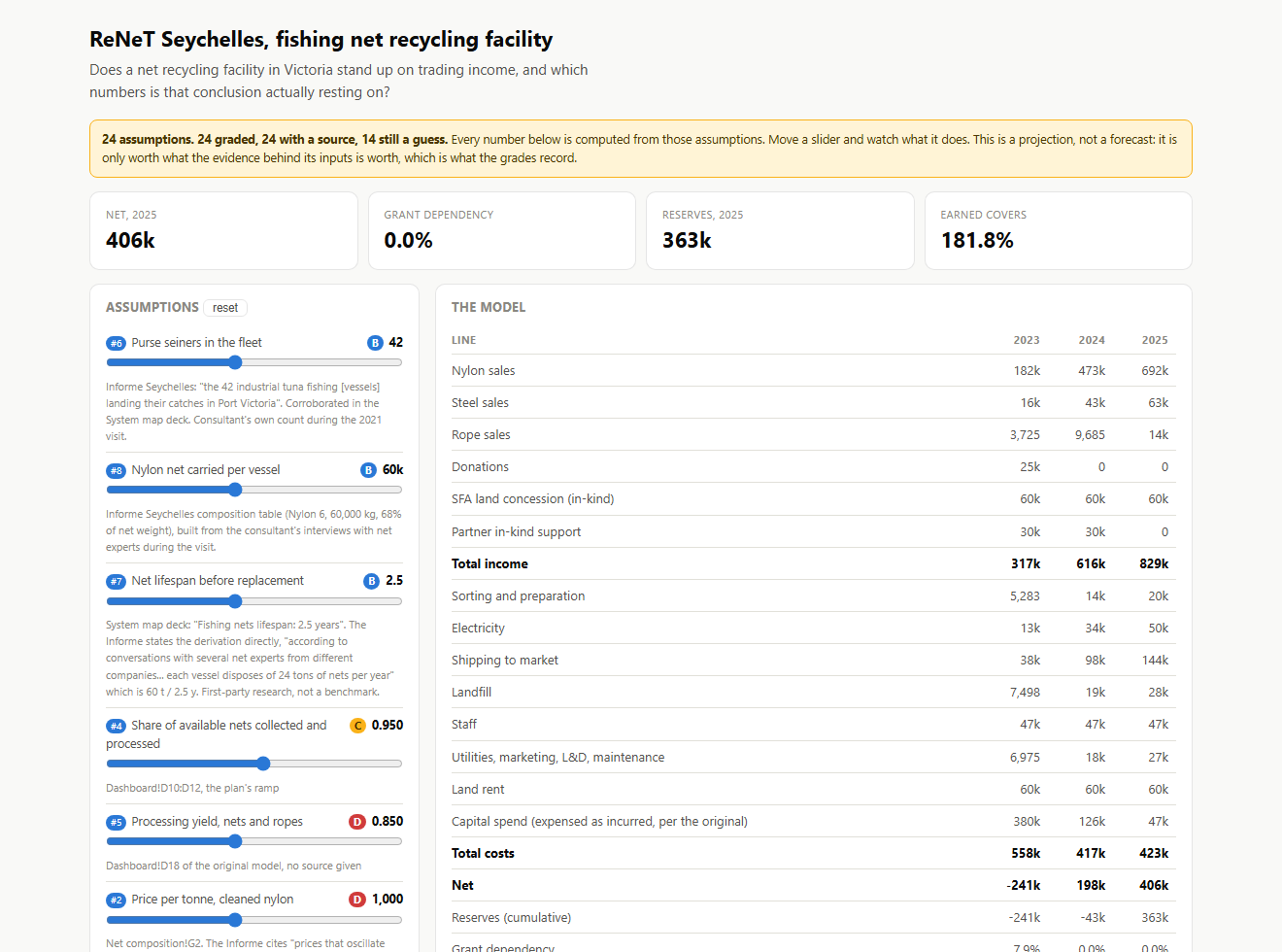
The folder surfaced four disagreements. A paper published a year after the study surfaced a fifth that sits underneath all of them.
A 2022 Frontiers in Sustainability study of tropical tuna purse-seine net recycling covers this exact subject. Three findings bear on the model.
Average net weight is 93.1 tonnes, plus or minus 16.2. The model assumed 60. That is the unit at the bottom of the volume build, and everything multiplies through it.
Netting is replaced every 12 to 14 months, against the model’s 2.5-year lifespan assumption. That is the feedstock supply rate, and it moves in the project’s favour, which is why nobody thought to check it. Nobody audits a number going their way, in either direction.
Recycled PA6 flake and pellets cost 37% and 50% more than virgin PA6, while the recycled yarn carried roughly 69% lower environmental impact per kg. The sector’s most comfortable intuition, that recycled is the cheap option, is false in the one place it was measured. That is a benchmark-laundering trap running in the opposite direction.
The study did not exist when the 2021 work was done, so nobody could have read it. The argument that the answers are usually already in your folder has a limit, and the limit lands on the volume assumption. Three of four findings were internal. The fifth was only ever coming from outside.
The method needs both stages, and the external one decays, because the literature keeps moving after your model stops. A model is not a document you finish.
The 2026 tooling broke too. The report’s compiled JavaScript silently dropped an entire revenue line, caught by a cross-check rather than by the report looking wrong. The audit’s Findings tab was writing live formulas that would have reached a funder as #VALUE! errors.
Draw the line back to the empty cell. It failed silently. So did both of these. Silent failure is the category, and it does not care whether the thing failing is a 2021 spreadsheet, a 2026 language model, or the tool built to check them.
Verification is not a stage you bolt on at the end. It is the only thing separating a model from a story.
Frequently Asked Questions
Can I just use Claude for Excel instead of doing all this?
Claude for Excel is generally available on Pro, Max, Team and Enterprise per Anthropic’s Help Center, handling .xlsx and .xlsm with no macros, VBA or data tables. Anthropic itself advises against audit-critical use without verification, while its own marketing page still calls it a waitlisted beta. It is good, and it is not what decides whether your argument holds.
What does a funder actually check in a financial model?
No funder publishes a rubric. Zero Waste Scotland’s Circular Economy Investment Fund publishes three Stage 1 screening criteria (circular-economy contribution including an explicit tCO2e estimate, development stage and commercial readiness, and potential for carbon savings, investment leverage and jobs), then directs applicants to email. The tCO2e estimate is screened explicitly, and that is the number the Seychelles folder disagreed with itself about by four times.
Is any of this reproducible or do I have to take your word for it?
github.com/Borjablm/claude-skills, MIT, two skills with synthetic fixtures. The 234k tie reruns on the shipped fixture, so that claim is checkable in a clone. The ReNeT workbook, spec and evidence files stay private, because they are not mine to publish. That is a real limit on what you can verify, and I would rather say so.
Does AI make financial modelling better or worse?
Both. It makes arithmetic and sourcing nearly free, which means more well-formed, well-sourced, confidently wrong assumptions per hour than any human could previously produce. It also makes reading forty documents and tabulating every number with its provenance cheap for the first time, and that step surfaced three of the four findings here. The population, period and unit test is your defence.
My venture is not a fishing-net facility. Does any of this transfer?
Yes. Multiplicative chains, undocumented provenance, and a folder of evidence nobody reconciled against the spreadsheet are not properties of recycling. They are properties of modelling a venture that does not exist yet, which is what a pre-revenue social or environmental enterprise is by definition.
Want this built around your own projects?
The skills are free and the method is in this article, so take both. If you would rather have them applied to your own work, or want a custom AI workflow built around how your team actually operates rather than around a demo, that is what I do. Tell me what you are modelling and which decision it has to survive.
For the wider consulting context first, that is AI for sustainability research.