

Most ocean-plastic interventions either think too small or too big. Too small looks like a single sorting facility serving one village. Too big looks like a national policy reform that never gets implemented. The missing middle is the operating system for a coastal city of fifty to a hundred thousand people. That is where the plastic actually leaks into the ocean, and that is where the design work is hardest.
Between 2018 and 2020 I worked with the SYSTEMIQ team on Project STOP, a programme designing waste-management systems for three coastal Indonesian cities (Muncar and Pasuruan in East Java, and Jembrana on Bali). By 2020 the programme had brought waste services to about 133,000 people and was diverting more than 1,100 tonnes of plastic per year from the natural environment. The work continues, with additional cities and additional partners since.
This article is the city-scale companion to Designing a Circular Economy from Scratch, which used a single-stream industrial case in the Seychelles. The framework I used in that piece (system mapping, value-leak diagnosis, governance design) still applies here. What changes is everything that depends on scale: the number of stakeholders, the role of households, the centrality of behaviour change, and the slow handover from project to permanent municipal infrastructure. This piece is about those differences.
Why City-Scale Waste Systems Fail Differently
The Seychelles case had a single material type (end-of-life fishing nets), a small number of well-defined generators (the tuna fleet), captive logistics (one port), and a formal-sector setting. None of those simplifications hold at city scale.
Coastal city waste in Indonesia is generated by tens of thousands of households plus several thousand small commercial outlets. The material is mixed, with organics typically over half by weight. The logistics are informal, often a mix of community tricycle collection and private waste pickers. The formal sector is thin. Local government has limited revenue and even more limited operational capacity. International donors and NGOs come and go.
The default failure mode at city scale is not bad design. It is good design that nobody runs. The sorting facility gets built, the launch ceremony happens, the press releases circulate. Eighteen months later the facility is operating at 20% of capacity, the collection fleet is half-broken, the household separation rate has dropped to single digits, and the municipal government cannot find the recurring budget to pay the staff.
This is the failure mode the design has to anticipate from day one. The system has to be cheap enough to run on local money, simple enough to maintain without expat advisors, legible enough to political cycles that it survives a change of regent, and sticky enough in household behaviour that the input flow does not collapse.
If you can hold all four of those constraints together in your design, you have a chance. If you let any one of them slip, the system slowly degrades back to the pre-intervention state.
The Five Workstreams
Municipal waste systems globally are organised around the same five workstreams. The labels vary by country. The substance is the same.
- Collection. Moving the waste from where it is generated (households, businesses, public spaces) to where it can be processed. Routes, vehicles, schedules, fee structures, worker conditions
- Sorting and material recovery. Separating recoverable materials from residuals. In Indonesia this is a TPST (Tempat Pengolahan Sampah Terpadu, an integrated waste processing facility). Recovery efficiency depends on input quality (which depends on collection and behaviour change)
- Recycling and off-take markets. Selling the recovered materials to processors, both formal recyclers and the informal-sector aggregators. Prices fluctuate. Material quality matters more than tonnage
- Behaviour change communication (BCC). Persuading thousands of households and small businesses to separate and present waste correctly. Without this, the upstream of the system is broken and every downstream investment underperforms
- Governance and financial sustainability. The political, contractual and financial machinery that lets the other four workstreams keep operating after the project ends. The slowest workstream to design and the one that determines whether the system survives
Most waste-management projects I have seen design two or three of these well and assume the others will sort themselves out. They do not. The five workstreams are tightly coupled. A weakness in any one degrades the others.
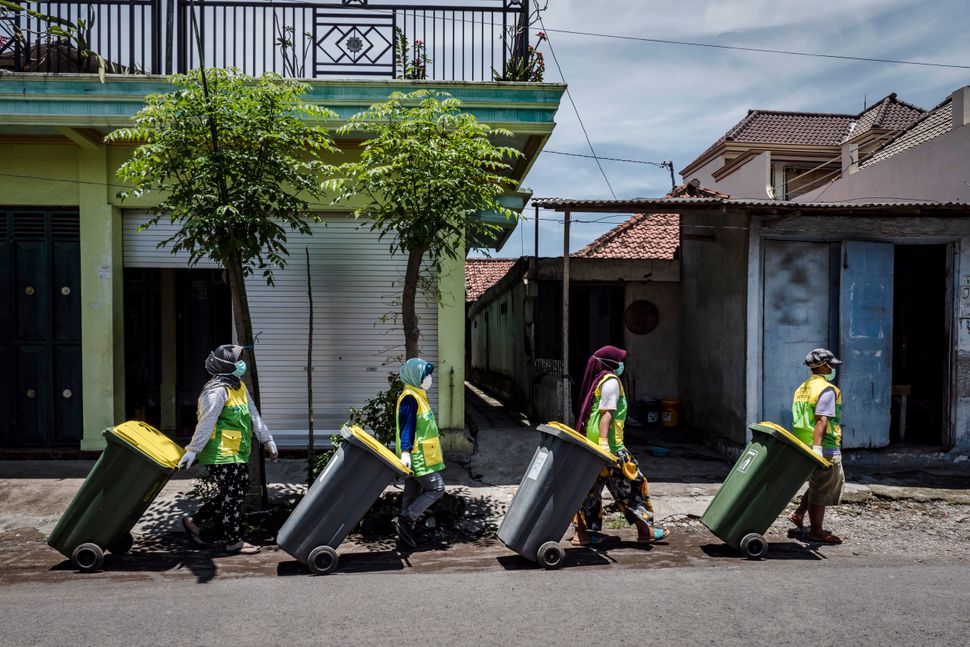
The work in the Indonesian city partnerships went better when the design treated all five as equally load-bearing from the start. That sounds obvious. In practice it required active discipline against the natural tendency to over-invest in the visible workstreams (the TPST building, the collection trucks) and under-invest in the invisible ones (the behaviour change campaign, the governance contracts).
Behaviour Change Is the Load-Bearing Workstream
If I had to pick one workstream as the load-bearing one for the whole system, it would be behaviour change. The reasoning is structural. The whole downstream system depends on households separating their waste at source. If they do not, the sorting facility receives mixed waste at high contamination rates, recovery efficiency drops, the recyclables that do come out fetch lower prices, the financial model breaks, and within a year the operator is asking why the project did not deliver.
Behaviour change is also the workstream that most consultants underweight. There is a recurring temptation to treat it as a communications problem, to fix it with posters and a launch event. That almost never works. Behaviour change in a household waste context is a sustained operational discipline, not a campaign.
A few things consistently moved the needle.
Pair the message with the new infrastructure. Households separate when separation visibly leads somewhere. The behaviour change officer arriving with a leaflet two months before the collection vehicle starts is a near-guaranteed waste of effort. The behaviour change officer arriving in the same week as the new bins, the new schedule, and the visibly different collection vehicle is operating on a much stronger lever.
The corollary holds. A collection system that launches without serious behaviour change capacity in the same neighbourhood will get contaminated waste from week one, and the operators will conclude that “the community is not ready”. This framing tends to stick. It is almost always wrong. The community was ready. The behaviour change support arrived late or not at all.
Use peer-to-peer social proof. Top-down messaging from a project officer is weaker than a neighbour saying “we separate now and it works”. Door-to-door peer-led campaigns in pilot neighbourhoods consistently outperformed broadcast campaigns by a wide margin, even though they are slower and more expensive per household.
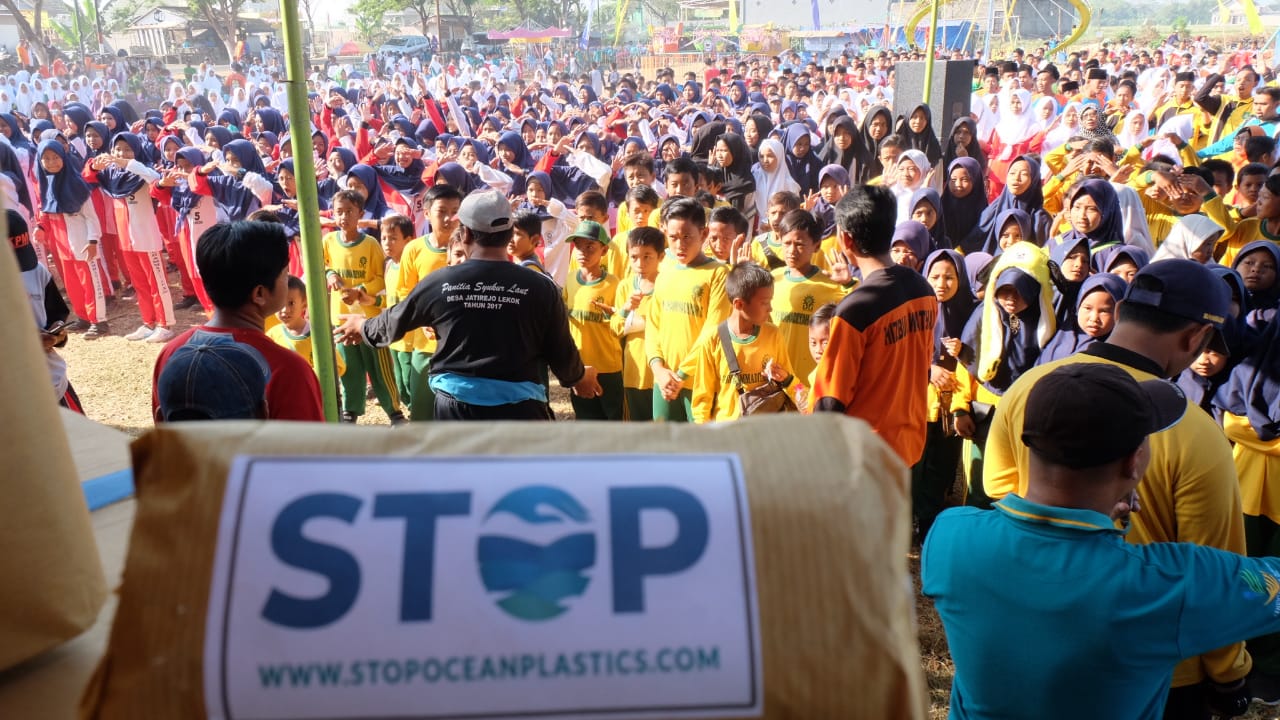
Align the fee structure with the behaviour you want. When the waste-management fee is collected at the same moment as the collection service is provided, with a clear price tag and a clear “we are paying for this to run”, the behaviour change is reinforced by household financial logic. When the fee is buried in a municipal tax or invisible to the household, the system feels free, the value is undervalued, and the participation drops.
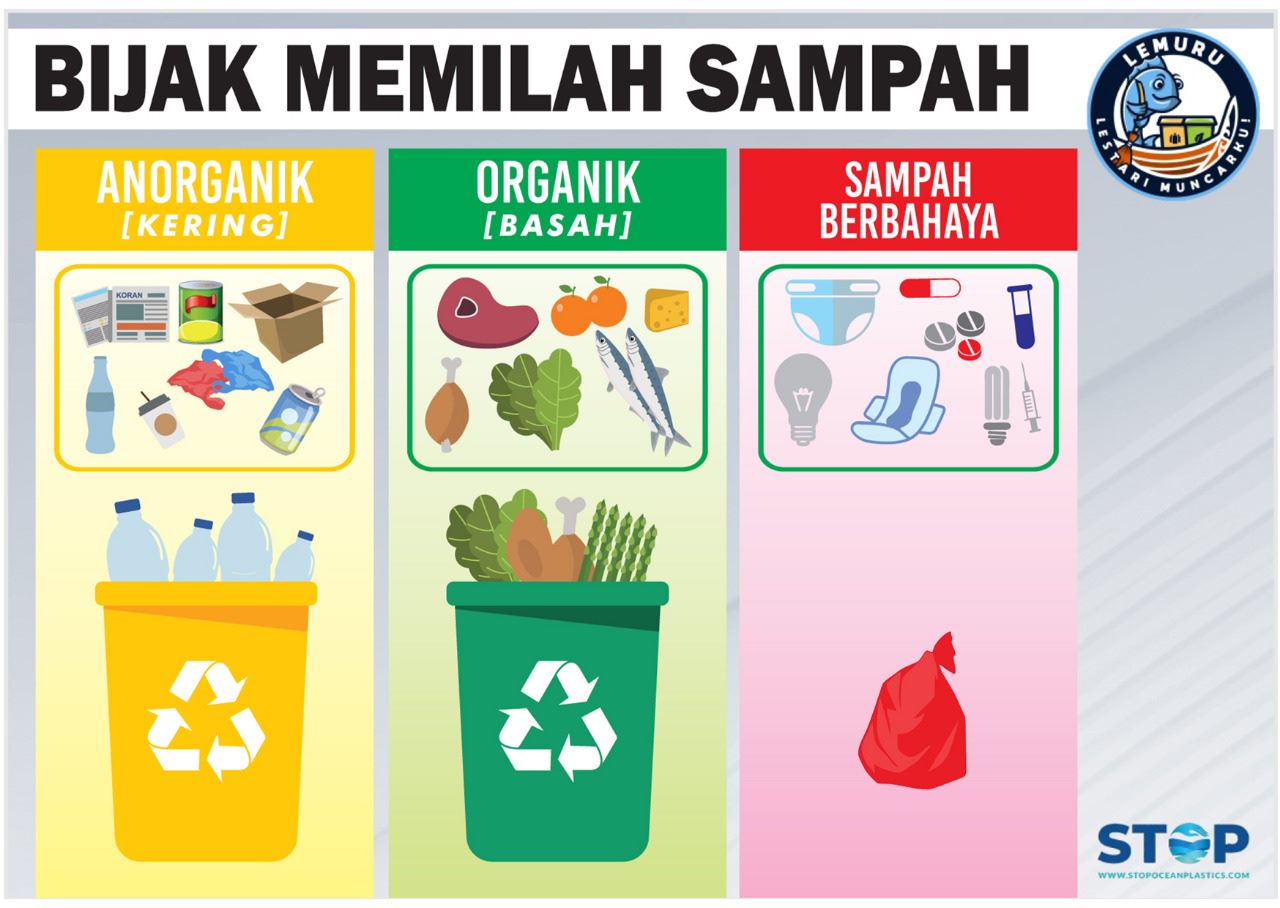
None of this is novel. All of it is consistently underdone. The first hire on a new city implementation should be a senior behaviour change lead, not a senior facility-design lead.
The Sorting Facility Trap
The most common technical error I saw across the Indonesian city work was undersizing the sorting facility for the wrong reasons.
The undersize comes from designing for current waste capture. The facility receives, say, 10 tonnes per day in the first six months because collection is only at 30% rollout. So the facility gets sized for 12 to 15 tonnes per day with a small buffer.
Eighteen months later the collection system is at 90% rollout, the household participation rate has risen, and the daily inflow is 35 to 40 tonnes per day. The facility is now permanently bottlenecked, recovery efficiency collapses because there is no time to sort properly, and rejected material starts piling up. The political cost of building a second facility is high and the operational cost of running over capacity is paid daily.
The fix is to size for the peak day, two to three years out, with conservative assumptions on participation growth. Conservative growth assumptions sound prudent but are usually a trap, because the system you build influences the growth you get. A facility that demonstrably works pulls participation up. A facility that fails pulls participation down.
The sizing question also interacts with the material mix. Organic-heavy input streams (which is the typical Indonesian profile) need different processing capacity than dry-recyclable streams. Misjudging the split by even 10 to 15 percentage points produces an under-capacity facility on one side and a stranded asset on the other.
The discipline that matters here is honest scenario modelling at the design stage. Three scenarios, with explicit growth assumptions, against the same facility footprint. Pick the design that survives the high-participation scenario. The political pain of explaining a slightly over-built facility on day one is much smaller than the political pain of a permanently overwhelmed facility in year three.
The Handover Problem
Every project ends. The question is what happens the day after.
For Project STOP, the design intent from the start was that each city implementation would eventually hand the operating system to a permanent local arrangement, typically a public-private partnership or a fully municipal operation. This is the part most NGO waste interventions get wrong. The project succeeds operationally for two to three years, then degrades visibly within the next two as the support and funding wind down.
Two things made the handover question more tractable.
Embed the financial model in the municipal budget cycle, not parallel to it. If the system runs on project funding that disappears in year three, the handover is fictional. If the system runs on a household fee plus a municipal contribution that has been written into the regular budget cycle for two years before the handover, the handover is a documentation exercise rather than a financial cliff.
That requires sustained political engagement long before the operational design is complete. The political stakeholders need to see the financial trajectory and sign their part of it. This is slow work, with low immediate output, and it is consistently underbudgeted.
Train the trainers, not just the workers. A system that depends on the original implementation team is a system that fails when the team rotates out. The Project STOP Academy work I led was an explicit response to this risk. The Academy is a 9-day curriculum across three modules, designed to be facilitated in one of the operating cities so that the theoretical training is combined with practical field exercises. The trainees are local waste-management leaders who will run their own cities and, in time, train the next cohort.
The deeper point is that capacity building cannot be a side activity. It is the core deliverable of the second half of every implementation. If the only people who understand the system are the project’s expat advisors, the system is one departure away from collapse.
Knowledge Transfer as Institutional Infrastructure
Two pieces of the Academy work are worth surfacing because they generalise beyond waste management.
The first is the Waste Management Game. I designed an early version of this as a systems-thinking exercise modelled on the MIT Beer Distribution Game from the 1960s. The Beer Distribution Game is the classic teaching tool for showing how local optimisations in one part of a supply chain produce poor outcomes globally when the interdependencies are ignored. A waste-management system has exactly the same property. Decisions in the organics processing workstream interact with collection scheduling, which interacts with TPST sorting efficiency, which interacts with off-take pricing. People who have only worked in one workstream find this hard to internalise from a slide deck. They tend to understand it after losing a few rounds of the game.
The version we developed eventually moved beyond the simulation to a strategy board game, in collaboration with an Indonesian serious-game studio. The point of the game is not entertainment. The point is that the participants leave the training session having felt the consequences of the system’s interdependencies in their own decisions, which is much stickier than being told about them.
The second piece is the continuous-learning structure. Documented training material captures the best practice known at one moment. The cities running the system continuously develop better practice, by problem-solving, by improvisation, by accident. Without an explicit mechanism for capturing that new knowledge, refining it and pushing it back out across the network, every new city has to relearn what other cities already discovered.
The Academy was designed with that feedback loop built in. Formal channels for project officers to log new knowledge after problem-solving sessions. Informal channels (city exchanges, WhatsApp groups) for fast peer-to-peer learning. A small knowledge-management role responsible for curating, deciding what is worth elevating and updating the central materials accordingly.
This is unsexy work. It is also the difference between a programme that scales and a programme that gets re-invented every time.
What Worked, What Was Hard
Looking back on the work, the design choices that aged best were the ones that took the handover problem seriously from day one. Phased rollout by neighbourhood rather than city-wide launch. Waste fee collection started early to anchor household perception of the service. Sustained political engagement with the regency government, with explicit financial transition plans. The Academy and the Game as institutional memory for the workstream leaders.
The hardest part, looking back, was the integration of the informal-sector waste pickers into the formal system. Indonesian waste pickers represent a real and large workforce who already do material recovery, with their own informal economy of collection routes, aggregation points and sale to recyclers. A new TPST that does not negotiate that relationship deliberately tends to either compete with the pickers (degrading their livelihoods) or get bypassed by them (degrading its own recovery rates). The right design treats the picker network as a partner with negotiated terms, not as competition to displace.
This is harder than it sounds. The picker community is heterogeneous, often migrant, often without formal contracts or representation. Negotiating with it requires real time and trust, which projects with quarterly milestones often do not budget for. The Indonesian work made progress on this but I would not say it was solved by the time I rotated out. It is the open problem most worth attention from anyone designing the next generation of these systems.
The other hard thing was the digital tools question. We started in 2019 with the assumption that an app would help operational visibility across the cities. We ended in 2020 with a clearer view that the problem was not “build an app”. The problem was understanding what data would change which decisions, and getting that data flowing through the existing system before deciding whether an app was the right delivery mechanism. The Nestlé and Google workshops in late 2019 helped reframe the question. The decision after that was to build a data platform and analytics layer, with apps as one possible later output rather than the starting point. The right tooling question is what data the operator needs, not what app the donor wants to see.
A Working Method for City-Scale Waste Design
If you are designing a municipal waste system in a low-infrastructure coastal context, the method that emerged from this work generalises as follows.
- Map the five workstreams together, not separately. Collection, sorting, recycling, behaviour change, governance and finance. Each workstream has a design lead. The workstream leads sit together in the design phase, not in parallel work streams.
- Hire the behaviour change lead first. The temptation is to lead with engineering or operations. The behaviour change capacity is the binding constraint on the whole system and the slowest to build. Start it before the facility design is locked.
- Size the facility for the peak day three years out, with conservative growth assumptions. The cost of slight over-capacity at launch is small. The cost of permanent bottleneck in year three is large.
- Pair behaviour change with the new infrastructure in the same week. Leaflets without a new collection service are noise. Collection without behaviour change support produces contamination from week one.
- Build the handover financial plan before the operational design is complete. If the recurring revenue does not exist in the municipal budget cycle two years before handover, the handover is fictional.
- Treat informal-sector waste pickers as partners with negotiated terms. The picker network is part of the existing system. Compete with it and the system fails. Integrate with it and both sides win.
- Train the trainers, not just the workers. Capacity that depends on the original implementation team disappears with the team. Capacity embedded in a local training cadre survives staff rotation.
- Build the continuous-learning structure as a deliverable, not a side activity. Cities will discover better practice as they operate. Without an explicit mechanism for capturing and redistributing it, every new city relearns the same lessons.
- Decide what data the operator needs before deciding whether to build an app. The right tooling question is operational, not technological. App-first is usually a sign that someone is selling something.
None of these are exotic. The discipline is in not skipping any of them under time pressure.
How This Analysis Was Put Together
This article was written in 2026 from project materials produced between 2018 and 2020, including the Project STOP Academy curriculum across all three modules, the Waste Management Game design documents, the digitalisation strategy notes from the Nestlé and Google workshops, and the operational handover documentation produced when I rotated out of the project. The work itself was done in person, with field rotations across the three Indonesian city sites, design workshops in Bali, and writing periods in London.
The synthesis and re-framing for this piece was supported by AI workflows of the kind I now write about at azvai.com. Project materials were re-read and summarised using Claude Code skills for structured-document extraction. The methodology arguments, the case interpretation and the four-to-six year retrospective are mine. The AI work was on the desk side rather than the field side, which is the position on AI in sustainability work I have come to hold.
For public context on the programme, the SYSTEMIQ portfolio page, the impact summary and the Nestlé announcement are all useful starting points. The Project STOP site is the primary current source on cities, partners and impact figures.
If you are designing a city-scale waste system and the behaviour change workstream is being treated as marketing rather than as core operational infrastructure, that is almost always a sign that the design will fail in year two. The behaviour change workstream is the cheapest insurance you will buy on a project of this kind. Skip it at your cost.